I bet you’re excited and absolutely terrified in equal measure.
You’ve done everything right. Found your perfect queen, got her on the active register, shown her a couple of times, invested in earplugs after her first call had the neighbours checking whether someone was being murdered — and now she’s ready.
Ready to visit a gentleman caller.
The problem is, nobody tells you how this bit actually works. You’ve read about choosing a breeder, raising kittens, the cost of it all — but the actual mechanics of taking your precious girl to some bloke’s house and leaving her there for a few days? That’s the part most first-time breeders quietly panic about.
I’ve been on both sides of this. I’ve taken my queens out to stud and I’ve had queens visit my own stud boy. And I can tell you now — the first time is nerve-wracking, slightly chaotic, and full of moments where you think “why did nobody warn me about this?”
So let me warn you.
Quick Answer: Taking your queen to stud for the first time means finding an experienced, proven stud cat whose strengths complement your queen’s weaknesses. You’ll need her GCCF registration (active register), up-to-date vaccinations, a negative FeLV/FIV snap test done within 24 hours, and her pedigree. Expect to leave her for 2–3 days, pay a stud fee that starts at £500 (champion studs charge more), and collect a mating certificate, the stud’s pedigree, and an expected due date when you pick her up. Choose a stud close to home for a maiden queen — stress from a long journey can stop her call dead.
👇 Skip to the 8 things every first-time breeder needs to know before going to stud
Start With the Person Who Sold You Your Queen
Here’s a tip that should be obvious but somehow isn’t.
The very first person you should ring when you’re looking for a stud cat is the breeder who sold you your queen. They know her lines. They know her bloodlines’ strengths and weaknesses. They may even have a suitable stud boy themselves — or know someone who does.
This is the cat fancy, not Tinder. Reputation matters. Relationships matter. The breeder who trusted you with a queen on the active register has a vested interest in those kittens being well-bred, because their prefix is going to appear on the pedigree too.
If they don’t have a stud cat themselves, they’ll know breeders who do. They’ll know which boys are producing good kittens. They’ll know which stud owners are meticulous about health testing and which ones are — shall we say — a bit more relaxed than you’d like.
(Trust me on this one. The cat fancy is a very small world. Everyone knows everyone else’s business, and gossip travels faster than a Siamese who’s spotted a fly.)
If you’re newer to all of this, our Breeding pillar guide covers the wider picture — registration, ethics, raising a litter, and what comes after the kittens are born.
Cat Shows Are Your Secret Weapon
By now you’ve hopefully been to a few cat shows. If you haven’t — start. I mean it.
Cat shows aren’t just about rosettes and benching cages. They’re networking events for breeders. You’ll meet stud owners, you’ll see their cats in the flesh, and — crucially — you’ll get honest opinions from people who’ve used those stud cats before.
Ask around. Breeders love talking about their cats (understatement of the century) and most will happily tell you which boys are producing what. You might even get to assess a potential stud at the show itself — his type, his temperament, the way he handles the show hall.
Just don’t be that person who walks up to a stud owner mid-judging and asks “can my girl visit your boy?” Give them a cup of tea and a biscuit first. Manners cost nothing.
The Internet Option — But Read the Small Print
The internet is an excellent resource for finding stud cats. Many breeders advertise their boys online, either on their own websites or through breed club directories. But you need to understand the terminology before you start firing off emails.
Open Stud means the breeder is accepting suitable visiting queens. Contact them to discuss requirements and restrictions. This is the one you’re looking for.
Private Stud means the breeder only accepts queens from close friends or breeding partners. If you don’t already have a relationship with this breeder, don’t ask. It’s not personal — it’s about managing workload and maintaining quality control.
Closed Stud means exactly what it says. The stud is for the breeder’s own queens only. Do not contact them. Do not pass Go. Do not collect £200.
(I’ve had people email me about a closed stud and then follow up three more times as if persistence will change the answer. It won’t. It just gets your name remembered for the wrong reasons.)
Choosing the Right Boy — It’s Not a Beauty Contest
Finding a stud cat is the easy part. Choosing the right stud cat takes a bit more thought.
Here’s what most first-time breeders get wrong — they fall in love with a beautiful stud cat and forget to think about what he’ll actually produce with their queen. A stunning boy doesn’t necessarily produce stunning kittens with every girl. Breeding is genetics, not magic.
Match Strengths to Weaknesses
Your queen isn’t perfect. (Sorry, but she isn’t. No cat is.) Maybe her chin is a bit weak. Maybe her ears could be larger. Maybe her coat texture isn’t quite where you’d like it. That’s fine — but the stud cat you choose needs to be strong where she’s weak.
If her ears are small, pick a boy with big, wide-set ears. If her chin could be firmer, find a stud with a strong jaw. If she’s got a super long, whippy tail then it’s not the end of the world if the stud cat could do with an extra inch on his for balance — because your girl is already contributing that.
The stud cat’s good points should far outweigh his faults. And he should not have any withholding faults under the breed standard of points that would prevent him being shown.
Choose the best stud cat you can.
Think About What You Can Sell
This is the practical bit that nobody likes talking about but everyone needs to hear.
As a first-time breeder, you probably don’t have a waiting list of buyers queuing up for your kittens. Some colour combinations are more popular with pet buyers than others. An experienced stud owner should be able to tell you what colours you can expect from the mating — and honestly, for your first litter, it’s wise to consider breeding kittens that will be easier to find homes for.
That’s not selling out. It’s being responsible. There’s nothing worse than having beautiful kittens sat at home at 16 weeks because you bred a colour nobody’s looking for.
▶ Choosing a Stud Cat — What to Look For
The Stud Visit — Do Your Homework First
You’ve found a boy you like. He’s shown well, he complements your queen, and he’s not halfway across the country. Before you commit, there are things you absolutely must check.
Paperwork First, Romance Later
The stud cat needs to be:
- Registered in the breeder’s name and on the active register. No active register, no registrable kittens. Full stop.
- In possession of a Certificate of Entirety — signed by a vet and lodged with the GCCF. This confirms the cat has both testicles descended and is physically capable of breeding. Without this, you cannot register any kittens from the mating. I’ve seen first-time breeders miss this check and then wonder why the GCCF rejected their kitten registration. Don’t be that person.
- Fully vaccinated and up to date — flu, enteritis, the works.
- Blood tested negative for FeLV and FIV. Ask to see the results. A responsible stud owner won’t be offended. They’ll expect it.
Ask whether he’s a proven stud — has he already sired litters of healthy, registered kittens? If yes, you know the GCCF paperwork is in order and you won’t hit a brick wall when it’s time to register your litter.
Visit Before You Commit

If at all possible, arrange to visit the stud cat in his quarters before your queen comes into call. This isn’t being fussy — it’s being sensible.
Take note. Is the stud pen clean and comfortable? Is there fresh water, clean bedding, decent space? Is the stud cat himself friendly with his owner? Does he seem happy and healthy?
You may have seen this boy at a show looking magnificent on his best behaviour. But a show pen is not the same as his home environment. Would you be happy leaving your queen there for three days? If the answer isn’t an immediate yes, keep looking.
Discuss the Terms
Now is the time — before your queen is screaming the house down and you’re desperate — to discuss the stud owner’s terms. Because every stud owner’s terms are different, and you need to know what you’re agreeing to.
Stud fee. Now starts at around £500 for Siamese in the UK, with champion or grand champion studs charging more — often £700+. When you add the blood test (£40–100 at your vet) and your fuel for two trips (£80–120), you can easily be looking at £700–1,000 for the whole trip.
Return matings. Many maiden queens don’t fall pregnant on their first visit. Most stud owners will accept a queen back free of charge for a second mating. Some will even keep offering until you get a successful litter. Others won’t. Ask now, not after a failed mating when you’re already upset.
Kitten restrictions. This is the big one that catches first-time breeders off guard. Most stud owners impose restrictions on the resulting kittens — typically, females can go on the active register but males must go on the non-active register. Some only allow one active female per litter. Some allow none.
These restrictions exist for a reason — stud owners want to control how their bloodlines are used. But you need to know the terms before the kittens arrive, not after you’ve promised a buyer an active-register boy and can’t deliver.
The Big Day — Your Queen’s in Call
Right. Your queen has started calling. The neighbours are complaining. The dog’s hiding under the sofa. Your ears are ringing.
Don’t rush her out the door on day one. Seriously.
Wait until she’s properly in season and ready to accept the male. You’ll know she’s ready when you scratch her lower back at the base of her tail and she “presents” — bum in the air, tail swept to one side, treading with her back legs. That’s the green light.
(If you’ve never experienced a Siamese in full call before, I should warn you — it’s like living with a tiny, furry opera singer who’s been told the world is ending. The volume is extraordinary. The drama is unmatched. And it goes on. And on. And on.)
The Vet Trip
Before you go anywhere, your queen needs a same-day FeLV/FIV snap test from the vet. This has to be an in-house rapid test — not one sent to an external lab — because you need the result before you leave the surgery. Most stud owners require results within 24 hours. International Cat Care has clear guidance on both viruses if you want to read up before your vet appointment.
This is non-negotiable. It protects the stud cat, it protects your queen, and it stops the spread of diseases between breeding cats. Some stud owners go further and require PCR swabs for herpes, calicivirus, chlamydia, and mycoplasma. Ask what they need before the day arrives so you’re not scrambling.
Your queen also needs to be:
- Fully vaccinated and up to date
- On the GCCF active register
- Transferred into your ownership (not still in the breeder’s name)
Pack Your Queen’s Handbag
When you head to the stud owner’s house, you need to bring:
- Blood test results (that day’s FeLV/FIV snap test)
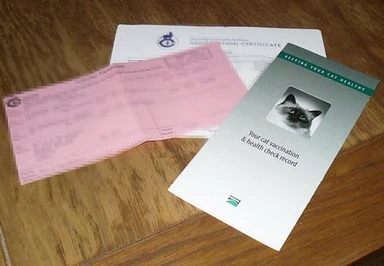
- Vaccination card (up to date)
- GCCF registration certificate (or pink slip)
- Five-generation pedigree
Forget any of these and you’ll be driving home again. Trust me, turning up without paperwork after a two-hour drive is the kind of day-ruining experience you only need once.
(Ask me how I know.)
What Happens When You Get There
You arrive. You hand over the paperwork. The stud owner checks everything and — importantly — you should check the stud’s paperwork too. Registration, Certificate of Entirety, blood test results, vaccination record. A good stud owner will not be offended by this. They’ll respect you for it.
Your queen will typically be placed in the stud pen still in her carrier, so the stud can get used to her scent. After a while — sometimes hours, sometimes overnight — she’ll be let out to meet him properly.
And then you leave.
That’s the bit nobody prepares you for. You hand over your precious girl and you drive away. You leave her in someone else’s home with a strange cat and you go home to an empty house and spend the next two days checking your phone every eleven seconds.
It’s fine. It’s normal. Every breeder goes through it with their first queen.
The Wait
The stud owner will keep you updated. Mating in cats is quick but dramatic — the tom grips the queen by the scruff, the act itself lasts seconds, and the queen will typically swipe at him afterwards (which is entirely normal and not a sign of trouble). Multiple matings over 2–3 days ensure the best chance of conception.
After 2–3 days, you’ll make the journey to collect her.
What You Get When You Collect Her
When you pay the stud fee and collect your queen, the stud owner should provide:
- A mating certificate — without this, you cannot register the kittens with the GCCF
- The stud cat’s pedigree — you’ll need this for the kitten registrations
- An expected due date — approximately 63–65 days from mating
Keep all of this somewhere safe. You’ll need every piece of it.
▶ What to Expect When Your Queen Goes to Stud
Back Home — And the Longest Nine Weeks of Your Life
Your queen may still seem like she’s in call when she first comes home. Don’t panic — this usually subsides within a day or so.
Introduce her back to your other cats carefully. She’ll smell of the stud cat, and your resident cats may not be thrilled about it. A bit of hissing and side-eye is normal. Within a day or two, everyone should settle down — though don’t be surprised if your male neuter gives her the cold shoulder for a week. Cats are nothing if not dramatic.
Now you wait. Approximately nine weeks of alternating between excitement and low-level terror.
If she doesn’t fall pregnant, don’t despair. Maiden queens frequently miss on their first visit. It’s disappointing, yes — you’ve spent the money on the blood test, the travel, and the stud fee, and you’ve got nothing to show for it. But it happens. Talk to the stud owner about a return mating and try again.
The Mistakes First-Timers Make
I’ve seen them all. Here’s the shortlist, so you don’t have to learn these the hard way.
Choosing the most expensive stud instead of the best match. A Grand Champion with a £700 stud fee who doesn’t complement your queen will produce worse kittens than a modest boy with the right type who costs £500. Breeding is about genetics, not prestige.
Driving four hours to the “perfect” stud. Your maiden queen has never left your house. She’s been prodded at the vet, shoved in a car, driven across the country, and dumped in a stranger’s house. She’s stressed. She’s gone off call. Nobody’s mating anyone. Pick a stud close to home for the first time. She can visit the long-distance Casanova once she’s experienced.
Not checking the Certificate of Entirety. I cannot stress this enough. If that certificate isn’t lodged with the GCCF, you cannot register your kittens. It doesn’t matter how beautiful the stud is, how lovely the owner is, or how perfect the mating was. No certificate, no registrations.
Forgetting paperwork on the day. Blood test, vaccination card, registration certificate, pedigree. Stick them all in a folder the night before. Check the folder before you leave. Check it again when you get in the car.
Not discussing restrictions before the mating. Finding out after the kittens are born that you can’t put any females on the active register is a conversation nobody wants to have. Get it in writing before your queen sets foot in that stud pen.
It Gets Easier — I Promise
Your first time going out to stud is the hardest. The anxiety, the paperwork, the strange experience of handing your cat to someone else. It’s a lot.
But by the second or third time, it becomes routine. You’ll know the stud owners, you’ll have the paperwork ready, you’ll have a system. Your queen will be experienced and confident. The stud will know his job.
And hopefully — in about nine weeks’ time — you’ll have a litter of kittens that makes every single moment of stress and worry completely worth it.
Plenty of laughs and tears along the way, of course. But isn’t that what breeding’s all about?
Key Takeaways — Going Out to Stud
- Start your stud search by calling your queen’s breeder — they know her lines and will have recommendations.
- Cat shows are invaluable for meeting stud owners and assessing potential stud cats in person.
- Match the stud’s strengths to your queen’s weaknesses — breeding is genetics, not a beauty contest.
- Check the stud’s Certificate of Entirety is lodged with the GCCF before you agree to anything — no certificate means no kitten registrations.
- Both cats need up-to-date vaccinations and negative FeLV/FIV blood tests. Your queen’s snap test must be done same-day.
- Choose a stud close to home for a maiden queen — long journeys cause stress and can stop her call.
- Discuss stud fee, return matings, and kitten registration restrictions before the mating, not after.
- Bring all paperwork (blood test, vaccination card, registration certificate, pedigree) or you’ll be driving home empty-handed.
Frequently Asked Questions
How much does it cost to take a queen to stud in the UK?
The stud fee alone now starts at around £500 for Siamese, with champion or proven studs charging £700 or more. Add the FeLV/FIV blood test (£40–100 at your vet), fuel for two trips (£80–120), and you’re realistically looking at £700–1,000 for the whole experience — assuming the mating takes first time.
How long does a queen stay at the stud cat’s home?
Usually 2–3 days. The first day is typically settling in and allowing the cats to become familiar with each other’s scent. Matings then take place over the following day or two before you collect her.
What if my queen goes off call during the journey?
It happens — the stress of the vet visit and travel can suppress her season. This is exactly why choosing a stud cat close to home is so important for a maiden queen. If she goes off call, you’ll need to take her home and try again on her next season. Most stud owners won’t charge for a failed visit where no mating occurred.
What is a Certificate of Entirety?
It’s a document signed by a vet confirming the stud cat has both testicles descended and is physically capable of breeding. It must be lodged with the GCCF before the stud’s first litter can be registered. If the stud cat doesn’t have one on file, your kittens cannot be GCCF registered — regardless of everything else being in order.
Does the queen need a blood test every time she goes to stud?
Yes. Most stud owners require a fresh FeLV/FIV snap test done within 24 hours of the visit — every single time. Some also require additional PCR swabs for herpes, calicivirus, and chlamydia. Always confirm what’s needed before the day.
What happens if my queen doesn’t get pregnant?
It’s more common than you’d think, especially with maiden queens. Most stud owners offer a free return mating — but the terms vary. Some offer unlimited returns until a litter is produced, others allow one free visit. This is exactly why you discuss terms before the first mating.
Can I stay and watch the mating?
Most stud owners will ask you to leave. The mating process is natural but can look alarming if you’re not used to it — the tom grips the queen by the scruff, and the queen typically yells and swipes at him afterwards. It’s completely normal behaviour, but having an anxious owner hovering doesn’t help anyone. Trust the stud owner — they’ve done this many times before.
What restrictions do stud owners put on kittens?
Typically, female kittens can be placed on the active register (meaning they can breed) but males must go on the non-active register. Some stud owners only allow one active female per litter, and a few restrict all kittens to non-active. These restrictions protect the stud’s bloodline — get them in writing before the mating.