You’ve just spent the last eight weeks with a litter of five kittens tearing your house apart. The wallpaper is shredded. The leather suite looks like it’s been through a war. Your spare bedroom, once your sanctuary, now smells like a combination of kitten pee and despair. And the credit card bill? Let’s just say you’ll be having words with your bank about the overdraft.
Then the last kitten leaves for their new home, and you stand in the wreckage of your living room, covered in kitten hair, and you think: “Why did I do this?”
But here’s the thing — tomorrow, you’re already thinking about the next litter.
Cat breeding isn’t really a hobby. Not in the way that knitting or stamp collecting is. A hobby is something you do to relax. Breeding cats is the opposite of relaxing. It’s expensive, emotionally draining, physically exhausting, and absolutely brilliant. It’s the kind of thing that ruins your credit rating and your marriage whilst simultaneously being the most rewarding thing you’ve ever done.
I’m going to be honest with you about what cat breeding actually involves. Because if you think it’s just a bit of fun with some cute kittens running around, you need to read this article with your eyes wide open.
Quick Answer: Cat breeding is an expensive, time-consuming, and emotionally intense hobby that requires careful genetic planning, significant veterinary costs, sleepless nights hand-feeding newborns, and the heartbreak of saying goodbye to kittens you’ve raised from birth. It’s rewarding, but it will test your marriage, your credit card, and your sanity. Is it worth it? Ask me again when I’ve finished cleaning the kitten pee off my curtains.
👇 Skip to the 8 things cat breeders need to know
Is Cat Breeding Really a Hobby?
Let’s start with the hard truth. Cat breeding is not a hobby in any traditional sense. Hobbies are fun things you do in your spare time. Hobbies don’t wake you up at 3 a.m. because you’re worried about whether the queen is going to have a caesarean section. Hobbies don’t cost thousands of pounds before you’ve earned a single penny back.
But we call it a hobby anyway, because “obsession” is too honest, and “mild financial suicide” doesn’t fit on the business card.
The reality is that cat breeding — proper cat breeding, the kind where you care about genetics, health testing, pedigree lines, and finding genuinely good homes for your kittens — is closer to running a small business than it is to having a hobby. Except the business loses money, doesn’t pay taxes, and gives you insomnia.
If you’re thinking about getting into cat breeding because you love cats and you want to make a bit of pocket money on the side, stop right here. You won’t make pocket money. You’ll lose it. You’ll lose a lot of it. The only way you’ll ever break even is if you breed cats for fifteen years straight and accept that you’re essentially working for free.
So why do we do it? Because there’s nothing quite like breeding your own cats. Nothing. It’s exhausting and brilliant in equal measure.
Finding a Stud and Going Out to Stud
Right, so you’ve got a beautiful female cat — your queen — and you’ve decided she’s going to have kittens. First thing: it takes two to tango. You need a stud.
This is where the first round of stress begins. You can’t just pick any tom cat. You need a stud that’s going to complement your bloodline, bring in good genetics, and (crucially) pass all the health tests. FeLV and FIV testing are absolute musts. You don’t mess about with these. Get them done before your queen ever meets the stud.
Then there’s the timing. A queen comes into call — and believe me, when she’s in full blown call, she will let you know about it. She’s screaming her head off and wants more kittens! This is the bit where your partner starts giving you meaningful looks, because a cat in call is not subtle. She’ll howl at all hours, roll about on the floor, and generally make life difficult.
The queen always seems to come into call on a Tuesday afternoon when you’ve got meetings. This is a law of nature. You will have to take time off work. Your boss will not be amused. But if you miss the window, you’re waiting another month.
If you’re taking your queen to a stud, you’ll be paying a stud fee — usually anywhere from £100 to £500, depending on the pedigree and reputation of the tom. If you’re standing your own stud, congratulations, you’ve just signed up for a very different kind of chaos, but that’s another article entirely. For now, we’re assuming you’re going out to stud.
You can read more about the full process in our article on breeding from your cat and going out to stud, which covers health testing, genetic considerations, and what to expect from a stud owner.
Pregnancy and Birth
Okay, so the mating’s done. Now your queen is pregnant for about 65 days. You’ve got time to prepare, which is good, because if you think you’re prepared, you’re not. No one is ever prepared for kitten birth. Not really.
Get a birthing kit ready. You’ll want clean towels, a heat lamp, scales for weighing kittens, umbilical cord clamps, and your credit card on hand in case you have to dash off to the vets in the need of a caesarean section. Because that’s a real possibility. And it’s expensive. Very expensive. Hundreds of pounds expensive.
The pregnancy is the calm before the storm. Your queen will get bigger, eat more, and generally make it clear that she’s not happy with any of this. Then one day, she’ll start nesting. You’ll know it when you see it. She’ll be searching for the perfect spot to have her kittens — and it will not be the £50 kitten bed you bought. It’ll be your airing cupboard. Or the back of your wardrobe. Or (yes, this happened to me) the bottom shelf of your filing cabinet.
Expect sleepless nights as the birth approaches. You’ll be checking on her constantly, making sure everything’s progressing normally, and worrying about all the things that could go wrong. Most births go fine, but some don’t. Some queens need emergency C-sections. Some kittens don’t survive. This is the harsh reality of breeding, and it’s not something anyone likes to talk about, but it needs to be said.
Read our guide to what to expect when your cat is expecting kittens for detailed preparation advice. It covers everything from nesting behaviour to when to call the vet.
Hand Feeding and Bottle Rearing
A new born kitten needs feeding every hour, all day and all night. Every. Single. Hour.
That’s not exaggeration. That’s not a rough estimate. That’s literal fact. You will not sleep for weeks.
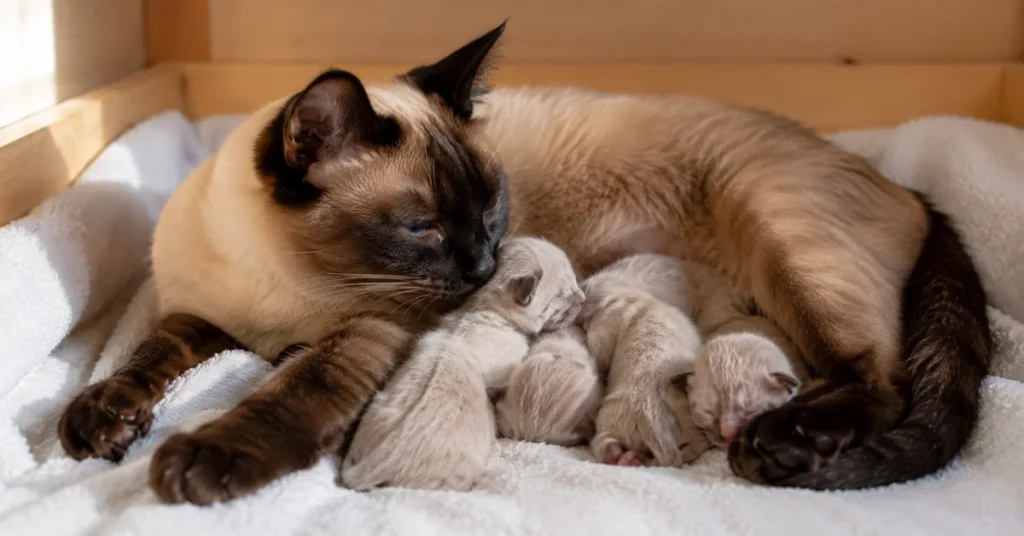
Sometimes the mother cat can’t feed her kittens — perhaps there’s a medical issue, or she simply doesn’t produce enough milk, or (and this does happen) she just refuses to cooperate. When that happens, you become the mother. You’ll be sterilising bottles at 2 a.m., warming formula to exactly the right temperature, and hand-feeding tiny mewling creatures who have absolutely no idea what they’re doing.
The good news is that kittens are incredibly resilient. The bad news is that hand-fed kittens are also incredibly needy. You’ll develop a profound relationship with your electric kettle and coffee machine. You’ll smell permanently of kitten formula. You’ll forget what daylight looks like.
There’s a comprehensive guide on tube feeding kittens if you’re considering this route — it covers safe feeding practices and troubleshooting common issues.
But here’s the thing: once those kittens start doing well, once you see them growing and thriving because of your efforts, it’s hard to explain how satisfying that feels. You’ve literally kept them alive with your own hands. There’s no bond quite like it.
Weaning: The Battle of Wills
Around four to five weeks, it’s time to introduce solid food. This is a battle of wills between you and the kittens, and the kittens are going to win.
You’ll start with some kitten wet food mixed with water, and you’ll try to interest them in it. Some kittens will dive straight in and demolish the lot. Others will approach it like you’re trying to poison them, because believe it or not, that’s genuinely what they think. A kitten that simply refuses to eat is convinced you are trying to poison them. There is no logical argument that will change their mind.
They’ll get it everywhere. It’ll be in their fur, on the walls, in your hair. Be prepared for the food coming back out the other end as well — weaning kittens have notoriously unstable digestive systems. Your house is about to smell like a farmyard.
The key is patience. Introduce food gradually, leave it available, and eventually they’ll work it out. But for a few weeks, it’s a mess. A literal, actual mess.
Litter Training
Kittens come with a built-in litter instinct, which is great. Except when it isn’t. A kitten that much prefers to use the spot behind the TV or the sofa is not unusual. It’s actually remarkably common.
You’ll set up multiple litter trays. You’ll clean them obsessively. You’ll still find pee in places you didn’t know existed. There will be pee behind the sofa. There will be pee under the bed. There will be pee in your shoes, potentially while you’re still wearing them.
Most kittens sort themselves out by the time they’re eight weeks old, but “most” is not “all”. Some kittens are remarkably stubborn about the whole business.
Inoculations and Vet Costs
Every kitten needs two sets of inoculations before they leave your home. You’ll also be taking them to the vet for health checks, microchipping, and generally making sure everything’s above board. Then there’s the cost of the pedigree certificates, GCCF registration, and all the paperwork.
A rough estimate: expect to spend £200-300 per kitten in vet costs alone. With a litter of five, that’s £1,000-1,500 before you’ve even thought about food, litter, or the fact that you haven’t slept in six weeks.
This is why you can’t make money from breeding. By the time you’ve paid for the stud fee, the vet bills, the food, the litter, and the sleepless nights, you’re operating at a significant loss. And that’s assuming everything goes smoothly. If something goes wrong — if a kitten gets ill, if the mother needs emergency treatment, if anything goes sideways — the costs spiral.
Finding Homes for Your Kittens
This is arguably the most important part of breeding, and also one of the most difficult. You’ve got five (or three, or seven, or however many) adorable, fluffy kittens, and they all need homes. Good homes. Not just any home.
You can’t just advertise them on Gumtree and hope for the best. Well, you can, but you’ll be responsible for every one of those kittens’ futures, and if one ends up in a bad situation, that’s on you. Some breeders use waiting lists, others do word-of-mouth, and many advertise carefully on breed-specific websites and in cat magazines.
Check out our article on how to advertise kittens online for best practices and safe advertising methods.
You’ll want to vet your potential new owners carefully. Ask questions. Lots of questions. Where will the kitten live? Do they have experience with cats? Are they prepared for vet costs? How long will the kitten be alone during the day? It’s your job to make sure these kittens go to people who will love them and care for them properly.
If you’re serious about building a professional presence and want to showcase your kittens online, many professional breeders work with web designers who specialise in breeder websites. You can find resources on cat breeder websites that explain what makes a good breeder site.
Paperwork and Registration
Every single kitten needs a pedigree. Every kitten needs to be registered with the GCCF or equivalent cat association. There are documents to fill in, fees to pay, and records to keep.
It’s not difficult, but it’s tedious. You’ll be filling out forms, double-checking pedigrees, making sure every kitten’s papers are in order before they leave. Get it wrong, and you’ll have unhappy customers.
This is also where you need to start thinking about your breeding name (your cattery prefix), which is a whole separate process with the GCCF. Budget time and money for this if you’re serious about breeding long-term.
The Destruction Zone
Now, let’s talk about what breeding kittens actually do to your house. Because this is the part that no one really prepares you for, and it’s important.
Kittens are not cute little fluffballs that sit quietly and look adorable. Kittens are tiny terrorists with claws and teeth and absolutely no impulse control.
The wallpaper will be shredded. It will be absolutely destroyed. You’ll have scratched wallpaper in corners, along the bottom of walls, and in places where you didn’t even know there was wallpaper. It’s like they’ve got a map of every vulnerable surface in your house.
The leather suite is next. If you’ve got leather furniture, I’m so sorry. Kittens view leather as some kind of challenge. They’ll scratch it, chew on it, and generally treat it like it personally offended them. Scratching posts are viewed as being for grown up cats. These kittens have other plans.
And then there’s the toys. Toys are generally for eating as a means to engineer a visit to the ‘out of hours vet’, the kittens do this because watching your face as you hand over the credit card to the vet (again) is priceless! A kitten swallowing a jingly toy or a feather is somehow hilarious to them, even though it costs you £400 in emergency vet fees.
The brown stuff is definitely going to hit the fan when the credit card bill arrives. You’ll sit at the kitchen table, staring at the statement, wondering where it all went. Vet bills. More vet bills. Food. Litter. Formula. Microchips. Registration fees. And somehow, despite spending thousands of pounds, you still don’t feel like you’ve done enough.
Then the kids now hate you with a vengeance because you are selling the babies. This is their new best friends, and you’re tearing them away. Nobody likes you. Least of all your partner, who is threatening to leave if the kittens don’t go. Your husband is threatening divorce if they don’t go, he says it’s either him or them. Though tempted at such an opportunity it really would be unfair to let down the new families at such a late stage so unfortunately the husband will have to stay but you have made a mental note for the future.
Saying Goodbye
This is the part nobody talks about, and it’s the part that gets you every single time.
When those kittens leave your house for the last time, it’s genuinely heartbreaking. You’ve spent eight weeks with them. You’ve fed them, cleaned up after them, raised them from tiny mewling creatures to proper little cats. You know them individually. You know which one is the goblin, which one is the shy one, which one is the bruiser.
And then they’re gone. Their new families come to pick them up, and you hand over these little lives you’ve been responsible for, and you go back into your house, and it’s suddenly quiet and empty. The mess is still there — the shredded wallpaper, the pee stains, the scratched furniture — but the kittens aren’t.
You’ll cry. You will absolutely cry.
Then, a few weeks later, the new owners will send you photos. And you’ll realise that you made the right decision, because these kittens are thriving. They’re loved. They’re happy. And you’re already thinking about breeding again.
Was It Worth It?
So, was cat breeding worth it?
Ask me that question during the sleepless nights of hand-feeding, and the answer will be absolutely not. Ask me when the vet bill arrives, and I’ll tell you you’re insane if you do this. Ask me when I’m cleaning kitten pee off my curtains for the seventh time in one afternoon, and I’ll agree that this is the worst hobby on earth.
But ask me when I see those photos of the kittens in their new homes, thriving and happy, and I’ll tell you it was the most rewarding thing I’ve ever done.
Cat breeding is brilliant and terrible in equal measure. It will exhaust you, bankrupt you, test your marriage, and fill you with pride. You’ll question why you ever started, and then you’ll immediately start planning the next litter.
If you’re thinking about getting into cat breeding because you love cats and you want to make some money, don’t. You won’t make money. You’ll lose it.
But if you’re thinking about cat breeding because you want to create something, because you want to improve the breed, because you want to be responsible for bringing better, healthier, more beautiful cats into the world, then it might be for you.
Just make sure you do it properly. Get the health testing done. Find a good stud. Vet your new owners carefully. Register your kittens. Keep proper records. Care about what you’re doing.
And buy some leather protection spray. You’re going to need it.
Key Takeaways
- Cat breeding is not a hobby in the traditional sense. It’s an expensive, time-consuming commitment that combines financial investment, sleepless nights, and genuine emotional attachment to creatures you’re about to give away.
- You will not make money. Budget £1,000-2,000+ per litter for vet costs, health testing, food, litter, and paperwork. You’ll operate at a loss.
- Health testing is non-negotiable. FeLV/FIV testing for the stud, genetic screening, and proper GCCF registration are essential — not optional extras.
- Hand-feeding requires sleepless nights. Every hour, all day and all night. If the mother can’t feed the kittens, you become the mother.
- Your house will be destroyed. Wallpaper will be shredded, leather furniture will be scratched, and there will be pee in surprising places. Accept this now.
- Finding the right homes is your biggest responsibility. These aren’t just kittens you’re selling — they’re creatures you’ve raised, and their futures depend on you vetting new owners properly.
- Saying goodbye is the hardest part. After eight weeks of intensive care, the kittens leaving is genuinely heartbreaking, even when you know they’ve gone to good homes.
- It’s still worth it. Not for the money, but for the satisfaction of creating something beautiful, improving the breed, and knowing you did it right.
Frequently Asked Questions
How much does it cost to breed cats?
Expect £1,500-3,000+ per litter, depending on vet costs, stud fees, and whether anything goes wrong. This includes health testing, vet visits during pregnancy, emergency C-section costs if needed, kitten inoculations, microchipping, pedigree registration, and basic supplies. You can read more about costs in our article on how much it costs to raise a kitten.
Do I need a licence to breed cats?
Licensing requirements vary by country and location. In the UK, you don’t need a specific “breeder’s licence” for a small number of litters per year, but you may need animal welfare registration depending on your local council. Check your local regulations and consider registering your cattery prefix with the GCCF.
How often can I breed my cat?
Responsible breeders limit queens to 4-5 litters in their lifetime, with at least one year between litters for recovery. Breeding every cycle is cruel and irresponsible. Your queen’s health comes first.
What health tests should I do before breeding?
Essential tests include FeLV (feline leukaemia virus) and FIV (feline immunodeficiency virus) testing for both parents, and breed-specific genetic screening depending on your breed (e.g., PKD screening for Persians, HCM screening for certain breeds). Work with your vet and breed club to identify all necessary tests.
How do I find a good stud?
Look for studs from established, reputable breeders with good health-testing records, champion pedigrees, and positive references. Ask about health tests, pedigree compatibility, and what health guarantees come with the stud fee. Visit our guide on going out to stud for detailed advice.
What should I do if a kitten gets ill?
Don’t panic, but don’t wait either. Kittens can go downhill fast — a kitten that’s fine at breakfast can be seriously ill by teatime. Keep your vet’s number (and the out-of-hours emergency number) somewhere you can grab it without thinking. If a kitten stops feeding, becomes lethargic, or feels cold to the touch, that’s an emergency. Have your credit card ready — emergency vet visits aren’t cheap, but they save lives.
What’s the best way to hand-feed kittens?
Hand-feeding requires feeding every hour around the clock, using appropriate kitten formula (never cow’s milk), sterilised bottles, and careful temperature control. Tube feeding can be an alternative for very young or weak kittens. Read our detailed guide on tube feeding kittens for safe practices.