If you’ve ever sat at a cat show and listened to two breeders discussing genetics, you’ll know the feeling. They’re speaking English — technically — but the words coming out of their mouths might as well be ancient Greek. Alleles. Polygenes. Dilute modifier. Temperature-dependent pigmentation.
And then someone says “she’s carrying chocolate” and you momentarily wonder if they’re talking about the cat or their handbag.
Siamese cat genetics can seem impenetrable. But it doesn’t have to be. The basics are surprisingly logical once someone explains them properly — and that’s exactly what this article sets out to do.
I’ve been breeding Siamese and Balinese for over twenty years and I still find the genetics endlessly interesting. So this is my attempt to explain it the way I wish someone had explained it to me when I started — plain English, no textbook tone, and worked examples from real cats I’ve bred.
Quick Answer: Every Siamese cat’s colour is determined by a combination of genes inherited from both parents. The pointed pattern itself comes from a temperature-sensitive mutation (cs) that limits pigment to the cooler extremities — ears, nose, paws, and tail. The specific colour of those points depends on which combination of colour genes (Black/Chocolate/Cinnamon), dilution genes, and other modifiers the cat carries. Understanding even the basics helps you predict kitten colours and make better breeding decisions. And it finally explains why your lilac point is that colour and not just “a weird grey.”
👇 Skip to the key genetics facts every breeder should know
How Cat Genetics Works — The Foundations
Before we get into Siamese-specific genetics, you need to understand the basics. Don’t worry — this is the simplified version.
Every cell in your cat’s body contains 19 pairs of chromosomes, made up of thousands of genes. Each gene is essentially a recipe — a chemical instruction that tells the body how to build something. The exception is the egg and sperm cells, which carry only one set of chromosomes. When they combine at fertilisation, the kitten gets one copy of each gene from mum and one from dad.
This is why two cats can produce kittens that look nothing like either parent. The kittens aren’t just getting their parents’ visible traits — they’re getting whatever was lurking underneath as well.
Dominant and Recessive — The Key Concept
When a cat has two different versions (alleles) of the same gene, one usually wins. The winning allele is dominant. The losing one is recessive — it’s still there, it’s just not showing.
This is why a seal point Siamese can produce chocolate kittens. The cat looks seal, but it’s secretly carrying the chocolate gene. One copy of seal (dominant) is enough to make the cat look seal, but if both parents carry chocolate (recessive), some kittens will inherit chocolate from both sides — and that’s when chocolate babies appear.
Breeders denote dominant alleles with capital letters and recessive alleles with lowercase. So B is the dominant Black (Seal) gene, while b is the recessive Chocolate gene and b^l is the recessive Cinnamon gene.
The practical takeaway: a cat’s appearance doesn’t tell you the whole story. What it carries matters just as much as what it shows. This is why experienced breeders spend so much time studying pedigrees — you need to know what’s hiding behind the visible colour.
The Sex Chromosomes
One pair of chromosomes determines sex. Females have two normal-sized X chromosomes (XX). Males have one X and one much smaller Y chromosome (XY).
This matters for genetics because some genes — most importantly the Orange (Red) gene — sit on the X chromosome in a spot where the Y chromosome has no matching gene. This is why tortoiseshell cats are almost always female, and why red point males are more common than red point females. More on this when we get to the Orange gene below.
The Pointed Pattern — Why Siamese Cats Look Like Siamese Cats
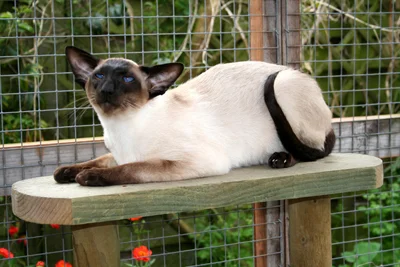
The most distinctive feature of a Siamese cat is the pointed pattern — dark colour on the ears, face, paws, and tail, with a lighter body. This isn’t just cosmetic. It’s the result of a genuinely fascinating piece of biology.
The gene responsible is a mutation of the tyrosinase gene, which controls pigment production. In Siamese cats, this gene has mutated to produce a temperature-sensitive version of the enzyme. The enzyme works normally at cooler temperatures but becomes inactive at warmer body temperatures.
The result: pigment is only produced on the cooler extremities (the “points”), while the warmer body stays pale. This is why Siamese kittens are born almost completely white — inside the womb, every part of their body is warm. As they grow and their extremities cool down, the colour gradually develops.
It’s also why older Siamese cats tend to darken all over. As circulation decreases with age, body temperature drops slightly, and the enzyme becomes more active across the entire coat. That lovely clear body your kitten had at twelve weeks? It’s going to get progressively darker over the years. Every breeder knows this — and every judge at a show knows the difference between a kitten’s body colour and a veteran’s.
The Siamese allele is denoted c^s (the s stands for Siamese). A cat needs two copies — one from each parent — to show the pointed pattern. One copy of the full-colour allele C is dominant, so a cat with C and c^s will look fully coloured but carry the pointed gene.
The Colour Genes — What Determines Seal, Chocolate, Lilac, and Beyond
Now we get to the part that breeders actually argue about at shows. The colour of your Siamese cat’s points is controlled by several independent genes working together. Here are the ones that matter.
Black (Seal) / Chocolate / Cinnamon — The B Gene
This gene controls the shape of pigment molecules in the hair. Different shapes reflect light differently, producing different colours.
- B (Black/Seal) — dominant. Produces the dark seal brown colour.
- b (Chocolate) — recessive to B. Produces warm milk-chocolate brown.
- b^l (Cinnamon) — recessive to both B and b. Produces a warm reddish-brown.
A seal point can carry chocolate or cinnamon without showing it. A chocolate point can carry cinnamon. But a cinnamon point must be homozygous — b^l b^l — because there’s nothing recessive to cinnamon at this locus.
One practical note from breeding experience: chocolate points carrying cinnamon are often visibly paler than pure chocolates. If you’ve got a chocolate that always looks slightly “off” compared to the others on the bench, check the pedigree for cinnamon in the background.
Dense Colour / Dilution — The D Gene
This is the gene that turns seal into blue, chocolate into lilac, cinnamon into fawn, and red into cream. The dilution allele causes pigment to be distributed more thinly in the hair, weakening the colour.
- D (Dense) — dominant. Full colour.
- d (Dilute) — recessive. Weakened colour.
The combinations:
- Seal (B + D) → Blue (B + dd)
- Chocolate (b + D) → Lilac (b + dd)
- Cinnamon (b^l + D) → Fawn (b^l + dd)
- Red (O + D) → Cream (O + dd)
The Dilute Modifier — Caramel and Apricot
The Dilute Modifier gene (Dm) is unusual — it’s the dominant allele that has the effect, not the recessive. But it only works when the dilution gene (d) is also present. So it has no visible effect on seal, chocolate, cinnamon, or red cats — they can carry it for generations without anyone knowing.
When Dm meets dilution:
- Blue + Dm → Caramel (based on blue)
- Lilac + Dm → Caramel (based on lilac)
- Fawn + Dm → Caramel (based on fawn)
- Cream + Dm → Apricot
Caramel and apricot are still relatively uncommon on the show bench, but they’re becoming more established. If you’re breeding dilutes and getting unexpectedly warm-toned kittens, the dilute modifier may be at play in your lines.
Orange (Red) — The O Gene
Orange is the genetics gene that causes the most confusion — and the most interesting results.
- O (Orange) — changes all pigment to red, regardless of what B-series gene is present.
- o (non-Orange) — normal colour expression.
The Orange gene sits on the X chromosome, which means:
Males (XY) can only be red or not red. There’s no middle ground — they’ve only got one X chromosome.
Females (XX) can be OO (red), oo (normal colour), or Oo (tortoiseshell). In a tortie, one X chromosome is randomly inactivated in each cell during embryonic development. Some cells express O, others express o — producing the characteristic mottled tortoiseshell pattern.
This is why male tortoiseshells are extremely rare and almost always sterile — they typically have an extra sex chromosome (XXY) or another genetic anomaly.
One more important point: Orange overrides the non-agouti gene. All red cats show some tabby pattern, which is why distinguishing between red point and red tabby point requires either knowing the parents or getting a DNA test. GCCF registration rules reflect this — all red-series cats with one or more tabby point parents must be registered as tabby point until proven otherwise.
Agouti (Tabby) / Non-Agouti — The A Gene
All cats are genetically tabby. The non-agouti allele (a) simply hides the pattern by stopping the switching mechanism that creates banded hairs.
- A (Agouti/Tabby) — dominant. Tabby pattern visible.
- a (Non-Agouti) — recessive. Tabby pattern hidden.
For Siamese breeders, this is mostly relevant when breeding tabby points or when trying to work out whether red-series cats are “true” reds or tabby points. Ghost tabby markings — faintly visible stripes, especially on kittens — are common even in non-agouti cats and usually clear with age. The classic M on the forehead and leg bars are typically the last to disappear.
Short-hair / Long-hair — The L Gene
- L (Short-hair) — dominant.
- l (Long-hair) — recessive.
Two copies of the long-hair allele produce a Balinese — essentially a long-haired Siamese. The actual length, texture, and amount of undercoat are influenced by polygenes (see below), which is why some Balinese have more luxurious coats than others despite having the same basic genotype. Four different mutations causing long hair have been identified in cats, but only one is present in the Balinese/Siamese family.
Silver (Inhibitor) — The I Gene
The silver gene suppresses pigment in the base of the hair, creating a sparkling effect. It’s dominant, but expression is variable — some cats carrying the gene don’t look obviously silver. DNA testing for this gene is now available, which helps breeders identify carriers.
Polygenes — Why No Two Chocolates Look Quite the Same
If you’ve ever lined up five chocolate points at a show, you’ll have noticed they’re not all the same shade. Some are deep, warm chocolate. Others are paler, almost milky. They all have the same major genes — so what’s going on?
The answer is polygenes — collections of genes that individually have tiny effects but collectively make a significant difference. They’re responsible for the subtle variations in colour depth, body colour clarity, eye colour intensity, coat texture, and type. They’re also why some breeding lines consistently produce deeper colours or clearer body colour than others.
Polygenes are the reason breeding is an art as much as a science. You can know all the major genes and still be surprised by what comes out. Selecting for polygenes is what separates good breeders from great ones — it takes generations of careful observation and record-keeping.
The Full Genetics Table
Here’s the genetic makeup for all recognised Siamese colour varieties. In this table, a dash (-) means any allele of that gene may be present, and an asterisk (*) means either b or b^l.
The four columns represent: Non-Tabby Female, Non-Tabby Male, Tabby Female, Tabby Male.
| Colour | Female (non-tabby) | Male (non-tabby) | Female (tabby) | Male (tabby) |
|---|---|---|---|---|
| Seal | aaB-D-oo | aaB-D-oY | A-B-D-oo | A-B-D-oY |
| Blue | aaB-ddoo | aaB-ddoY | A-B-ddoo | A-B-ddoY |
| Chocolate | aab*D-oo | aab*D-oY | A-b*D-oo | A-b*D-oY |
| Lilac | aab*ddoo | aab*ddoY | A-b*ddoo | A-b*ddoY |
| Cinnamon | aab^lb^lD-oo | aab^lb^lD-oY | A-b^lb^lD-oo | A-b^lb^lD-oY |
| Fawn | aab^lb^lddoo | aab^lb^lddoY | A-b^lb^lddoo | A-b^lb^lddoY |
| Red | aa–D-OO | aa–D-OY | A—D-OO | A—D-OY |
| Cream | aa–ddOO | aa–ddOY | A—ddOO | A—ddOY |
| Seal Tortie | aaB-D-Oo | — | A-B-D-Oo | — |
| Blue Tortie | aaB-ddOo | — | A-B-ddOo | — |
| Chocolate Tortie | aab*D-Oo | — | A-b*D-Oo | — |
| Lilac Tortie | aab*ddOo | — | A-b*ddOo | — |
| Cinnamon Tortie | aab^lb^lD-Oo | — | A-b^lb^lD-Oo | — |
| Fawn Tortie | aab^lb^lddOo | — | A-b^lb^lddOo | — |
| Caramel | aa–ddDm-oo | aa–ddDm-oY | A—ddDm-oo | A—ddDm-oY |
| Apricot | aa–ddDm-OO | aa–ddDm-OY | A—ddDm-OO | A—ddDm-OY |
| Caramel Tortie | aa–ddDm-Oo | — | A—ddDm-Oo | — |
Predicting Kitten Colours — A Worked Example
This is where genetics becomes genuinely useful rather than just intellectually interesting. Here’s how to work out what colours a specific mating might produce.
Example: Blue Point carrying Chocolate × Chocolate Tabby Point (one parent was Lilac)
First, write out the genetic makeup of each parent:
- Blue Point carrying Chocolate: aa Bb dd
- Chocolate Tabby Point (carrying Lilac from parent): Aa bb Dd
For each gene, write out the possible combinations from one allele of each parent:
| Gene | Parent 1 gives | Parent 2 gives | Possible combinations |
|---|---|---|---|
| A (Tabby) | a | A or a | Aa (tabby) or aa (non-tabby) |
| B (Colour) | B or b | b | Bb (seal-based) or bb (chocolate) |
| D (Dilution) | d | D or d | Dd (dense) or dd (dilute) |
The possible kitten colours from this mating are:
- AaBbDd — Seal Tabby Point (carrying chocolate and dilute)
- AabbDd — Chocolate Tabby Point (carrying dilute)
- AaBbdd — Blue Tabby Point (carrying chocolate)
- Aabbdd — Lilac Tabby Point
- aaBbDd — Seal Point (carrying chocolate and dilute)
- aabbDd — Chocolate Point (carrying dilute)
- aaBbdd — Blue Point (carrying chocolate)
- aabbdd — Lilac Point
Eight possible colour outcomes from one mating. In practice, most litters won’t include all possibilities — but knowing they’re possible helps you identify what you’re looking at when the kittens arrive.
Why This Matters for Breeders
Understanding genetics isn’t academic. It directly affects your breeding decisions. If you’re newer to breeding, our Breeding pillar guide covers the wider picture — registration, ethics, going to stud, raising a litter — with genetics as one piece of it.
If you’re planning a mating, genetics tells you what colours are possible — and impossible — from that pairing. It prevents surprises (or at least explains them). It helps you understand why some colours are rarer than others and why certain breeding combinations are more valuable to your programme.
It also protects you. If someone tells you they’ve got a chocolate point that produced a cinnamon kitten but the pedigree shows no cinnamon anywhere in the line, you know something doesn’t add up. Either there’s an unrecorded ancestor carrying cinnamon, or someone’s made a registration error. Genetics gives you the tools to ask the right questions.
And for those of you who find all of this fascinating rather than terrifying — there are now DNA tests available for most of the major colour genes. Companies like Langford Vets and UC Davis offer panels that can confirm exactly what your cat is carrying, removing the guesswork. For some genes, like the silver inhibitor, this is the only reliable way to identify carriers.
⚡ Key Takeaways
- The pointed pattern is temperature-sensitive. The Siamese cs mutation produces a heat-sensitive enzyme — pigment only develops on cooler extremities. Kittens are born white and darken with age.
- Dominant genes mask recessive ones. A seal point can carry chocolate, dilute, or both without showing it. This is why unexpected colours appear in litters.
- The D gene turns seal→blue, chocolate→lilac, cinnamon→fawn, red→cream. Dilution weakens pigment, creating the lighter colour variants.
- The Orange gene sits on the X chromosome. Males are red or not. Females can be red, non-red, or tortoiseshell. Male torties are extremely rare and usually sterile.
- All red cats show tabby pattern. Orange overrides non-agouti, so red point vs red tabby point requires parentage knowledge or DNA testing.
- Polygenes explain why no two chocolates look identical. Collections of minor genes modify colour depth, body clarity, and coat quality. Selecting for these separates good breeders from great ones.
- You can predict kitten colours from parental genotypes. Write out each parent’s genes, list the possible combinations, and read off the results.
- DNA testing is now available for most colour genes. Langford Vets and UC Davis offer panels that confirm carriers, removing guesswork from breeding programmes.
Frequently Asked Questions
Why are Siamese kittens born white?
Siamese kittens are born almost completely white because the womb is uniformly warm. The pointed pattern is caused by a temperature-sensitive enzyme that only produces pigment at cooler temperatures. Inside the womb, no part of the kitten is cool enough to trigger pigment production. As the kitten grows and its extremities (ears, nose, paws, tail) cool to lower temperatures, the colour gradually develops over the first few weeks of life.
Can two seal point Siamese produce a chocolate kitten?
Yes — if both parents carry the recessive chocolate gene. A seal point with the genotype Bb carries one copy of chocolate. If both parents are Bb, there’s a 25% chance of each kitten being bb (chocolate). This is why knowing what a cat carries — not just what it looks like — is so important for breeding decisions.
What’s the difference between chocolate and cinnamon points?
Chocolate and cinnamon are different alleles of the same gene (B). Chocolate (b) produces a warm milk-chocolate brown colour, while cinnamon (b^l) produces a warmer, reddish-brown tone. Cinnamon is recessive to both seal and chocolate, making it rarer. Their dilute equivalents are lilac (from chocolate) and fawn (from cinnamon).
Why are male tortoiseshell cats so rare?
The tortoiseshell pattern requires two different versions of the Orange gene — one O and one o. Since the Orange gene is on the X chromosome, females (XX) can carry both versions (Oo), creating the mottled tortie pattern. Males (XY) only have one X, so they’re either red (O) or not red (o) — there’s no middle ground. Male torties almost always have a genetic anomaly like an extra X chromosome (XXY), which is why they’re typically sterile.
Why does my Siamese cat get darker as it ages?
The pointed pattern depends on temperature. As cats age, their circulation becomes less efficient and overall body temperature drops slightly. This means the temperature-sensitive enzyme becomes more active across the body, producing pigment in areas that were previously too warm. The result is a gradual darkening of the body colour over the cat’s lifetime. Environmental temperature also plays a role — cats kept in cooler environments tend to develop darker body colour.
What are caramel and apricot points?
Caramel and apricot are created by the Dilute Modifier gene (Dm) acting on dilute colours. When a cat has both the dilution gene (dd) and at least one copy of the Dilute Modifier (Dm), blue becomes caramel, lilac becomes caramel, fawn becomes caramel, and cream becomes apricot. The Dm gene is dominant but can hide in non-dilute cats for generations because it only has a visible effect when dilution is also present.
Can DNA testing tell me what colours my cat carries?
Yes. DNA tests are now available for most major colour genes including chocolate, cinnamon, dilute, colourpoint, and long-hair. Langford Vets (UK) and UC Davis (US) both offer comprehensive colour panels. A simple cheek swab is all that’s needed. This is particularly useful for identifying carriers of recessive genes like chocolate or dilute when the pedigree is unclear.
How do I predict what colour kittens a mating will produce?
Write out the genotype of each parent for the relevant genes (you may need to work backwards from their parents and previous litters to fill in any unknowns). For each gene pair, list the possible combinations from taking one allele from each parent. Then combine all possibilities across all genes. The worked example in this article shows the process step by step — it’s easier than using a table and becomes intuitive with practice.