
You noticed something was off a few weeks ago. She was a bit cuddlier than usual. Her appetite had gone through the roof. She’d taken to dragging every clean towel off the airing cupboard shelf and flattening it on the kitchen floor.
Then this morning you spotted it. The nipples. They’ve gone pink.
And now you’re on the sofa with a cup of tea and a face like someone’s just told you the boiler’s packed in, googling “cat expecting kittens” at — what time is it — half past eleven at night.
Welcome. You’re in exactly the right place, and you’re not the first person to end up here tonight. You will not be the last.
I’ve been breeding Siamese and Oriental cats since 2004. I’ve had planned pregnancies, I’ve had “well, that wasn’t supposed to happen” pregnancies (yes, it happens to experienced breeders too — more often than any of us like to admit), and I’ve talked dozens of first-time owners through the entire nine weeks over the phone, by text, and once memorably in a supermarket car park because the poor woman was crying into her steering wheel.
This article, like most of what I write on here, is me sharing my own experiences in the hope it’ll help you when you’re preparing for your cat to give birth. There’s no theory in here that I haven’t lived through at the Burnthwaites cattery at some point, usually at three in the morning while making my fourth coffee of the night.
So here’s what I’m going to do for you. I’m going to walk you through the whole thing — from “wait, is she actually pregnant?” right through to the morning you wake up and find five kittens where there used to be one very smug cat. I’m going to tell you what she needs, what she doesn’t need, what to watch for, and — the important bit — when to put the tea down and phone the vet.
Deep breath. Put the kettle on again. She’s going to be fine. Most cats do this for a living and you’re just her chauffeur.
Quick Answer: Cat pregnancy lasts 63–67 days — roughly nine weeks from mating. If you’ve only just noticed the signs, you’ve probably got somewhere between three and six weeks left. Between now and then she needs a switch to kitten food, a quiet nesting corner, a vet check for confirmation, and calm. Most cats handle labour themselves, quietly, usually overnight, and most owners sleep through the whole thing. Your real job is to prepare the space, stay out of the way, and know the warning signs that mean it’s time to phone the vet.
👇 Skip to the 8 things every owner needs to know before the kittens arrive

First — Is She Actually Pregnant?
Let’s deal with this before we do anything else. Because every year I speak to at least two or three owners who’ve convinced themselves their cat is pregnant, bought the kitten food, built the nesting box, and then — surprise — she’s just been raiding the neighbour’s food bowl and putting on a bit of a paunch.
The signs of genuine pregnancy are actually quite specific, and they appear in a reasonably predictable order. Here’s what you’re looking for.
“Pinking up” of the nipples. This is the big one. Around three weeks after mating, her nipples will change colour — from the pale, flesh-coloured things you’ve never really noticed before to a distinct, almost rose-pink. They’ll also get slightly larger and more prominent. This is the most reliable early sign and it’s the one most owners notice first, usually by accident when she rolls over for a belly rub.
Increased appetite. She’ll suddenly be interested in her breakfast in a way she absolutely wasn’t last month. If your previously food-fussy madam is now hoovering her bowl and then giving you the stare that means “more, please”, that’s a clue. (It’s also a clue that she’s fallen in love with a new flavour of cat food, so this one on its own doesn’t prove anything.)
Weight gain and a changing shape. From around week four or five, her belly will start to look different — not just rounder but lower, particularly when she’s standing. The best test: watch her from behind as she walks. Pregnant cats develop a distinctive pear-shaped profile that’s hard to mistake once you know what you’re looking at.
Behaviour changes. Some cats become extraordinarily affectionate — I’ve had queens who’d normally headbutt me out of the way turn into velcro cats for the duration. Others go the opposite way and become quietly withdrawn. She might sleep more. She might start hunting for dark, enclosed spaces (that’s the nesting instinct warming up, more on that later).
Morning sickness. Yes, really. Some pregnant cats throw up during the first three or four weeks, usually in the morning, usually on the carpet you just hoovered. It doesn’t happen to all of them, but if it happens to yours, it’s not food poisoning.
One last thing worth knowing: false pregnancy is a real thing in cats. Sometimes a queen who’s mated but not conceived — or even a queen who hasn’t mated at all but has been calling loudly in season — will show some of these signs for a few weeks before they fade away. If you’re not sure, the vet can tell you definitively with an ultrasound from about week three onwards, which brings me to the next bit.
How Long Is a Cat Pregnant For? (And When Are the Kittens Actually Coming?)
The standard answer is 63 to 67 days. I’ve had litters arrive on day 62 and I’ve had one memorable girl who went to day 69 before she finally obliged, by which point I was phoning the vet roughly every four hours asking if we should be worried. (We shouldn’t have been. She was just taking her time.)
In practice, if you don’t know exactly when she mated — and most owners of accidentally-pregnant cats don’t — you’re looking at roughly nine weeks from conception, and you can narrow it down by the signs above. Here’s the rough timeline:
- Weeks 1–2: Nothing visible. She’s pregnant but you wouldn’t know.
- Week 3: Nipples start pinking up. Possible morning sickness.
- Weeks 4–5: Belly becomes visible. Appetite increases. Ultrasound confirmation possible at the vet.
- Weeks 6–7: Unmistakably pregnant. X-ray now possible to count kittens. Nesting behaviour begins.
- Week 8: She’s enormous. Probably a bit uncomfortable. Nesting becomes obsessive.
- Week 9: Milk comes in. Kittens arrive any day now, usually overnight.
If you’ve only just noticed she’s pregnant, work backwards from the signs. Pinking nipples but still slim? You’ve probably got five or six weeks left. Already huge with a belly you can see from orbit? Might only be two or three. Either way — you’ve got time to get everything you need in place, provided you start now.
If you know the exact mating date — most stud owners make a note of it and provide an estimated due date on the mating certificate — you can work your own cat pregnancy timeline from there. Nine weeks from conception, give or take a day or two. I personally like to use the second day of the girl being mated as the conception date, because that’s when most of my girls have actually caught. If you’re frantically trying to work out when will my cat have kittens, that second mating day plus 63 days is your best bet. My own queens usually go no more than a day or two either side of it.
The Vet Visit That’s Worth Booking
Get her to the vet. I know, I know — it’s another thing on the list and she hates the carrier. Do it anyway. There are three reasons it matters.
One: confirmation. From about week three onwards, your vet can confirm pregnancy with an ultrasound. This costs somewhere between £40 and £100 depending on your practice. It’s worth every penny just to know you’re not preparing for kittens that aren’t actually coming.
Two: a general health check. The vet will check her heart, her weight, her condition, and flag anything that might make the pregnancy harder on her. A queen in poor condition going into labour is the single biggest risk factor for things going sideways, and a check-up now gives you time to sort out anything that needs sorting.
Three: flea and worming advice. This is the one most owners forget. A lot of standard flea and worming treatments are not safe for pregnant cats. The spot-on treatment you’ve been using for years might be fine, or it might be absolutely not fine, and you need the vet to tell you which. Do not — I cannot stress this enough — do not dose her with whatever’s in the drawer without checking first.
If you can stretch to it, book a follow-up X-ray at around week six or seven. An X-ray at that stage will give you an accurate count of how many kittens you’re expecting, which matters enormously when she’s in labour and you’re trying to work out whether she’s finished or whether there’s one more in there. Costs around £70–£120. It’s the best seventy quid you’ll spend.
What She Should Be Eating Now (Short Answer: More, and Better)
Right, food. This is one of the easier bits.
From around week four onwards, switch her onto a high-quality kitten food. Not adult food. Kitten food. The reason is protein and calorie density — kitten food is formulated to support rapid growth, and a pregnant queen is essentially growing four to six tiny cats inside her, which is the fastest growth spurt of her adult life. Adult maintenance food doesn’t have the nutrients she needs for what she’s about to do.
Pick something reputable. The supermarket cheap stuff is fine for a normal cat having a normal week, but now is not that week. Royal Canin, Hill’s, James Wellbeloved, Purina Pro Plan — any of the proper brands. Wet food is good. A mix of wet and dry is fine. What matters is that it says “kitten” or “growth” on the packet.
Her appetite will climb steadily through the pregnancy. By week eight or nine she’ll be eating roughly 1.5 times her normal amount — sometimes double. Don’t ration her. Let her eat what she wants. Smaller, more frequent meals tend to work better than two big ones because by the end of the pregnancy her stomach is squashed up against a lot of kittens and she physically can’t fit much in at once.
Fresh water, always. More than usual — she’s drinking for several. Change it daily.
One thing to avoid: do not start adding supplements “to help”. Calcium supplements in particular can actively harm her by suppressing the release of her own calcium during labour, which causes a life-threatening condition called eclampsia. Kitten food contains everything she needs. If the vet says she needs something extra, the vet will tell you. Otherwise, hands off the pet shop shelf.
The Nesting Box — Building It Before She Builds Her Own in Your Wardrobe
Here’s something nobody tells owners until it’s too late. Around week seven or eight, your cat will start looking for somewhere to have her kittens. And if you haven’t offered her somewhere suitable, she will choose somewhere herself.
It will be the worst possible spot. Every single time.
The top shelf of the wardrobe behind the jumpers you’ve not worn since 2019. The airing cupboard, under the towels. The back of the sofa. Once, memorably, the footwell of my husband’s car because he’d left the door open for ten minutes while unloading the shopping. Cats are drawn to enclosed, dark, high-up, warm spaces, and they will find the one you least want them to use.
So get in there first. Build her a nesting box around week six or seven and give her time to get used to it.
You don’t need anything fancy. A large cardboard box works perfectly — bigger than you think she needs, because she needs to be able to stretch out flat with kittens attached to her. Cut a doorway in one side, high enough to keep the kittens in for the first fortnight but low enough for her to step over easily. Line the bottom with a layer of newspaper, then clean old towels or vet bed on top. Do not use anything with loose fibres (no fleece blankets) because newborn kittens can get tangled.
Where you put it matters more than what it’s made of. It needs to be:
- Quiet. Away from the washing machine, away from the telly, away from the front door.
- Warm. Not cold, not draughty, not next to a radiator that cycles on and off.
- Dark or dim. A spare bedroom with the curtains half-drawn is ideal.
- Away from other pets. If you have a dog, or another cat, they do not come into this room. Not once. Not for a “quick look”. Not ever, until the kittens are at least three or four weeks old and mum says it’s okay.
- Away from children. Same rule, same reason.
Here’s the trick that’s worked for every one of my Burnthwaites queens: let her find the nest herself — but rig the room so the nest you’ve prepared is the only good option available. If you’re clever, you can let her pick the kittening pen of your choice by putting it in a nice quiet room (I use our bedroom) and making sure there’s nowhere else in that room she might prefer. This works much better than confining her to a pen, because letting her choose her own nest reduces her stress levels, and a low-stress queen is a good thing for everybody concerned — especially the kittens.
Show her the box. Put a worn T-shirt of yours in there so it smells like something she knows. She may completely ignore it for a fortnight and then suddenly decide it’s the best thing ever. She may sniff at it, shrug, and carry on trying to climb into the airing cupboard. That’s fine — keep the airing cupboard door shut, keep offering the box, and she’ll usually come round by the last couple of days when the nesting instinct takes over properly.
And if she does pick her own spot despite your best efforts? Don’t fight her on it. If it’s a broadly acceptable location (not the top of a wardrobe six feet off the ground, obviously), let her have it. She knows more about giving birth than you do, and moving a queen in labour is a terrible idea.
The Birthing Kit: What You’ve Been Told vs What You Actually Need
If you go Googling “birthing kit for cats” you’ll find lists that read like a medical supply catalogue. I’ve seen recommendations that include all of the following:
- Forceps
- An air bed (so you can be close to your queen if the labour is a long one)
- Towels — boil washed twice, to be sure they are sterile
- Scissors
- Blankets — minimum of six
- Cotton wool balls where possible
- Washable cat beds, at least two, big enough to fit a medium-sized dog
- Energy drinks — your queen will appreciate them, labour’s hard work
- Strong coffee, two full jars, be prepared for an overnight job — you’ll appreciate it
- Your vet’s phone number, in fact preferably their home address in case they don’t answer the phone
- Plastic bags for rubbish
Forget all that. I’ve been doing this for over twenty years at the Burnthwaites cattery, across dozens of litters, and I’m telling you now: most of that list is either unnecessary, actively dangerous (put the forceps down), or reads like whoever wrote it has never actually sat up with a labouring queen at four in the morning. Here’s what you actually need:
- A place for your queen to “find” where she can give birth. Queens often get loved up and start nesting near their due date. A cardboard box or a purpose-built kittening pen in a nice quiet room is ideal, and we’ve already built that in the section above.
- A heat pad to keep the kittens warm once they’re born. Half the nesting box, not the whole thing — they need a cool side too.
- A couple of clean, dry towels or a kitchen roll. Not boiled. Just clean.
- Your vet’s out-of-hours number to hand, just in case. On a piece of paper. Stuck to the fridge.
- To be awake and alert. Not wired on caffeine. Not asleep on the sofa. Just quietly present.
- Plastic bags for rubbish. This one’s on both lists because it’s genuinely useful.
- Kitchen scales. Grams, not pounds. You’ll use these every day for the first fortnight.
- Pen and paper to record the birth weights. You think you’ll remember which kitten was which, and you won’t.
- Fresh bedding to change the box out once the kittens are born.
That’s it. No scissors. No forceps. No two jars of coffee. The best thing you can bring to a cat in labour is a calm owner who isn’t rummaging through a tackle box at three in the morning.
The 48 Hours Before Labour — What You’re Watching For
Right. You’re in the home stretch. She’s enormous, she’s uncomfortable, she’s given up trying to wash her own back end, and she’s giving you looks that clearly say “please, for the love of god, let’s get this over with”.
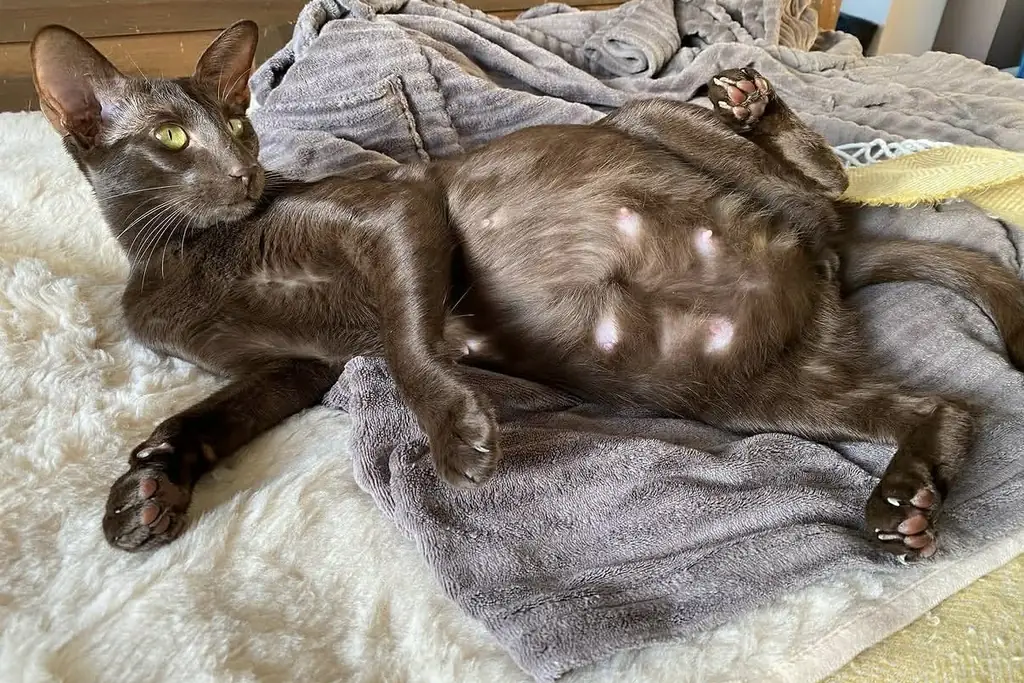
Usually a couple of days before the birth a pregnant cat looks as if she’s “dropped”. What this means is that the kittens are moving into position to be born, and instead of her walking around with two huge saddle bags either side of her middle, she now has a bulge that hangs down underneath her. It’s an unmistakable shift in her shape and if you’re paying attention you’ll spot it the morning it happens.
I know from my own experiences how anxious it is when that due date starts approaching. You stay up all night and nothing. You’re still awake but not quite with it during the next day — still nothing. The night after, your eyes are wide open but your head’s all over the place, again nothing. Then by the fourth night, your queen quietly gets on with giving birth at two in the morning while you’re fast asleep on the sofa comforting and encouraging your pillow to push, because you are delirious due to sleep deprivation and in no state to be helpful should she actually need you.
Learn from my mistakes. At least two days before the due date, it’s a good idea to take your expectant queen up to your bedroom with you at night. This way you’re on hand if she needs you, and both of you can sleep with ease until the birthing begins. If by chance you are asleep when your queen begins her contractions, don’t panic — I find my girls let me know one way or another.
A quick note on timing, because everybody asks: queens can give birth during the day or at night, but in my experience of Siamese and Orientals they like to be as inconvenient as possible. It’s in their DNA, and the Burnthwaites queens in particular seem to insist on night-time births. I no longer bother trying to predict the hour. I just assume I’m staying up.
The signs that labour is about to start start appearing in the 24 to 48 hours before anything actually happens. Here’s the full list of what to watch for.
Milk comes in. Squeeze gently around a nipple — actually don’t, you don’t need to squeeze, just look — and you’ll see her mammary glands visibly full. You may even see a drop of milk if she’s very close.
She goes off her food. This is a big one. A cat who’s been eating enough for a small dinner party suddenly walks past her bowl without a glance. That’s usually a 12 to 24 hour warning sign. Don’t worry about it — she’s not meant to eat in early labour.
Restlessness and pacing. She’ll start wandering. In and out of the nesting box. Round the room. Back to the box. Back out again. She’s checking, adjusting, overthinking — basically what you’d do if you were about to push five kittens out without any pain relief.
Vocalising. Some queens get very chatty in the hours before labour. Siamese and Orientals are extremely chatty at the best of times, so you might not notice at first, but even the quiet breeds will have a few things to say. It’s not distressed meowing — it’s conversational, sometimes a bit questioning, sometimes a bit “hmph”.
Temperature drop. If you can take her temperature (rectally, and frankly if you can get a thermometer into your queen during the 48 hours before labour without losing a finger, you’re braver than me), it’ll drop from around 38.5°C to below 37.5°C in the 24 hours before kittens arrive. Most owners never get anywhere near this measurement, and that’s completely fine.
The nesting frenzy. She’ll rearrange the box. Dig up the bedding. Scratch at the bottom. Turn in circles. This is the final sign — she’s committed to the spot and labour is now imminent, usually within a few hours.
And the really obvious ones, in rough order: very often the signs that your cat has started to have her kittens become obvious even before she’s pushing. An immediate sign is when your cat discharges her mucus plug, which usually results in her having her kittens within the following 24 hours — though I’ve known it to be longer. Another obvious sign, once her mucus plug has gone, is that your cat might start to discharge some of her amniotic fluid, which is a clear fluid sometimes tinged with blood. These are the earliest unmistakable signs of labour.
What you don’t want to see is dark green or black discharge with no kitten following it within an hour — that’s a sign something’s wrong and it’s the vet-now signal. We’ll come back to that.
During Labour — When to Watch, When to Help, and When to Phone the Vet
Here’s the bit everyone worries about. So before we go any further, the two most important things I can say to any first-time owner whose cat has just started labour.
The first thing I would say is: do not panic.
The second thing I would say is: do not panic!
I’m not being flippant. Your cat will pick up any “vibes” coming off you, and so I believe it’s essential for you to remain calm — because that calm passes down to your girl, and a calm queen has an easier labour. Nine times out of ten your cat will do all the hard work herself and will need no help from you at all. If you’re unlucky and your queen falls into the one out of ten who genuinely need a hand, then you’re prepared because you’ve read this article — so do not panic.
Most cats give birth quietly, confidently, and usually in the middle of the night. Plenty of first-time owners wake up in the morning to find the whole thing already done — five or six kittens, already clean and feeding, mum purring contentedly, looking at them as if to say “well, that was busy, where’s breakfast?” That’s not a failure on your part. That’s a successful labour. Cats have been doing this for about eleven million years without human help and yours is unlikely to have forgotten the instructions.
Here’s what a normal labour looks like so you know what you’re watching.
Stage one. Restlessness, panting, the nesting frenzy I mentioned above. Contractions are happening but you probably can’t see them yet. This stage can last anywhere from a couple of hours to twelve or more — first-time queens tend to be at the longer end.
Stage two. Visible contractions. She’ll lie on her side and you’ll see her abdomen rippling. Then she’ll push — sometimes with a little grunt — and within 15 to 30 minutes the first kitten should be out. Kittens can be born head-first or back-feet-first; both are normal.
Stage three. She’ll break the birth sac (if it’s still intact), chew through the cord, lick the kitten clean, and usually eat the placenta. Yes, all of it. Yes, it’s a bit grim if you’ve never seen it. No, you don’t need to intervene — she knows what she’s doing and the placenta contains nutrients she needs. Let her get on with it.
Between kittens, you’re looking at gaps of anywhere from 10 minutes to an hour. Occasionally a queen will take a longer break — sometimes several hours — between kittens if she’s having a big litter, particularly if she’s tired. As long as she’s calm, the already-born kittens are feeding, and she’s not straining to no effect, a long gap isn’t necessarily a problem.
A whole litter can take anything from two to eight hours from the first kitten to the last.
Now — the bit I really want you to pay attention to. Here’s when you phone the vet.
- She’s straining hard for more than 30 minutes with no kitten appearing. This is the big one. Active, visible pushing with no result = something is stuck. Phone the vet now.
- A kitten is partially out and stuck for more than a few minutes. Do not pull. Phone the vet.
- Dark green or black discharge with no kitten following within an hour. The placenta has separated from a kitten that hasn’t been delivered. This is a vet-now situation.
- Fresh red blood, more than a few drops. A small amount of bloody discharge during labour is normal. A steady flow of bright red blood is not.
- She seems collapsed, very weak, or non-responsive. Phone immediately.
- It’s been more than two hours between kittens and you know from the X-ray there’s still one inside. Worth a call for advice.
- You’re past day 68 and she’s showing no signs of labour at all. Book a check-up the next morning.
Have your vet’s out-of-hours number written down somewhere you can actually find it at three in the morning. Not in an email. Not in a text six months old. On a piece of paper stuck to the fridge. Labour almost always happens at the worst possible time and you will not be at your most organised.
If in doubt at any point — phone. Vets are used to worried owners calling at 2am about pregnant cats, and any decent practice would rather you call for nothing than not call when you should have.
If you’d like a visual walk-through of what the early stages actually look like, I’ve written a separate article about an Oriental queen giving birth to her kittens over at Burnthwaites — it includes a video of one of my own girls in the middle of a textbook labour and it’s a much less scary watch than you’d expect. And if, despite everything, you end up with a kitten who isn’t feeding properly in the first 24 hours and you’re worried mum isn’t producing enough milk, my guide to tube-feeding newborn kittens is the one you want bookmarked now, not at two in the morning when you suddenly need it.
The First Week — What You Do, What You Don’t Do, and What Happens Next
Congratulations. You’ve got kittens. Let me tell you what happens now.
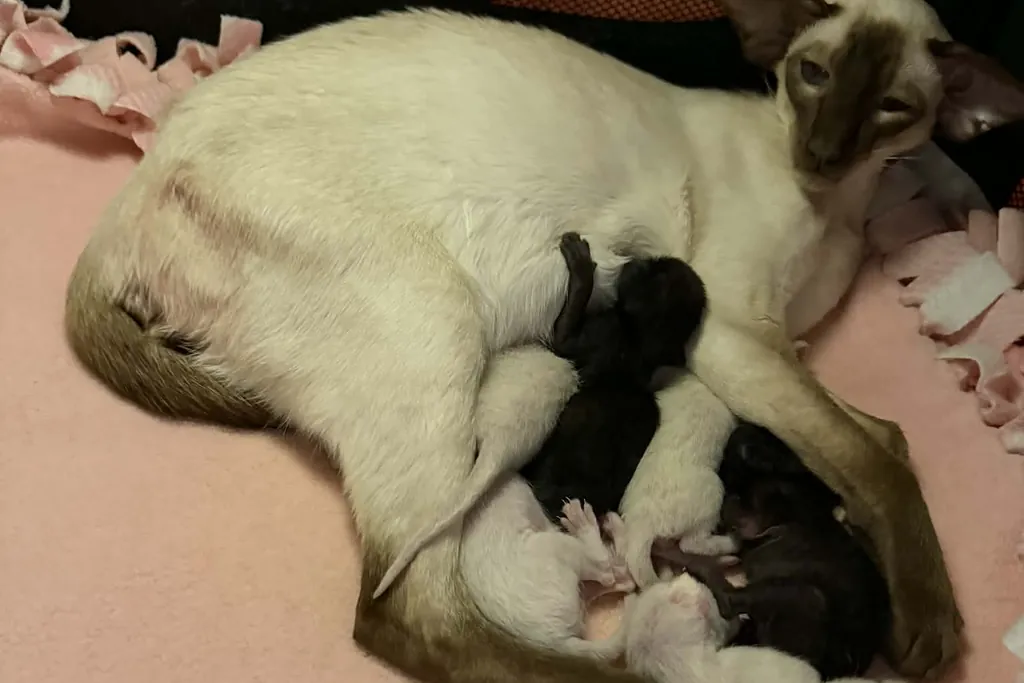
Mum does everything. For the first two to three weeks, she feeds them, keeps them warm, cleans them, and stimulates them to toilet by licking. Your job is to keep her fed, watered, and undisturbed, and to leave her alone to get on with it.
Do not touch the kittens unless you have to. Once upon a time people said you absolutely must not touch newborn kittens or the mother would reject them. That’s largely a myth — most queens don’t mind a gentle handle at all — but the less disturbance she has in the first few days, the less stressed she’ll be. A quick daily check to make sure all the kittens are warm, round-bellied (fed), and breathing is plenty. Don’t pick them up unless you need to.
Weigh them daily if you can. This is the single best indicator that everything’s going well. A healthy newborn kitten should gain weight every single day — typically 10 to 15 grams a day in the first week. A kitten that isn’t gaining weight, or worse, losing weight, needs veterinary attention quickly. A small kitchen scale in grams is all you need.
Keep them warm. Newborn kittens cannot regulate their own body temperature. The room needs to be warm — around 22–24°C — for the first fortnight. If you can’t heat the whole room, a covered heat mat under half the nesting box gives them somewhere warm to crawl to, with a cool side for when they need it.
Mum’s appetite is going to go through the roof. A nursing queen eats more than a pregnant one. Keep her on kitten food. Keep the bowl full. Fresh water always available. She’ll eat roughly two to three times her pre-pregnancy amount for the next six to eight weeks and it will cost you a fortune, but it’s fine — the kittens are all drinking milk that has to come from somewhere.
Around day 10 to 14 their eyes will open. Around week three they’ll start staggering around. At four weeks you can introduce weaning food (soaked kitten kibble, gradually firming up). By six to eight weeks they’re eating solids properly. By twelve weeks they’re ready to leave — though please read the next paragraph before that happens.
If this is your very first litter and you’re feeling a bit overwhelmed by the idea of the next twelve weeks, it’s worth reading my honest account of my first litter of kittens. I made a lot of the mistakes you’re worrying about making right now, and the cats and kittens all survived — usually no thanks to me.
Rehoming the Kittens (Properly) and Resting Your Queen
I’m going to be blunt about this bit because it matters and nobody else is going to say it. If this pregnancy was an accident, you now have five or six kittens to rehome, and how you do that matters enormously for what kind of life those kittens end up having.
Twelve weeks minimum before they leave. Not eight. Not ten. Twelve. Reputable breeders hold their kittens until twelve to thirteen weeks because that’s when their immune system is up, their vaccinations are done, and they’ve had enough time with mum and siblings to learn how to be cats. Kittens removed at eight weeks are statistically more likely to have behavioural problems, aggression issues, and anxiety for the rest of their lives. Twelve weeks. Please.
First vaccinations before they go. Kittens need their initial vaccination course (usually a pair of jabs, three weeks apart, starting at nine weeks). This is not optional and any new owner will expect it.
Vet-check every kitten before rehoming. A basic health check at 10 to 12 weeks catches any problems before the kitten goes to its new family and it’s a weight off everyone’s mind.
Vet the new owners. Ask questions. A lot of them. Where will the kitten live? Other pets? Children? Will anyone be home during the day for the first couple of weeks? Don’t hand over a kitten to the first person who turns up with cash. I cannot overstate how often “free to good home” kittens end up in homes that are neither good nor the final one.
And rest her properly before she’s mated again. Most experienced Siamese breeders rest a queen usually six to twelve months between litters — sometimes longer if she’s pulled down in condition or had a difficult labour. Going straight back to stud at her next call is hard on her body, and the next litter often suffers for it. Block her from calling out unsupervised (cats fall pregnant within days of the kittens leaving — they don’t have a menopause and they don’t stop being fertile), watch her body condition come back, and only book her next mating when she’s genuinely ready.
When to retire her permanently is a judgement call — most queens are done by around six or seven years old. A retired queen can be rehomed as a beloved house pet, kept on as part of the household, or spayed and settled into retirement — that’s a personal decision and depends on the queen and the household.
A note for anyone reading this who hadn’t planned to breed: the standard advice for non-breeding cats is to spay or neuter at around six months old, well before they come into season. If your queen got out and got mated, that’s the conversation to have with your vet — alongside the kitten weaning timeline.
That’s the whole nine weeks, from pink nipples to kittens heading off to their new homes. It’s less stressful than the internet makes it sound, provided you know what you’re looking at. She’s going to be fine. You’re going to be fine. And once the kittens are gone, you’ll suddenly realise how quiet the house is, and you’ll miss them a bit. Everyone does.
Key Takeaways
- Cat pregnancy lasts 63–67 days. Nine weeks from mating. Most cats give birth between day 63 and day 67, though a day either side is normal.
- Pinking nipples at around three weeks is the most reliable early sign. Increased appetite, weight gain, and a pear-shaped profile follow over the next few weeks.
- Book a vet check early. Confirmation ultrasound from week three, health check, and advice on pregnancy-safe flea and worming treatments. Some standard products are not safe for pregnant cats.
- Switch her to kitten food from week four. She needs the extra protein and calories. Feed her as much as she wants in smaller, more frequent meals. Do not add supplements.
- Build a nesting box by week six or seven. Big cardboard box, clean towels, quiet warm room, away from other pets and kids. Let her approve it — if she picks her own spot, let her keep it.
- Most cats give birth quietly overnight. Two to eight hours from first kitten to last. Your job is to stay out of the way and watch for problems, not to help her push.
- Phone the vet if: she strains hard for more than 30 minutes with no kitten, a kitten is stuck, you see dark green discharge with no kitten following, there’s fresh red bleeding, or she seems collapsed.
- Keep the kittens for a full twelve weeks, vaccinate before they leave, then rest your queen usually six to twelve months before her next mating. Cats can fall pregnant again within days of the kittens leaving — block calls until you’re ready.
Frequently Asked Questions
How long is a cat pregnant for?
A cat’s pregnancy lasts 63 to 67 days — roughly nine weeks from mating. Most litters arrive on day 64 or 65, though a day or two either side is normal. If you’re trying to work out the kitten due date, take the second day of mating as the conception date and count 63 to 67 days from there. If she passes day 68 with no signs of labour, book a vet check the next morning just to be sure.
How can I tell if my cat is pregnant at home?
The most reliable early sign is “pinking up” of the nipples at around three weeks — they change colour and become slightly enlarged. Other signs include increased appetite, weight gain and a pear-shaped profile from week four or five, more affectionate or withdrawn behaviour, and possibly a bit of morning sickness. For definitive confirmation, your vet can do an ultrasound from week three.
Do I need to take my pregnant cat to the vet?
Yes — at least once. The vet can confirm the pregnancy, check her general health, and most importantly advise on which flea and worming treatments are safe to use during pregnancy (a lot of the standard products aren’t). A follow-up X-ray at around week six or seven is also worth doing because it gives you an accurate kitten count, which is invaluable during labour.
How many kittens will my cat have?
The average litter is four to six kittens, but cats can have anywhere from one to twelve. First-time queens often have smaller litters (two to four kittens), and experienced queens tend to have bigger ones. The only way to know for sure is an X-ray at around week six or seven, which gives an accurate count before labour starts.
What should I feed a pregnant cat?
Switch her onto a high-quality kitten food (not adult food) from around week four onwards. Kitten food has the extra protein and calories she needs to grow a litter of kittens. Feed her smaller, more frequent meals and let her eat as much as she wants — by the end of pregnancy she’ll be eating around 1.5 times her normal amount. Fresh water always. Do not add calcium supplements — they can actually cause problems during labour.
Should I be there when my cat gives birth?
You should be in the house and contactable, but you don’t need to be in the room. Most cats give birth quietly, confidently, and usually overnight. A lot of first-time owners wake up to find everything already done. If you are there, watch quietly from a distance and don’t interfere unless something goes wrong — the warning signs are covered in the “when to phone the vet” section above.
Can I hold the kittens after they’re born?
Gentle handling is fine — the old wives’ tale that mum will reject kittens you’ve touched is largely a myth. That said, the less disturbance the nest gets in the first week, the better. A quick daily check to make sure all the kittens are warm, round-bellied, and breathing is plenty. From around two weeks old, gentle handling is actually helpful for socialising them, provided mum is relaxed about it.
How soon can my cat have another litter — and when should I retire her?
Most experienced Siamese breeders rest a queen usually six to twelve months between litters — sometimes longer if she’s lost condition or had a tough labour. Going straight back to stud at her next call is hard on her body and on the next litter. Most queens are retired by around six to seven years old; from that point she can settle into retirement as a much-loved house pet. The standard advice for non-breeding cats is different — pet cats should usually be spayed or neutered at around six months old, well before they come into season.