It’s half past five in the morning and I’m standing in my kitchen in a dressing gown being stared at by eight cats.
None of them are blinking. None of them are moving. All of them are making that specific warbling noise that Siamese cats make when they want something and they want it now. The newest kitten has climbed up my dressing gown like a small furry rock climber and is currently sitting on my shoulder, purring directly into my ear canal at roughly the volume of a lawnmower.
This is the Burnthwaites breakfast routine. It is not optional. And over twenty years of mornings exactly like this one, I have learned more about cat nutrition than I ever meant to.
You’d think feeding a cat would be simple. You open a tin, the cat eats the tin, you go to work. And honestly — for the vast majority of cats, it pretty much is that simple, as long as you get the tin right. The problem is that most cat food companies are very good at making the wrong tin look like the right one, and most owners have no idea how to tell the difference.
So this is the guide I wish someone had handed me when I brought my first Siamese home nearly two decades ago. The stuff I’ve learned from feeding a houseful of pedigree cats, from watching queens through pregnancy and kittening, from rearing litters through weaning, and from the dozens of conversations I’ve had with new kitten buyers who turn up at collection day with a 3-kilo bag of whatever was on offer at the supermarket.
Grab a cup of tea. I’m going to walk you through what actually matters, what’s marketing fluff, and what I genuinely feed my own cats — eight of them, every day, without fail.
Quick Answer: Feed a good quality “complete” wet and dry food where the first ingredient is meat — not ash, not cereal, not “meat derivatives”. Cats are obligate carnivores and they need taurine, proper animal protein, and a balanced vitamin and mineral profile that you simply cannot replicate with home-cooked chicken or a bowl of tuna. Spend a bit more on food and you’ll spend a lot less at the vet. The cheapest cat food on the shelf almost always works out to be the most expensive one in the long run.
👇 Skip to the 9 things every cat owner should know about feeding their cat
Why cat food isn’t like dog food (and why this matters)
Here’s the bit that changes everything about cat nutrition.
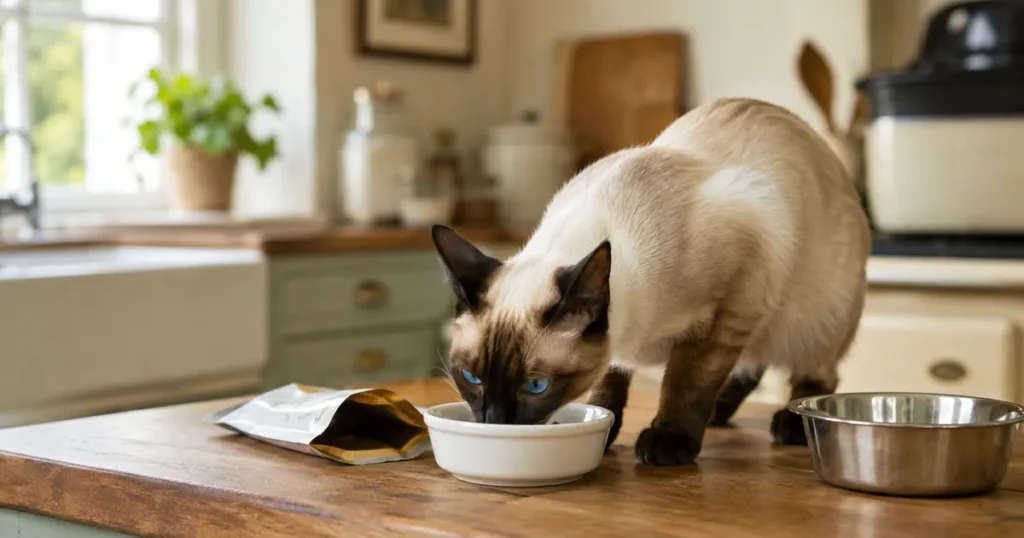
Cats are what’s called obligate carnivores. That’s a fancy biology term for “if they don’t eat meat, they literally die.” Dogs are omnivores — they’ve evolved over thousands of years of hanging round human settlements to eat pretty much anything we drop, and they’ll thrive on a varied diet that can even include vegetables, grains and pulses if it’s balanced properly. Cats have not done any of that. Cats are still — biologically speaking — tiny little tigers in a different shape.
This matters for two very specific reasons.
First, cats need taurine. Taurine is an amino acid that cats cannot make for themselves in anywhere near the quantities they need, which means they have to get it from their food. Where does taurine come from? Meat. Specifically the muscle meat and organs of animals. A cat fed on a taurine-deficient diet will, over time, go blind and develop a fatal heart condition called dilated cardiomyopathy. This isn’t speculation — it’s well-documented veterinary science and it’s the reason proper cat food is a regulated thing.
This is also the exact reason that feeding cooked chicken as the main meal every day is not recommended. I get asked this one constantly by new kitten buyers — “my cat loves chicken, can I just feed her chicken?” No. Plain cooked chicken is not a complete diet. It’ll keep a cat alive for a while, but it’s missing taurine in the right quantities, it’s missing the fats, it’s missing the vitamins and minerals, and long term it will cause serious problems. Chicken is a treat. Chicken is not a meal. There’s a difference and it genuinely matters.
Second, cats need a much higher proportion of protein in their daily food than dogs do. Somewhere between 35% and 50% of their diet should be animal protein. Dogs can get away with much less. So even a really well-intentioned owner who tries to feed their cat a sort of “rounded” diet of meat and vegetables and grains is often still under-feeding the protein their cat actually needs — while simultaneously over-feeding carbs the cat doesn’t need at all.
If you only remember one thing from this entire article, remember this: a cat’s body expects to be fed meat. The closer your cat’s food is to that, the better your cat will do.
“Complete” vs “complementary” — the label that actually matters
Right. If you take nothing else away from this whole guide on cat nutrition, take this bit.
Every commercial cat food sold in the UK has to be labelled either “complete” or “complementary”. This is a legal requirement, it’s printed on every single packet, and it tells you the single most important thing about whether that food is actually safe to feed as a main meal.
- Complete — contains all the nutrients, minerals, vitamins and amino acids your cat needs. You can feed this as the whole of your cat’s diet and she’ll be fine.
- Complementary — does not contain everything your cat needs. It’s meant to be given as a treat or alongside a complete food. If you feed a complementary food as a main meal, your cat will be missing nutrients — quickly with some, slowly with others, but missing them either way.
You’d think this would be made obvious on the front of the pack. It isn’t. It’s usually printed in very small letters on the side or the back, tucked in with the feeding guide and the barcode. Lots of very expensive, very pretty-looking “premium” pouches and tins turn out to be complementary foods when you actually read the label. Including some brands you’ve absolutely heard of.
The things cats absolutely love — the lick-in-gravy pots, the fancy shredded fillet pouches, the jelly-covered strips that come out of a tin like a little gift — a surprising number of them are complementary. They taste brilliant because they’re essentially cat sweets. Feed them too often as meals and your cat is going to end up short on things she needs.
So here’s the rule, and I tell every single new kitten buyer this at handover: the main part of your cat’s diet must be a “complete” food. Full stop. Treats can be anything. Little pots of the fancy stuff once a day, fine. Half a tin of tuna as a Sunday treat, fine. But the backbone of what they eat every day — the food they’re actually relying on for nutrition — needs that “complete” label. If it says complementary, it is not a main meal. It is a pudding.
How to actually read a cat food label (it’s simpler than you think)
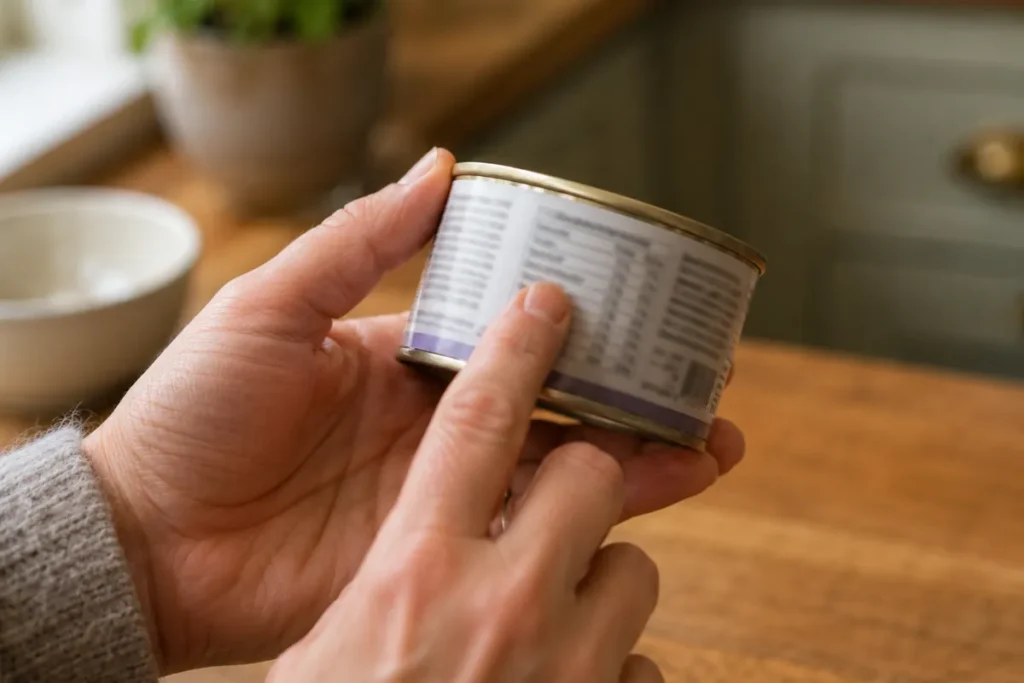
Pick up any tin or pouch in the pet aisle and flip it over. Cat nutrition labelling tells you everything you need to know — but only if you know how to read it. You’re looking for three things.
One: the first ingredient. Ingredients on cat food are listed in descending order of weight, which means whatever’s at the top of the list is what there’s most of in the food. You want the first ingredient to be a named meat. “Chicken.” “Salmon.” “Beef.” Not “meat and animal derivatives”. Not “meat by-products”. Not “cereal”. Not “ash”. A proper cat food should lead with a protein you can identify, ideally with a percentage next to it — “chicken 45%” is good, “with chicken” on the front of the pack with chicken sitting at number six on the ingredients list is not.
Two: the “ash” content. This one catches people out constantly. Ash on a cat food label doesn’t mean there’s literal ash in the food (though I know it sounds like it). It’s the mineral residue that’s left when you burn off all the organic matter in a lab — bones, minerals, that sort of thing. A small amount of ash is fine and actually necessary. A lot of ash tells you the food has been bulked out with low-quality ingredients like bone meal instead of actual meat.
The cheaper the food, generally the higher the ash. You’re looking for under about 3% for wet food, under about 8% for dry. If a tin’s ash content is up in the double digits, you’re basically paying for ground-up bones.
Three: whether it’s complete or complementary. Find that one word on the pack. If you can’t see it, it’s usually somewhere near the feeding guidelines. If there’s no labelling at all, put it back on the shelf — that alone is a red flag.
That’s it. Three things. First ingredient, ash percentage, complete or complementary. You can do a label check in about fifteen seconds once you know what you’re looking for, and it will instantly tell you whether the food is worth the shelf price.
(While I’m on ingredients — any time you see “meat and animal derivatives” listed without a specific animal named, that means the manufacturer is buying whatever meat waste is cheapest that week and putting it in the tin. It might be chicken. It might be beef. It might be something you’d rather not think about. There’s nothing illegal about it and it’s not automatically bad, but if a brand is confident in what they’re putting in the food, they tell you. If they’re hiding behind a vague phrase, there’s usually a reason.)
Wet, dry, or raw — what I actually feed mine
Here’s the part of every cat nutrition article where the writer usually goes all diplomatic and says “all three have their merits and you should decide based on your lifestyle”. That’s true, but it’s also a cop-out, so I’ll tell you what I actually do at Burnthwaites — and why.
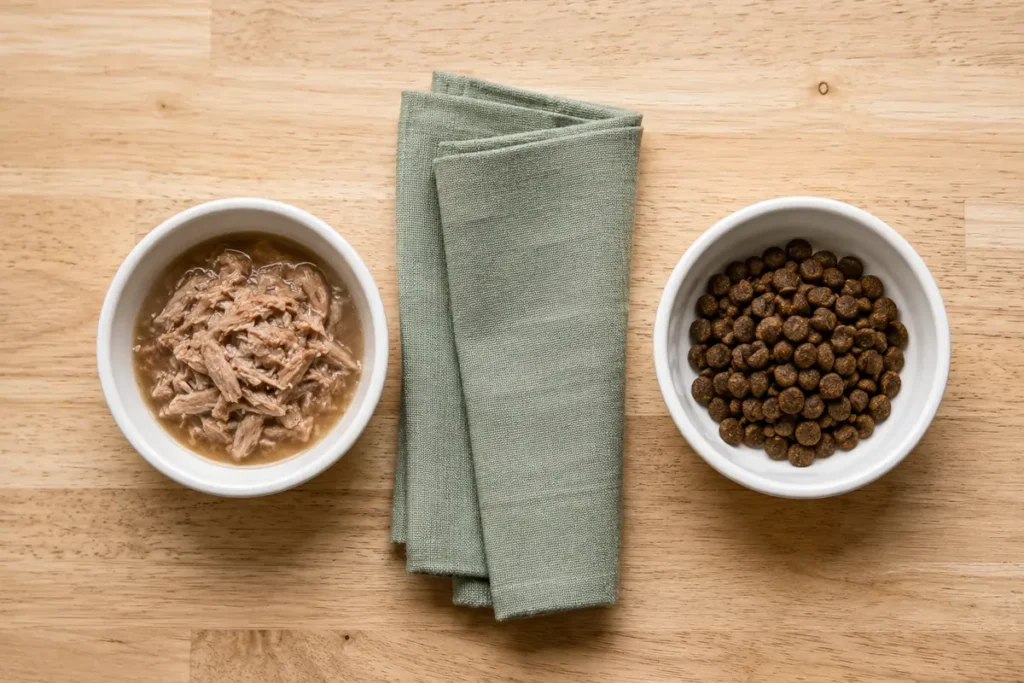
My cats get a premium, high quality dry food available all day (so they can graze — Siamese are grazers, not gulpers), plus a helping of high quality wet food each day, where the first ingredient is a named meat and the meat content is north of 90%. On top of that, their diet gets supplemented with whatever meat we happen to be having for tea that night. Not a scrap of meat on a cooked chicken is wasted in my household, and my Siamese and Oriental cats particularly enjoy this treat. They also love a helping of fish — salmon and trout are the favourites.
That’s the approach and it works. But let me walk you through the three main options properly.
Wet food
Wet food is the closest thing to how a cat would eat in the wild — high moisture, high protein, recognisable as meat. The water content matters more than most owners realise. Cats evolved in desert conditions and their thirst drive is weaker than a dog’s, which is why a lot of cats drink nowhere near enough water. Feeding wet food puts moisture into them via their meals, which supports kidney health and reduces the risk of urinary tract problems — especially in male cats, who are more prone to blockages.
Good wet food should have a named meat as the first ingredient, a meat content of 60%-plus (ideally 90%-plus for the top stuff), and the word “complete” somewhere on the label. If it’s complementary, it’s not a meal, it’s a treat. I don’t care how fancy the packaging is.
Dry food (kibble)
Dry food is convenient, long-lasting once the bag is open, cheaper per serving than wet, and lets cats graze across the day — which suits a multi-cat household like mine enormously. The downside: it’s low moisture, so cats on a dry-only diet need to be proper drinkers or you risk urinary problems creeping up over time.
Good dry food is almost always going to be more expensive than the stuff piled up in the supermarket. There’s no way round this. Cheap kibble bulks itself out with cereals and plant proteins to keep the price point down, and cats don’t need either of those things. Premium dry food has a high meat content (40%+), named meats rather than “animal derivatives”, and no added sugar (yes, some cheap dry foods have added sugar — read the label). You’re looking for brands that publish their full ingredient list and their AAFCO or FEDIAF nutritional standards statement without making you dig for it.
Raw food
Raw feeding has become fashionable over the last few years and I’m going to give it a careful, honest answer rather than a cheerleading one: it can be excellent, and it can also go very wrong very fast.
Done properly, a raw diet is biologically the closest thing a domestic cat can get to what its ancestors ate. Done badly — unbalanced, unhygienic, or without the right vitamins and minerals — and you can cause the exact same deficiencies I warned about at the start of this article. Taurine deficiency. Calcium/phosphorus imbalance. Nasty bacterial infections in the cat (and the owner, potentially). Raw bones splintering.
If you’re going to raw feed, my strong recommendation is to buy a commercially prepared, complete, frozen raw food from a reputable UK supplier rather than trying to DIY it from the butcher’s counter. Nutriment, Cotswold Raw and Purrform are three that I know breeders who trust. Store it properly, handle it cleanly, and transition slowly. And genuinely — if the thought of that sentence already sounds like too much faff, stick to a premium wet and dry combo. Raw isn’t for everyone and a well-fed cat on premium tinned food will live a perfectly long and healthy life without ever seeing a chunk of raw chicken wing.
Kittens, adults, and seniors — feeding the life stages
Cat food isn’t one-size-fits-all and the packaging usually tells you which stage it’s formulated for. Here’s the short version of what changes at each stage.
Kittens (under 12 months) need about twice as many calories per kilo of body weight as adults do, plus more protein, more fat, and more of certain vitamins and minerals for growth. Kitten food is formulated with all of this baked in, which is why you shouldn’t just feed a kitten whatever the adult cat is eating. A kitten on adult food will grow, but not as well, and you’ll sometimes see it in the coat quality and the skeletal development later.
Feed kitten-specific food until about 12 months, small frequent meals (4 times a day when they’re tiny, down to 2-3 times by 6 months), and don’t stress if they wolf food and then vomit it back up — that’s almost always “ate too fast”, not an illness.
Adults (1-7 years) are on cruise control. Feed a complete, high-quality food once or twice a day, weigh them every few months, and adjust portions if they start to lose or gain condition. Most adult cats do well on roughly 50-70g of wet food plus 30-50g of dry per day, but use the feeding guide on the pack as a starting point and then adjust based on what the cat actually looks like. A fat cat is not a healthy cat. A skinny cat is not a healthy cat. You want to be able to feel the ribs without a thick layer of fat, but not see them.
Seniors (7+ years) often benefit from a senior-formulated food, which is usually slightly lower in calories, slightly higher in certain joint and kidney-supporting nutrients, and sometimes a bit easier to chew. Older cats are also more prone to kidney issues, so the moisture boost from wet food becomes even more important. And an older cat who suddenly loses weight or stops eating is always a vet visit — it almost never turns out to be nothing.
Water (the bit everybody ignores)
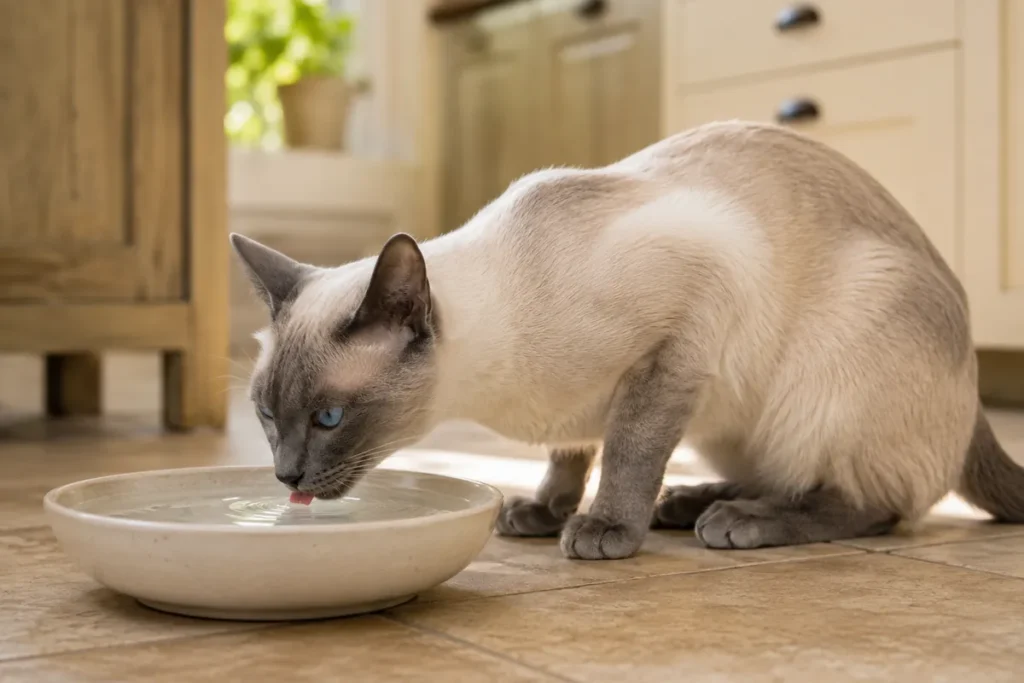
Speaking of water — there’s one bit of cat nutrition almost everyone forgets, and it’s the most basic one of all. Can we have a quick word about cats and drinking?
Cats are famously bad at drinking enough water. Their thirst drive is genuinely low and in the wild they would get most of their moisture from the prey they eat. Which is fine, except that a lot of modern cats live on dry food and then don’t drink enough to make up the difference. Over time this can put a strain on the kidneys and contribute to urinary tract problems.
Three practical things that genuinely help:
- Don’t put the water next to the food. Cats don’t like drinking where they eat — it’s an instinctive leftover from not wanting to contaminate their water supply with meat residue. Put the water bowl in a completely different spot from the feeding station. You’ll see an instant difference with most cats.
- Use a wide, shallow bowl. Cats hate their whiskers touching the sides of a narrow water bowl. The narrow plastic bowls that often come with cat dishes are the worst offenders. A wide ceramic bowl or a proper cat fountain bowl is much better.
- Consider a water fountain. Running water is more attractive to cats than still water — again, wild instinct. A cat fountain will usually double the amount a fussy cat drinks. Not essential, not magic, but they help.
And if you ever notice your cat drinking a lot more than usual — much more than usual, consistently — that’s a vet visit. Sudden increased thirst is one of the big warning signs for diabetes, kidney disease and hyperthyroidism in cats. Catch those early and a lot of them are very manageable. Miss them and they get serious fast.
The mistakes I see owners make again and again
I’ve lost count of the number of new kitten buyers I’ve had turning up with a bag of what I can only describe as “gateway-drug cat food” — the cheapest possible thing at the supermarket, usually with a cartoon cat on the front, promising “beef flavour” and delivering a lot of grain and about 4% actual meat. So here are the classic cat nutrition mistakes I see most often, in no particular order.
- Buying purely on price. I understand — cost of living, I’m not made of money either — but cheap cat food is a false economy. Your cat will eat more of it to get the same nutrition, you’ll go through bags faster, and the vet bills from the long-term health consequences will cost ten times what you saved. Spend a bit more, feed a bit less, save in the long run. I know that sounds like sales talk but I promise you it isn’t.
- Free-feeding wet food. Wet food left in a bowl goes off fast, attracts flies, and cats will often refuse it once it’s been sitting out for more than an hour or so. Portion it, serve it, take the bowl away when the cat has finished (or when the mealtime is over). Dry food can stay down all day — wet food cannot.
- Sudden diet changes. If you want to switch foods, do it over about a week. Mix the new food into the old food in increasing proportions — 25% new for two days, 50% for two days, 75% for two days, 100% on day seven. Cats have sensitive digestive systems and a sudden switch is a reliable way to produce a tray full of disappointment at 4 a.m.
- Using milk as a treat. Adult cats are largely lactose intolerant. That saucer-of-milk image from old cartoons will give most cats an upset tummy and give some of them full-blown diarrhoea. If you want to give them a milky treat, the lactose-free “cat milks” sold in the pet aisle are fine in small amounts. Regular cow’s milk is not.
- Tuna, every day. Tinned tuna is not a balanced cat food. It’s high in mercury, low in taurine compared to proper cat food, and cats can become addicted to it to the point of refusing anything else — which then causes the nutritional problems on top. Once a week as a treat, fine. Every day as a main meal, definitely not.
- Cat food from the clearance aisle. Out-of-date cat food can lose its nutritional value (particularly vitamin content) and sometimes the fats go rancid in a way that makes cats refuse to eat it. Save the bargain-hunting for your own shopping.
- “But she loves it!” Cats also love jelly pots of pure gravy that have the nutritional profile of a sweet shop. “She loves it” is not a reason to feed something as a main meal. Your toddler would also eat ice cream for every meal if you let them — that doesn’t make ice cream breakfast food. Treats are treats. Meals are meals. Don’t confuse the two.
Feeding a cat is a bit like feeding yourself
I know how I would feel if I found out that all I was going to eat for the rest of my life was ham sandwiches. Turns out cats feel exactly the same way — and it’s where good cat nutrition starts shading into something even more important: variety.
Variety matters. Not wild swings in diet (see: sudden changes, above), but a bit of rotation within the “complete” food category. A cat that only ever eats one brand of one flavour of one type of food is more likely to become a fussy adult, and if that one food ever gets discontinued or reformulated you’re in trouble. I feed my cats three or four different flavours of wet food in rotation, keep the dry food consistent, and supplement with real meat scraps from family dinners. It works.
Money need not be wasted on expensive commercial cat treats either. Little pouches of “treats” are marked up enormously for what they are. A scrap of cooked chicken, a flake of leftover salmon, a tiny bit of the cheese off the top of your pasta bake — these are all better treats than anything in a foil packet at twice the price. After all, every good Siamese out there would always much rather have what you had on your plate than what’s in a cardboard box on the shelf.
Two things to avoid giving them from the human table, though, and this is important: onions and garlic (both toxic to cats, including onion powder in cooking), and grapes and raisins (also toxic). A scrap of plain roast chicken is fine. A scrap of your spag bol is probably not fine because of the onion. Worth knowing before you start dishing out dinner leftovers.
When to talk to your vet (not the internet)
I’m a breeder, not a vet. Nothing in this article is a substitute for actual veterinary advice, and there are specific situations where you need to stop scrolling and ring your own vet rather than take nutrition tips from a stranger on the internet.
See your vet if your cat:
- Suddenly stops eating (more than about 24 hours is a red flag, especially in an overweight cat — cats can develop a nasty liver condition from going too long without food).
- Is losing weight without you deliberately feeding them less.
- Is gaining weight rapidly on the same food and same routine.
- Is suddenly drinking much more than usual.
- Has ongoing digestive problems — persistent vomiting, diarrhoea, or changes in stool.
- Has a medical condition like kidney disease, diabetes, hyperthyroidism or food allergies that needs a prescription diet. These diets exist for a reason and they genuinely help — but only the vet can decide if your cat needs one.
The vet isn’t the enemy. A good vet will work with you on nutrition, and if they recommend a prescription diet for a diagnosed condition they’re not trying to upsell you — they’re genuinely trying to manage a medical problem with food. Listen to them.
Bringing home a kitten? Don’t wing it.

I wrote an eBook for new kitten owners that covers everything you actually need to know — how to prepare your home, what to feed, litter training that actually works, stopping the biting and scratching, reading your kitten’s body language, and what’s normal versus what’s not. It comes with printable checklists, a vaccination record and a first-week diary.
It’s called Kitten Care for New Cat Owners, it’s an instant download, and it will save you a lot of late-night Googling at 4am.
Key Takeaways
- Cats are obligate carnivores. They need meat, taurine and a high protein diet — you cannot substitute with a home-cooked chicken bowl or a “rounded” diet with lots of veg and grains.
- The word “complete” on the pack is the most important word on the label. If it says complementary, it’s a treat, not a meal. Full stop.
- Read three things on every label. First ingredient (should be a named meat), ash content (lower is better), and complete-vs-complementary. Takes 15 seconds.
- Premium food is cheaper in the long run. Your cat eats less of it, stays healthier, and your vet bills go down. You get what you pay for with cat food almost every time.
- Wet food, dry food or both can work. A combination of premium wet and premium dry is what I feed at Burnthwaites, and it’s what I’d recommend to 90% of owners.
- Raw feeding can be great — or disastrous. If you go raw, buy a commercially prepared complete raw food, not DIY from the butcher. And if it sounds like too much hassle, a premium wet and dry combo is just as healthy.
- Feed for the life stage. Kittens need kitten food until about 12 months. Adults cruise. Seniors benefit from senior formulations and more wet food for kidney support.
- Water matters more than most owners realise. Separate bowl from the feeding station, wide and shallow, consider a fountain. And any sudden increase in thirst is a vet visit.
- Variety (within reason), no onions or garlic, no tuna as a main meal, no cow’s milk. Treats are treats, meals are meals. Don’t let your cat train you into feeding them the wrong thing just because “she loves it”.
If you’re bringing a kitten home and you want a proper, practical guide to the first few weeks and beyond — not generic internet advice, but the stuff that actually matters — my Kitten Care eBook covers everything you need. It’s £12.99 and it’s an instant download.
Frequently Asked Questions
What is the best cat food in the UK?
There isn’t one single “best” cat food — there are lots of very good ones and the best one for you depends on your cat’s age, any medical conditions, and what your cat will actually eat. Look for a complete food where the first ingredient is a named meat (not “meat derivatives”), the meat content is 60%+ for wet and 40%+ for dry, the ash is low, and there are no cereals padding out the ingredients list. UK brands that consistently hit those boxes in the premium end include Lily’s Kitchen, Encore, Applaws, Canagan, Orijen and Acana. Whichever you pick, check the label and transition slowly from whatever the cat is on now.
How much should I feed my cat each day?
Start with the feeding guide on the pack of whatever food you’re using — it’s there for a reason, and most packs give you a range based on your cat’s weight. Typical adult cats eat somewhere between 50-70g of wet food plus 30-50g of dry per day, but it varies a lot. Weigh your cat monthly and adjust up or down based on whether they’re maintaining condition. You want to be able to feel the ribs without a thick fat pad, and see a slight waist behind the ribcage from above. If the cat is getting rounder, cut back slightly. If they’re getting bonier, feed a bit more. Don’t free-feed wet food — portion it and take the bowl away after the meal.
Can I feed my cat cooked chicken as a main meal?
No. Cooked chicken is brilliant as a treat and I feed it to my own cats all the time, but as a main meal it’s missing taurine in the right quantities, it’s missing the full vitamin and mineral profile, and long term a chicken-only diet will cause real deficiencies — including serious heart problems and vision loss. Chicken is not a complete food. A little bit as a treat, scraps off the Sunday roast, flake off the top of a cooked breast — all fine and they’ll love you for it. As the whole of their daily diet, it’s not safe. Stick to a complete commercial food for the main meals and treat the chicken as a treat.
Is wet food or dry food better for cats?
Both are fine if they’re good quality and labelled “complete”. Wet food is closer to a cat’s natural diet and gets more moisture into them, which matters for urinary and kidney health. Dry food is more convenient, cheaper per serving, and lets cats graze across the day — which suits multi-cat households and cats that like to eat little and often. The honest answer most breeders and vets will give you is “both, in combination” — a mix of premium wet and premium dry gives you the best of both worlds. I feed both at Burnthwaites and have done for twenty years.
What does “complete” mean on cat food?
“Complete” is a legal label that tells you the food contains everything your cat needs nutritionally — all the protein, fats, taurine, vitamins and minerals — so it can safely be fed as the whole of your cat’s daily diet. “Complementary” means the food is missing some of those nutrients and is intended as a treat or alongside a complete food, not as a main meal. A surprising number of very pretty “premium” pouches and pots turn out to be complementary when you actually read the label, so always check before buying. If you feed a complementary food as a main meal your cat will be missing things she needs.
Can cats drink milk?
Most adult cats are lactose intolerant and cow’s milk will give them an upset stomach or diarrhoea. The image of a cat lapping up a saucer of milk is from old cartoons, not from reality. If you want to give your cat a milky treat, the “cat milks” sold in the pet aisle are lactose-free and safe in small amounts — but even those aren’t a necessity, and they’re essentially sweets. Fresh clean water is what your cat actually needs. Kittens under 8 weeks who haven’t yet weaned should only be on their mother’s milk or a proper kitten milk replacer, never cow’s milk.
Is raw food safe for cats?
It can be excellent if it’s done properly, and it can cause serious harm if it’s done badly. Properly prepared complete raw food from a reputable UK supplier (Nutriment, Cotswold Raw, Purrform are three I know breeders who use) is as close to a cat’s natural diet as commercial feeding gets. DIY raw from the butcher’s counter is where it goes wrong — you risk taurine deficiency, calcium/phosphorus imbalances, and bacterial contamination. If raw feeding sounds like too much faff, you’re honestly better off sticking to a premium wet and dry combo. A well-fed cat on high quality tinned food will live a perfectly long and healthy life without ever seeing a raw chicken wing.
How often should I feed my cat?
Adult cats usually do well on one or two main wet meals a day, plus dry food available to graze on across the day if that suits your household. Some adult cats do better on two smaller meals a day rather than one big one. Kittens under 6 months need more frequent meals — about four a day for very young kittens, tapering down to two or three by six months. Senior cats often prefer smaller more frequent meals too. Whatever routine you pick, try to stick to it — cats are creatures of habit and they prefer knowing when the next meal is coming. Mine certainly do.