
I’ll never forget the first time a cat show judge opened my stud’s mouth and pointed out a retained baby tooth. There he was, a gorgeous seal-point Siamese, and I hadn’t even noticed it. Twenty years of breeding cats and showing them at every major show in the UK, and that moment taught me more about cat dentistry than anything I’d learned before.
The truth is, most cat owners never look in their cat’s mouth. Not properly. We stroke them, groom them, admire their pretty faces — but we don’t actually examine their teeth. And that’s a problem.
Cat teeth aren’t just for show (though they look lovely). They’re working tools, and when they go wrong, your cat suffers. Bad breath, pain when eating, pawing at the face, refusing food — these are signs I’ve seen too many times in my cattery, signs that could have been spotted early if someone had simply opened the cat’s mouth and looked.
This article is about preventing that. It’s about understanding what’s in your cat’s mouth, why things go wrong, and how to spot problems before they become emergencies. Because unlike humans, cats can’t tell us their teeth hurt.
And yes — if you’re a breeder showing cats — judges will be opening your cat’s mouth anyway. You might as well be the one to get there first.
Quick Answer: Around 80% of cats over three years old have some form of dental disease. Siamese cats are particularly prone to oral problems. Early signs include bad breath, drooling, pawing at the mouth, or reluctance to eat. Regular home checks and a diet with some dry food can help prevent serious problems. If you spot retained baby teeth, incorrect bite, or signs of disease, see your vet — dental work costs £200–500+.
👇 Skip to the 8 things cat owners need to know about cat teeth
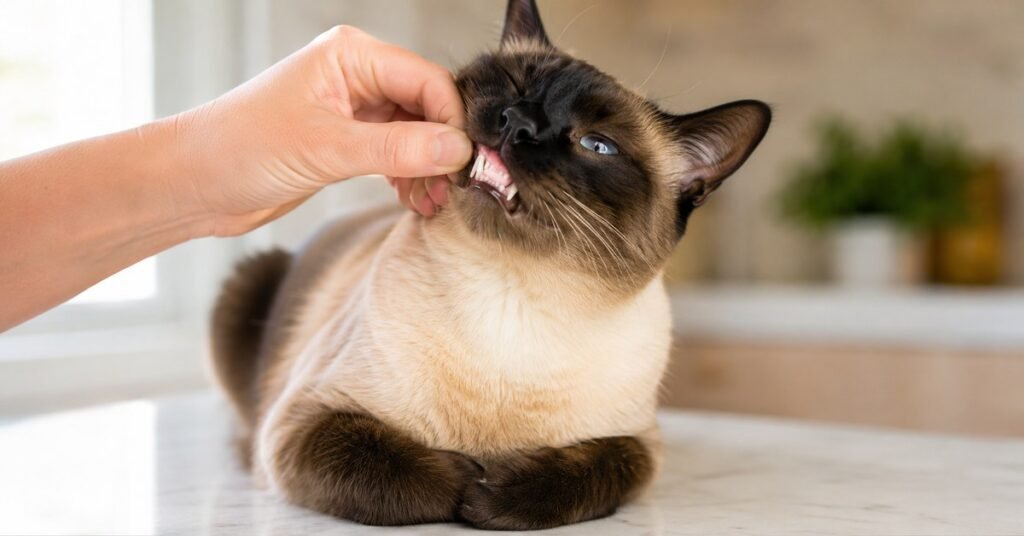
Why Cat Dental Care Matters More Than You Think
Here’s a stat that shocked me when I first heard it: about 80% of cats over three years old have some form of dental disease. Eighty percent. That’s not “most cats” — that’s “virtually all cats” if we’re being honest.
Now, some of that is preventable. Some of it is age, genetics, and diet. But here’s what matters: if you’re a Siamese breeder like me, or you own a Siamese, an Abyssinian, or any Oriental breed, your cat is already at higher risk of oral problems. It’s one of those breed-specific things nobody talks about until it’s too late.
Dental disease isn’t just about bad breath (though that’s usually the first sign). It’s about infection spreading to the jaw, pain that stops your cat eating properly, tooth loss, and in serious cases, infection reaching the bloodstream. A £30 toothbrush habit now beats a £500 vet bill later.
Understanding Your Cat’s Teeth: The Anatomy Bit (Don’t Worry, It’s Painless)
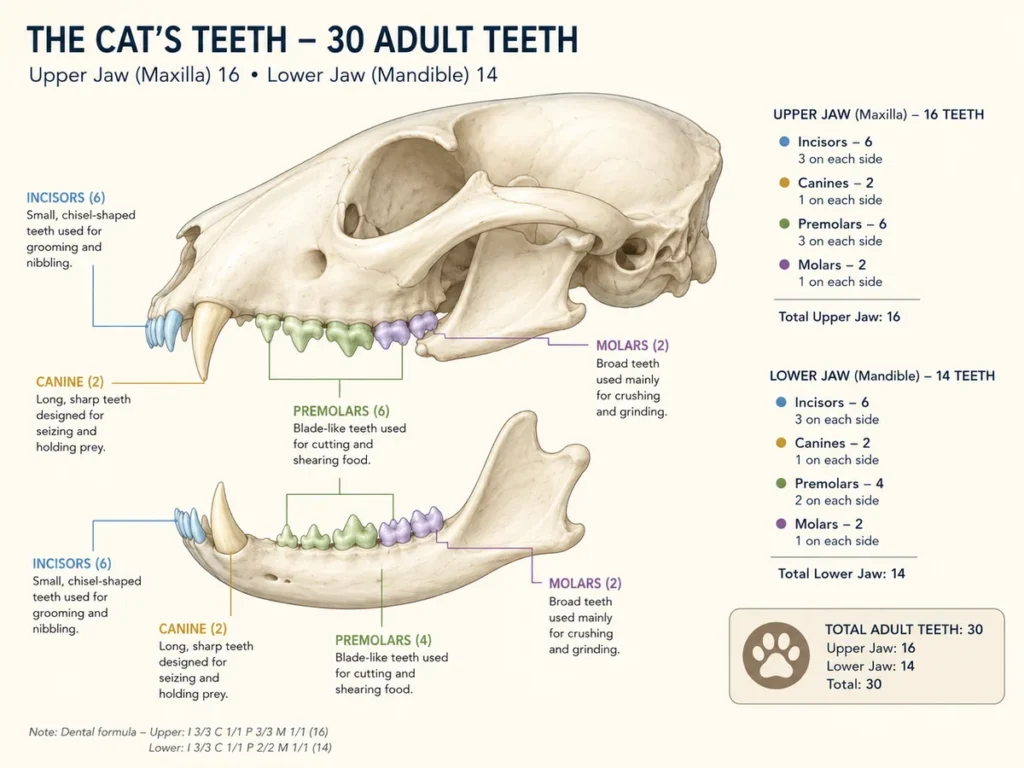
Kittens are born without visible teeth. Around 2–3 weeks, their baby teeth start coming in. These are called deciduous teeth or milk teeth, and kittens end up with 26 of them — 14 on the upper jaw, 12 on the lower.
Then, around 3–4 months old, the permanent adult teeth start erupting. Those baby teeth are supposed to fall out to make room. By about 6–7 months, your kitten should have all 30 adult teeth — 16 on the upper jaw, 14 on the lower. That’s four more than they started with.
Here’s what’s important to know: a cat’s teeth are nothing like ours. They don’t have flat grinding surfaces. They have sharp cusps designed to grip, tear, and slice — they’re carnivore teeth. A cat’s molars, in particular, are like tiny scissors. That’s why a cat’s bite is so efficient, and why dental problems in cats can escalate quickly.
Retained Baby Teeth: The “Double Dentistry” Problem
This is the one thing I wish every breeder knew about.
Sometimes, a kitten’s baby teeth don’t fall out when the adult teeth come in. Instead, you end up with two teeth in the same spot — one baby, one adult, both trying to occupy the same space. It’s called a retained deciduous tooth, or “double dentistry.”
I’ve seen this in my cattery several times. The first time, I thought it was normal until one of my queens started refusing wet food and grinding her teeth. That’s when I realised something was wrong.
Signs of retained baby teeth include:
• Bad breath (often the first sign)
• Drooling or excessive salivation
• Pawing at the mouth or face
• Grinding teeth
• Reluctance to eat, especially hard food
• A visible double row of teeth (if you look closely)
What to do if you spot it: Don’t wait. Book a vet appointment. Sometimes a retained baby tooth will eventually fall out on its own, but more often, it needs extracting. Feeding dry kibble can sometimes help loosen stubborn baby teeth — the mechanical action of chewing does help — but this isn’t a reliable cure.
The vet will extract it under anaesthetic, usually as a quick procedure. Costs vary, but expect £150–300 depending on how firmly the tooth is rooted.
Incorrect Bite: When Your Cat’s Teeth Don’t Line Up
Here’s something I check at every kitten assessment: the bite.
A cat’s bite should be a scissor bite — the upper front teeth slightly overlap the lower front teeth. It’s clean, efficient, and painless for the cat. But not all cats have perfect bites.
The three main bite types are:
Scissor bite (normal): Upper incisors slightly overlap the lower incisors. This is what you want to see.
Overshot or “long jaw”: The upper jaw is too long, so the upper front teeth protrude noticeably beyond the lower teeth. The lower teeth don’t touch the upper teeth at all. In show cats, this is a serious fault. In pet cats, it can cause eating difficulties and may need orthodontic correction in severe cases.
Undershot or “short jaw”: The lower jaw is too long, so the lower front teeth protrude beyond the upper teeth. Again, this is a show fault and can cause functional problems — the lower teeth can actually rub against the roof of the mouth, causing sores.
If you’ve got a kitten with an obvious bite problem, mention it to your vet. Mild cases often don’t cause issues, but severe ones can affect eating and lead to dental wear.
Signs Your Cat Has Dental Problems
Bad breath is the big one. I know cat breath isn’t supposed to smell like roses, but if it’s genuinely foul — that rotten, decay smell — something is wrong.
Other warning signs:
• Reluctance to eat, especially hard food or treats
• Dropping food while eating
• Excessive drooling
• Pawing at the mouth or face repeatedly
• Swelling around the jaw or cheek
• Visible red or inflamed gums
• A loose or discoloured tooth
• Behavioural changes — grumpiness, reluctance to be touched on the head
If you see any of these, don’t assume it’ll go away. Dental disease in cats gets worse, not better. Book a vet appointment.
How to Check Your Cat’s Teeth at Home
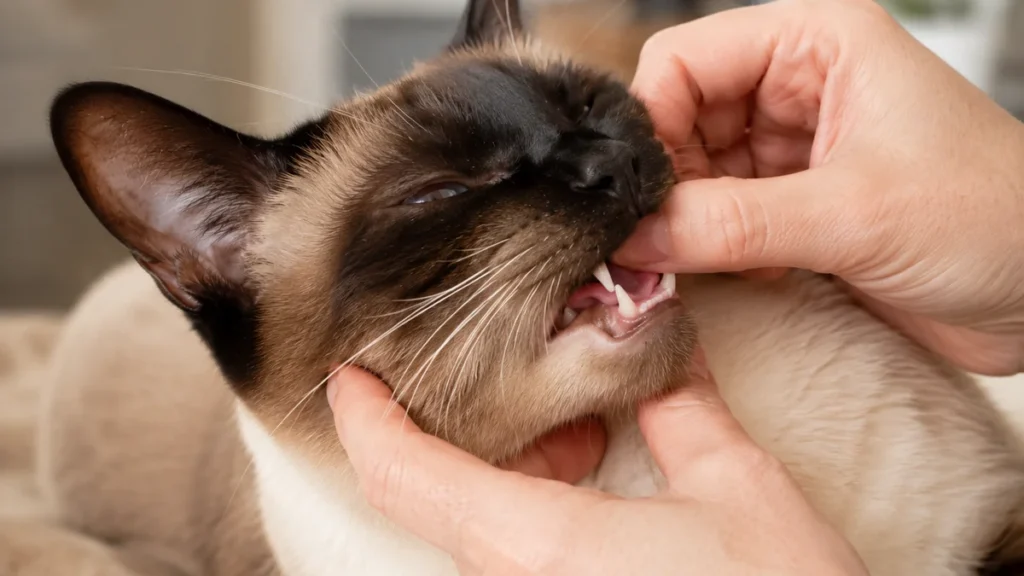
This is the most practical thing you can do, and honestly, it takes 30 seconds.
The process:
Start when your cat is relaxed. Don’t ambush them mid-sleep and yank their mouth open — that’s how you get bitten. Instead, sit quietly with them, maybe give them a treat, and let them settle.
Gently lift their lip on one side (just like you’re giving them a cheeky smile). Look at the gums — they should be pink, not red or swollen. Look at the teeth themselves — are they clean or are they discoloured? Are any loose? Do you see a double row of teeth?
Check both sides. Then, if your cat will tolerate it, gently open their mouth a bit wider and peek at the back teeth. The molar area is where problems often hide first.
If your cat’s not having it, don’t force it. The important bit is checking the front teeth and gums regularly — even once a month makes a difference because you’ll notice changes early.
Special note for breeders and show owners: Get your kittens used to having their mouths handled young. Show judges will open their mouths, and if your cat panics, that’s a mark against you. Plus, you’ll be able to check their teeth regularly.
Cleaning Your Cat’s Teeth: The Honest Truth
Let’s be real: brushing a cat’s teeth is hard.
It’s not impossible — some cats will tolerate it — but it’s not easy, and it’s not something every cat owner can do. I’ve tried with my show queens. Some of them will let me brush their teeth for maybe 10 seconds before they’ve had enough. Others won’t tolerate it at all.
If you want to try, you’ll need a cat-specific toothbrush (tiny, soft bristles) and cat toothpaste (never human toothpaste — the fluoride can be toxic to cats). Start by just letting them lick the paste off your finger. Gradually introduce the brush. Aim for a few times a week, even if it’s only 10 seconds at a time.
But here’s the thing: if your cat absolutely won’t cooperate, don’t stress. Diet and regular home checks matter more than you think. And if you do want to pursue tooth cleaning, your vet can do a professional clean under anaesthetic — it’s pricey (£300–500+) but extremely thorough.
There are also dental treats and water additives marketed for cats, but the evidence that these actually prevent serious dental disease is weak. They’re not harmful, but they’re not a substitute for proper care.
Diet and Dental Health: Dry vs. Wet Food
There’s a myth that wet food is terrible for cat teeth and dry food is a cure-all. The reality is more nuanced.
Dry kibble does provide some mechanical action that helps clean teeth — the friction of chewing does matter. But it’s not enough on its own to prevent dental disease. And wet food is absolutely necessary for many cats, especially those with dental problems or senior cats.
What actually matters more is the quality of the food and the cat’s genetics. A cat on premium, species-appropriate food with good ingredients will have better dental health than a cat on cheap, grain-heavy kibble — regardless of the texture.
If your cat has existing dental issues, feeding some dry food can help (the chewing action), but don’t switch to 100% dry if your cat prefers wet. A combination is fine, and a cat that eats well is healthier than one that refuses food.
Dental treats marketed for cats (like those enzymatic chews) might help slightly, but again — they’re not a replacement for actual care.
When to See the Vet — And What It’ll Cost
You should take your cat to the vet for a dental check if you notice any of the warning signs mentioned earlier — bad breath, drooling, pawing at the mouth, reluctance to eat, visible tooth problems.
You should also have your vet check your cat’s teeth at their annual health check. It’s easy to miss early dental disease, and vets are trained to spot it.
Cost expectations:
• Basic vet dental exam: £30–60 (included in most annual check-ups)
• Professional dental cleaning under anaesthetic: £300–600 depending on your vet and how much work needs doing
• Tooth extraction: £150–300 per tooth (retained baby teeth are usually cheaper than extracting diseased adult teeth)
• Pre-anaesthetic blood work: £100–150 (recommended especially for older cats)
If your cat has serious dental disease with multiple extractions needed, you could be looking at £500–1,000+. So yes, preventing problems is much cheaper than treating them.
Siamese Cats and Dental Problems: Why They’re at Higher Risk
I mentioned earlier that Siamese and Oriental breeds are more prone to dental issues. I’ve seen this firsthand in my cattery.
The exact reasons are complex — it’s partly genetic predisposition, partly jaw structure (Siamese have narrower jaws, which can affect bite and tooth spacing), and partly metabolism. But the bottom line is: if you own a Siamese, Tonkinese, Abyssinian, or any Oriental breed, dental care should be a priority.
Check their teeth more frequently. Watch for early signs more carefully. Be proactive about vet visits.
If you’re a breeder, this is especially important — you don’t want to perpetuate dental problems in your lines. Work with your vet to understand which of your cats have hereditary bite issues, and be thoughtful about your breeding decisions.
What I’ve Actually Learned (After 22+ Years at Burnthwaites)
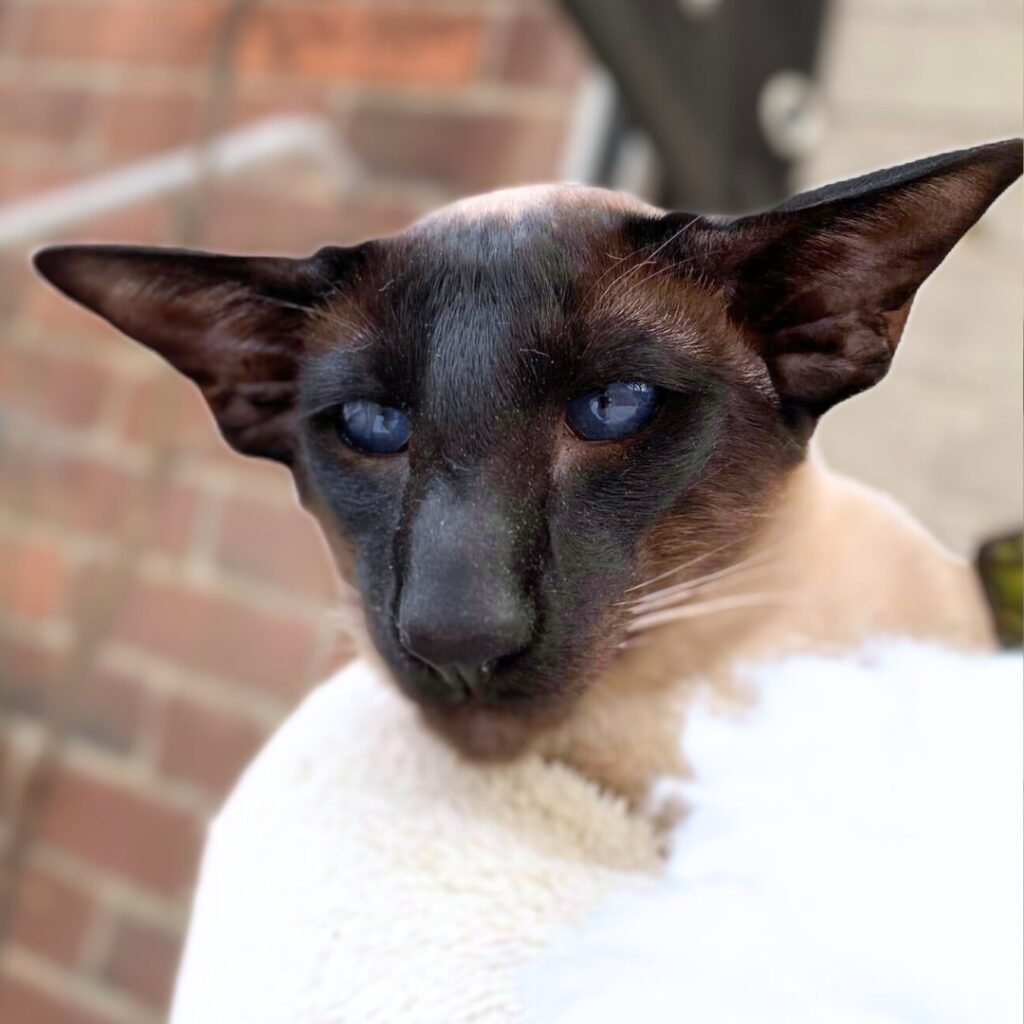
Right. The textbook stuff covers what dental disease IS. After two decades of watching it play out across dozens of cats at Burnthwaites, here’s what I’d tell any new cat owner that the vet won’t always say.
Start brushing at 8 weeks, not 8 years. I get my Siamese kittens used to having their mouths handled the same week they come home — just a finger gently lifting the lip, no toothbrush yet. By 12 weeks, I’m using a finger-brush with cat toothpaste. By 6 months, they tolerate it without fuss. The kittens that go to homes where this never happens are the ones that, ten years later, need general anaesthetic for a scale and polish because nobody can get near their mouth. The desensitisation window is small. Use it.
Siamese teeth are a known problem. The breed has elongated, narrow muzzles that crowd the teeth — particularly the molars at the back. Plaque accumulates in those tight spaces faster than in a moggy with a wider muzzle. I’ve watched this play out across maybe twenty different Siamese over the years, and the pattern is consistent. If you’ve got a Siamese or Oriental, double the brushing frequency from “ideally daily” to “actually daily, no excuses”. You can’t out-genetic the architecture, but you can stay on top of the plaque. (Which is why dental care is one of the most important pieces of overall Siamese health management.)
Diet matters less than people claim — but it’s not nothing. I’ve fed my breeding cats premium wet diets for 20+ years and the dental outcomes are noticeably better than I saw in earlier years on cheaper kibble-heavy diets. The cats with the worst tartar in my history have all been ones on cheap dry-only food. Wet food + occasional dental treats outperforms dry food alone, in my house, consistently.
Watch the older girls. Queens past their breeding career (8+ years) are where dental disease shows up most aggressively. They’ve spent years burning through nutrient reserves for litters; their immune systems are subtly compromised compared to a never-bred pet. I now book annual vet dental checks for every retired queen, on the dot of her 8th birthday. Caught two cases of early gum disease this way that would have been miserable if left.
The first time you see a cat in real dental pain, you’ll change your habits forever. I had a girl called Misha at age 12 who developed tooth resorption — one of the most painful things a cat can have, short of trauma. The way she stopped eating, hid, lost weight in three weeks. After her extraction surgery, she was a different cat. Made me brutal about prevention from that point on. Don’t wait to learn that lesson the hard way.
Key Takeaways
- 80% of cats over three have some dental disease. It’s incredibly common, but most of it is preventable or manageable with early detection.
- Bad breath is your first warning sign. It’s not normal and indicates something is wrong — don’t ignore it.
- Kittens have 26 baby teeth; adults have 30. Around 3–4 months, permanent teeth erupt. Check that baby teeth are falling out properly.
- Retained baby teeth need extracting. If a kitten still has a baby tooth when the adult tooth is coming in, see your vet — this causes problems.
- A correct scissor bite matters. Overshot or undershot bites can cause eating difficulties and require attention.
- Check your cat’s teeth at home monthly. Lift their lip, look at the gums and teeth. It takes 30 seconds and catches problems early.
- Siamese and Oriental breeds are at higher risk. If you own one, be extra vigilant about dental health.
- Professional cleaning costs £300–600, but it’s cheaper than extracting infected teeth. Prevention matters.
Frequently Asked Questions
At what age should I start checking my kitten’s teeth?
As soon as they’re old enough to handle being touched gently — around 4–5 weeks. Get them used to having their mouth handled young. This makes vet checks easier and helps you spot problems early. Check their teeth monthly from 8 weeks onwards, especially between 3–7 months when baby teeth are falling out.
Is cat toothpaste safe?
Cat-specific toothpaste is safe because it doesn’t contain the fluoride levels found in human toothpaste. However, most cats will swallow it, so it’s designed to be safe if ingested. Never use human toothpaste — fluoride can cause problems in cats. If you’re going to brush your cat’s teeth, use a paste made for cats.
Do cats really need anaesthesia for dental work?
Yes. Cats won’t sit still for dental procedures, and even gentle cleaning can cause stress. Anaesthesia allows the vet to do a thorough job safely and without the cat being distressed. Modern anaesthesia protocols are very safe, especially with pre-operative blood work. Ask your vet about their safety protocols.
Can I use a regular human toothbrush on my cat?
A regular human toothbrush is too large and has bristles that are too stiff for a cat’s mouth. You need a cat-specific toothbrush — they’re tiny with soft bristles. You can find them in most pet shops or online. Some people also use finger brushes (which look like a rubber thimble with bristles), which some cats tolerate better.
Is bad breath normal in cats?
Cat breath isn’t going to smell like roses, but noticeable bad breath — that rotten, decay smell — is not normal. It usually indicates dental disease, mouth inflammation, or sometimes other health issues. If your cat has genuinely foul breath, see your vet. It’s one of the easiest early warning signs to spot.
Will wet food damage my cat’s teeth?
Wet food itself doesn’t cause dental disease. A healthy diet includes both wet and dry food. What matters more is the quality of the food and your cat’s genetic predisposition. If your cat prefers wet food, that’s fine — a cat that eats well is healthier than one that refuses food. Just keep an eye on their teeth and include some dry food if possible for the mechanical benefit.
How often should I have my cat’s teeth professionally cleaned?
This depends on your individual cat’s dental health. Some cats never need professional cleaning. Others might need it every 1–2 years if they’re prone to tartar build-up or gum disease. Discuss this with your vet at your cat’s annual check-up. They can assess your cat’s teeth and recommend a schedule that suits them.