Your indoor Siamese is staring at the living room wall like it owes her money.
She’s not contemplating the colour of the paintwork. She’s bored out of her skull. And when a Siamese or Oriental gets bored, mate, you’ll know about it — at 3 a.m., through the closed bedroom door, at full volume.
The guilt hits different when you know it’s your fault.
Here’s the thing: we get it. You work full-time. The garden’s not secure. Maybe there’s a busy road. Maybe you live in a flat. All valid reasons to keep your cat indoors. But “indoors” doesn’t mean “put her in a box and hope for the best.” Indoor cats need stimulation. They need enrichment. They need to use their brains and their bodies, or they’ll use them on your sofa (and your sanity).
I breed Siamese and Orientals — arguably the most demanding, vocal, and intelligent cats you can own. If there’s a way to wind one up through sheer boredom, I’ve seen it happen. But I’ve also seen what happens when you actually crack the enrichment code: a cat that’s busy, happy, and (crucially) not screaming at you at midnight.
This isn’t rocket science. And it’s not expensive. Let me show you what works.
Quick Answer: Indoor cats need active enrichment — toys, puzzle feeders, climbing spaces, and daily play — to stay happy and healthy. Most of the best stuff costs nothing (egg cartons, cardboard boxes, paper bags), takes under 30 minutes a day, and keeps your cat mentally and physically stimulated. Without enrichment, indoor cats can become bored, overweight, stressed, and destructive. With it, they thrive.
👇 Skip to the 8 things every indoor cat owner needs to know
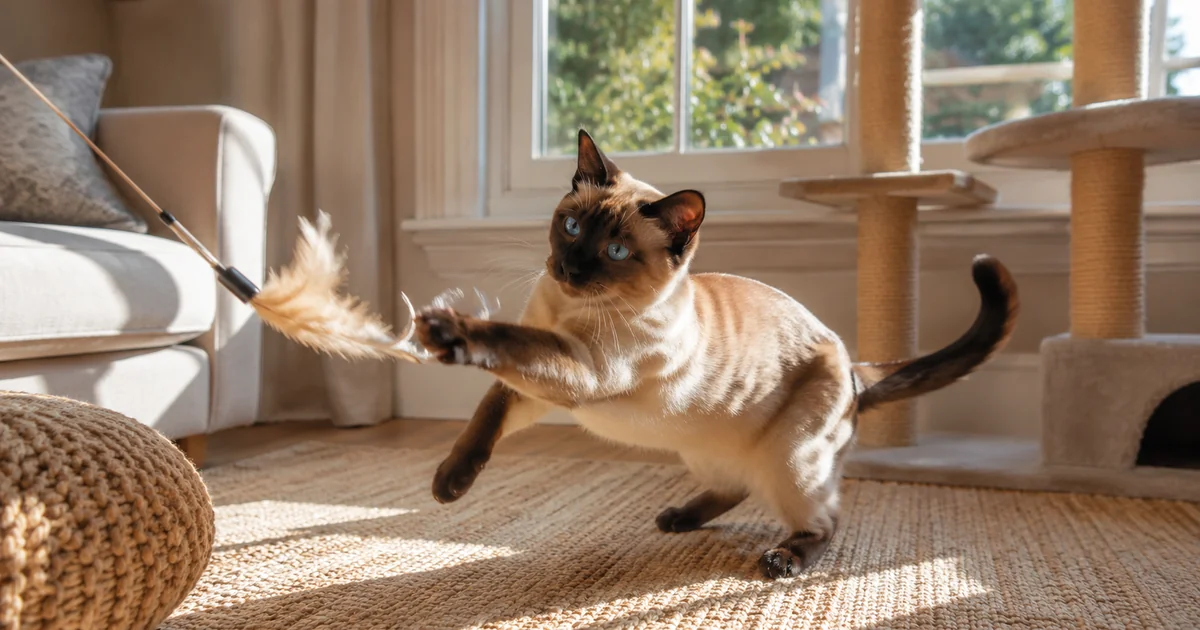
Why Indoor Cats Need More Than You Think
Let’s start with the uncomfortable truth: a cat that spends 16 hours a day sleeping on your bed is not living her best life. She’s surviving. There’s a difference.
Cats are hunters. Even your indoor Princess used to (and still does, in her DNA) stalk, chase, pounce, and kill. These aren’t violent impulses — they’re essential neurological drives. When you take away the hunting, you don’t take away the need. It just builds up like steam in a kettle.
An understimulated indoor cat doesn’t just get bored. She gets stressed. Chronically stressed.
That stress manifests in about a thousand ways: obesity (because eating is the only thing to do), excessive grooming (which can lead to alopecia and skin infections), aggression toward you or other pets, destructive behaviour, litter box problems, and — if you’ve got a vocal breed like a Siamese — absolutely relentless vocalisation. (And I mean relentless. At 2 a.m. You know what I mean.)
Research backs this up: cats with enrichment are leaner, less anxious, and less prone to behavioural issues. They also live longer, happier lives. Your cat isn’t asking for much. She’s asking for the mental equivalent of a job — something to occupy her brain and body.
The good news? It’s absurdly simple to provide.
The Free Stuff That Actually Works
Before you panic about buying expensive enrichment toys, let me tell you: your recycling bin is a goldmine.
I’ve spent years watching indoor cats (my own and my breeders’ cats) tear through fancy toys that cost £20 only to ignore them in favour of a cardboard box. Cats don’t care about your budget. They care about texture, noise, movement, and unpredictability.
Here are the free enrichment wins that actually work:
The Egg Carton Trick
When you have finished with your cardboard egg cartons pop a treat in each of the sections and put it down for your cat to ‘fish’ the treats out. Your indoor cat will love this game! It can take a very long time for your cat to get the treats out and gives them something to think about. Of course you are always going to get the smart ones that just tip the carton over but most of the time they will sit trying to shove their ‘slightly-too-fat’ paws into the gaps!
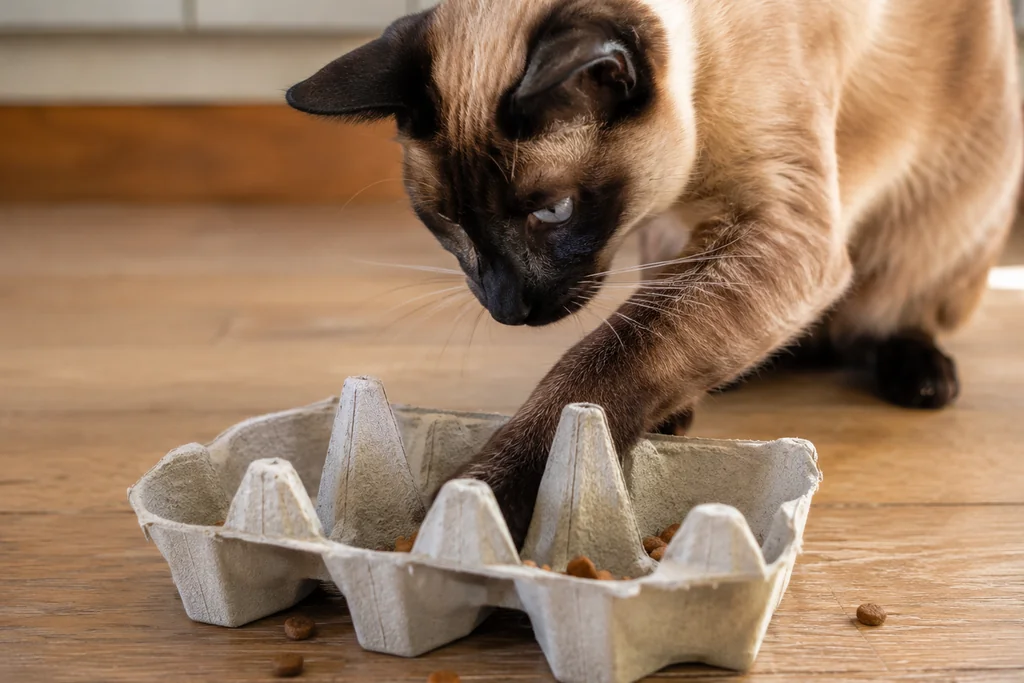
I’m not exaggerating when I say this single trick has saved my sanity more than once. There’s something about the puzzle of it — the treats are so close, but not quite within reach — that keeps cats locked in for ages. And the paw action is their hunting instinct in miniature.
The Food Hiding Game
Hide her dry food all over a room in your house. Sit back, relax and watch her spend time searching high and low, on things and under things until she is sure she has found it all!
This one’s genius because it doubles as feeding time. Instead of dumping kibble in a bowl (boring, five seconds flat), you’re turning dinner into a hunting expedition. Your cat has to use her nose, her brain, and her body. Fifteen minutes of this beats an hour of doing absolutely nothing.
Paper Bags and Rustling
Keep hold of your paper bags and cut off the handles. These can be exciting play thing for your pet cat! Rustle the bag about and watch her jump into it and pounce on it.
There’s something about paper bags that absolutely triggers the hunting response. Maybe it’s the noise. Maybe it’s the texture. Whatever it is, your cat will spend 20 minutes launching herself in and out of a paper bag like it’s the most thrilling thing that’s ever happened to her. (It probably is, if her daily life is a sofa.)
Scrunched Foil and Sweet Wrappers
My cats love to play with scrunched up foil even when there are no treats inside. There is no need to spend a fortune on expensive gadgets. Your cats will happily play with cardboard boxes and mine have been known to steal sweet wrappers! This is not that funny, particularly when the sweets are still inside!
I’ve lost count of the number of times I’ve caught one of mine mid-heist, making off with a chocolate wrapper like she’s robbed a bank. The crinkly noise, the shiny texture, the unpredictability of the thing — it’s catnip (literally not catnip, but you know what I mean). Just keep the unwrapped sweets out of reach and let her have at it.
Toilet Roll Tubes and Cereal Boxes
Save your toilet roll tubes and stuff them with newspaper or crinkled paper. Cats love batting them around, shredding them, pouncing on them. Better yet, cut cereal boxes into strips and create a “tunnel” on the floor by laying them end-to-end. Your cat will run through it like it’s an assault course.
The beauty of this stuff is that it’s so disposable. Your cat destroys it? Brilliant. Chuck it and make another one. No guilt about “wasting” a toy.
Cat Trees, Shelves, and Vertical Space
Here’s where you actually need to spend a bit of money (though not a fortune).
Cats don’t just want to move horizontally. They want to climb. They want height. They want to perch up high where they can survey their kingdom and feel safe. It’s hardwired into them.
A decent cat tree is one of the best investments you can make for an indoor cat. Look for one that’s at least 5-6 feet tall with multiple levels, scratch posts, and hiding spots. You don’t need the £200 monstrosity that looks like a tiny apartment building — a solid £50-80 tree will do the job. The key is that it’s sturdy enough not to wobble when your cat jumps on it (nothing kills interest faster than an unstable tower).
If you can swing it, install wall-mounted shelves or ledges as well. Cats absolutely love having a “highway” to run across the room at head height. It’s enrichment and exercise rolled into one.
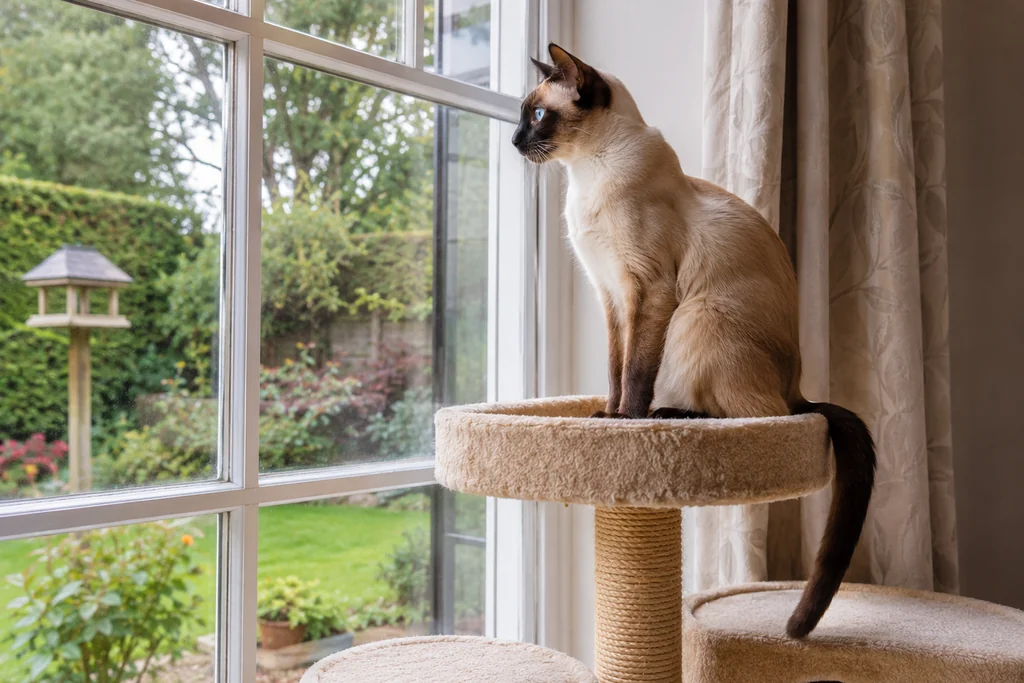
And here’s the thing nobody tells you: a window perch is basically Cat TV. Plant your tree or shelf by a window where your cat can watch the garden, birds, passing cars, delivery vans — whatever. Some cats will literally sit there for hours, utterly transfixed. That’s stimulation without you doing a thing.
The Fetch Thing (Yes, Really)
I know what you’re thinking. Cats don’t fetch. Dogs fetch. Cats are too cool for that nonsense.
Wrong. Many cats love to play fetch! Teaching your indoor cat to play fetch is relatively easy. Throw your cat’s toys to the other side of the room so that your pet cat feels stimulated by the fast movement.
This is especially true of Siamese and Orientals. We bred this into them — the drive to chase, to retrieve, to be actively involved in play. I’ve got Siamese that will fetch toy mice until I’m genuinely tired of throwing them. And the look of absolute joy on her face when that toy is flying through the air? That’s what a happy cat looks like.
The trick is using toys that move unpredictably. Toy mice. Balls. Crumpled paper balls. Anything that triggers the predatory chase instinct. Throw it, let her catch it, take it back, throw again. Just 10-15 minutes of this and you’ll have one knackered cat. (In the good way.)
And here’s the real magic: fetch creates a bond. You’re playing together. You’re part of her world, not just the person who fills the food bowl.
The Ping Pong Ball Staircase
If you have stairs in your house then try throwing a ping-pong ball up the stairs for your cat to chase up and down. Please remember to remove the ping-pong ball when you have finished playing with it! I will not be held responsible for any broken limbs that may occur if you leave it!
(That’s not actually a joke about me. I’ve just seen too many cats bonk down the stairs because someone left a ball lying around. Don’t be that person.)
But seriously — if you’ve got stairs, this is a game-changer. Ping pong balls are light, bouncy, unpredictable, and cheap. Throw one up and watch your cat launch herself after it like a furry missile. It’s cardio and entertainment wrapped into one.
Puzzle Feeders and Food Games
The egg carton trick is where food puzzles start, but it’s not where they end.
A puzzle feeder makes your cat work for her dinner. Instead of scoffing down a bowl in 30 seconds flat, she has to use her paws, her nose, and her brain to extract the kibble. It takes longer (which means her digestion benefits), it’s more stimulating (which keeps her mind active), and it triggers her natural hunting instincts.
There are loads of options — some cheap, some fancy:
Licky mats and snuffle mats. Freeze wet food or yoghurt onto a silicone mat or hide treats in a fabric “snuffle” mat. Your cat has to use her tongue and nose to extract them. Takes forever. They love it.
Treat balls. Pop kibble or treats inside and your cat has to roll it around to get them out. Simple, cheap, and it gets them moving.
DIY puzzles. Muffin tins with ping pong balls in each cup. Toilet roll tubes folded closed with treats inside. A box with holes cut in it and treats hidden in various compartments. Your creativity is the only limit here.
The philosophy is simple: make her work for it. Not to be cruel, but because work is enrichment. Work is what her ancestors did all day. Work is what keeps her brain happy.
The Great Outdoors (Safely)
Sometimes, though, you have to admit: an indoor-only life has limits.
If you can safely give your cat access to the outdoors — without the risks of traffic, predators, or disease — that’s the gold standard of enrichment. There are ways to do this.
If you are a little worried about what your neighbours might think of you if they see you taking the cat for a walk, then consider cat-proofing your garden or consider building a cat run.
Yes, cat walking is a thing. And yes, it does look a bit daft (I won’t lie to you). But if your cat’s comfortable in a harness and on a lead, even a short walk around the garden or a loop down the street can be absolutely transformative for her mental health. She gets new smells, new sights, new stimulation. For an indoor cat, it’s like a holiday.
If lead-walking feels like a step too far, a cat run is brilliant. It’s basically a large enclosed space (usually made of metal frames and mesh) that sits in your garden and lets your cat be outside safely. No predators, no traffic, no risk of escape. Just your cat, the fresh air, and the birds she’ll never catch but will spend hours trying to watch.
Or, if you’re the keen DIY type, cat-proof your existing garden. Fence extensions, angled netting, and wire barriers can all turn a regular garden into a safe outdoor space. It’s an investment, but for a cat who’s spent years indoors, it’s life-changing.
Having a safe outdoor space for your cat can really enrich her life and prevent her from becoming bored with her environment.
When to Get Serious: The Half-Hour Rule
Right. Here’s the bottom line.
Just half an hour a day will help with keeping your indoor cat happy and help you bond with each other.
30 minutes. That’s it. You don’t need to be a full-time entertainment coordinator. Split it up if you need to: 10 minutes in the morning, 10 at lunch, 10 at night. Mix it up — fetch one day, food hiding the next, cardboard box destruction the day after.
The catch is that it has to be active play. Not just leaving her in a room with toys and hoping for the best. You need to be involved. You throw the fetch toy. You hide the food. You rustle the paper bag. That interaction is half the point.
Your cat doesn’t just need enrichment. She needs you.
When Boredom Becomes a Problem
Sometimes, enrichment isn’t enough. Sometimes, you’re dealing with a cat that’s genuinely anxious or behavioural issues that go deeper than “she’s a bit bored.”
Watch for these signs:
Over-grooming. If your cat’s licking herself bald or has patches of raw skin, that’s stress, not just fastidiousness.
Aggression. Unprovoked attacks on you, other cats, or sudden swatting from “nowhere” can indicate frustration and anxiety.
Destructiveness. Scratching furniture to shreds (beyond normal scratching), destroying curtains, or pulling up carpet isn’t normal cat behaviour — it’s a cry for help.
Litter box issues. Weeing or pooing outside the box, especially if her box is clean, often points to stress or behavioural problems.
Excessive vocalisation. A Siamese can be loud — I get it. But if your cat’s gone from chatty to absolutely relentless, yowling at all hours, that’s worth taking seriously.
If you’re seeing these signs, enrichment is a good start, but you might need to bring in a feline behaviourist. They’re worth every penny. A good behaviourist can assess your cat’s environment, your routine, and her personality, and come up with a plan that’s actually tailored to her — not just a generic list of toys.
And please — if your cat’s showing behavioural issues, rule out medical problems first. Talk to your vet. Sometimes what looks like boredom is actually pain, hyperthyroidism, or another health issue.
Key Takeaways
- Indoor cats get bored, and boredom is stressful. A chronically understimulated indoor cat is at risk of obesity, anxiety, destructive behaviour, and litter box problems. Enrichment isn’t a luxury — it’s essential.
- The best enrichment is free. Egg cartons, cardboard boxes, paper bags, and scrunched foil keep cats entertained for hours. Your recycling bin is a goldmine.
- Make them hunt for their food. Hiding kibble around the room or using puzzle feeders forces your cat to use her brain and body. It’s more stimulating and better for her digestion.
- Vertical space is non-negotiable. Cat trees, wall-mounted shelves, and window perches let your cat climb, survey, and feel safe. A window perch with a view is basically Cat TV on loop.
- Many cats fetch. Especially Siamese and Orientals. Fetch is exercise, enrichment, and bonding rolled into one. Throw toy mice. Watch magic happen.
- 30 minutes a day changes everything. That’s it. Split across the day, mixed up week to week. Just half an hour of active, interactive play keeps an indoor cat mentally and physically healthy and deepens your bond.
- Safe outdoor access is the gold standard. A cat run, a harness and lead, or a cat-proofed garden transforms an indoor cat’s life. If you can manage it, do it.
- If enrichment isn’t enough, see a behaviourist. Excessive vocalisation, aggression, destructiveness, over-grooming, and litter box issues can indicate deeper problems. A professional can help.
Frequently Asked Questions
How much playtime does an indoor cat actually need?
At least 30 minutes a day of active, interactive play. This can be split up — 10 minutes three times a day works fine. The key is that it’s active (you’re throwing, hiding, rustling, moving) and consistent (daily, not just when you feel like it). More is fine, especially if your cat’s high-energy or vocal.
What’s the difference between enrichment and just having toys lying around?
Huge difference. Toys lying around get boring. Enrichment is active engagement. It means you’re involved — throwing fetch toys, hiding food, setting up puzzles. It means rotating toys so they stay novel. It means creating situations where your cat has to use her brain and body. A cat with toys but no enrichment is still a bored cat.
Is it cruel to keep a cat indoors?
Not if you’re doing it right. An indoor cat with proper enrichment, a good environment, and active play can be just as happy as an outdoor cat. The problem isn’t keeping cats indoors — it’s keeping them indoors without enrichment. If you’re providing stimulation, a stimulating environment, and daily interaction, your indoor cat can have an excellent life.
Why is my cat so much more bored than my friend’s cat?
Temperament varies wildly. Some cats are naturally more active and need more stimulation than others. Siamese and Orientals, for example, are notoriously high-energy and vocal — they need more enrichment than a more laid-back breed. If your cat seems genuinely restless or destructive, she might just have a higher enrichment threshold than the average cat. You might need to up the ante with more toys, more play, more puzzle feeders, or even considering safe outdoor access.
Can I use catnip to keep my cat entertained?
Catnip’s great for a quick boost, but it’s not a substitute for enrichment. Plus, if you use it too often, cats can become desensitised to it and stop responding. Use catnip toys occasionally — maybe once or twice a week — to keep them interesting. Rotate them in and out of the toy lineup so they stay novel. And remember: about 30% of cats don’t respond to catnip at all, so it’s not a magic solution anyway.
What’s the best cat tree to buy?
Look for one that’s at least 5-6 feet tall, sturdy (no wobbling when your cat jumps), and has multiple levels and hiding spots. You don’t need to spend £200 — a solid £50-80 tree will do the job. The key is stability and height. A cheap, wobbly tree will be ignored. Also consider the footprint — measure your space before buying so it actually fits. Wall-mounted shelves are a great supplement if you don’t have room for a full tree.
How do I teach my cat to fetch?
Start with toys your cat already shows interest in — usually small, light objects like toy mice or balls. Throw it a short distance and wait. Some cats will naturally chase it. If she does, celebrate. Throw it again. Some cats are natural fetchers and will bring it back; others will grab it and run away with it (also fine). Keep sessions short — 5-10 minutes — and stop while she’s still interested. Not all cats will fetch, and that’s okay. But many will, especially if you start young.
Is it safe to use catnip toys if I have kittens?
Catnip is safe for kittens, but they don’t usually respond to it until they’re older (around 3-4 months). At that point, occasional catnip toys are fine. However, kittens are naturally hyperactive and need less additional stimulation than adult cats. Focus on interactive play (chase games, pouncing on toys you move) rather than catnip. As your kitten grows, you can introduce catnip toys occasionally to keep enrichment fresh.