
You’ve just noticed black specks on your cat’s chin. Looks like dirt. Maybe coffee grounds somebody spilled.
You try to wipe them off.
They don’t budge.
That’s feline acne — and before you panic, it’s one of the most common skin conditions in cats. I’ve dealt with it more times than I can count across my years of breeding Siamese, and whilst it can look alarming (especially if it flares up into angry red lumps), in most cases it’s completely manageable at home.
But here’s the thing nobody tells you — it tends to come back. And if you don’t understand what’s actually causing it, you’ll be trapped in an endless cycle of treating symptoms while the trigger sits right there on your kitchen floor.
Let me explain.
Quick Answer: Feline acne is a common skin condition caused by blocked hair follicles on the chin. The number one cause is plastic food bowls — switching to stainless steel solves roughly 80% of cases. Mild cases respond to gentle daily cleaning; anything with swelling, redness, or pustules needs a vet. But there’s one popular home remedy that actually makes it worse — and a cheap kitchen-cupboard treatment that most vets quietly recommend.
👇 See the 8 things every cat owner gets wrong about feline acne
It’s Not Dirt — Here’s What’s Actually Happening
Feline acne is a keratinisation disorder — keratin being the protein involved in the production of hair and skin — where the hair follicles on your cat’s chin become clogged with a mix of sebum (natural skin oil) and dead skin cells. It’s the same basic process that gives teenagers spots, just happening on your cat’s face instead.
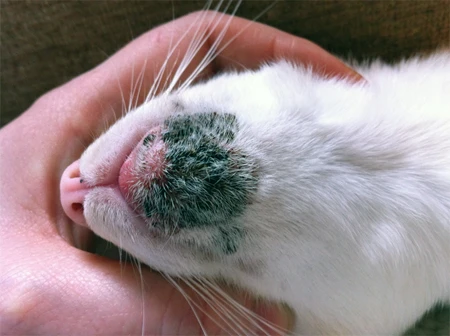
The chin is particularly vulnerable because it’s packed with sebaceous glands. These glands produce the oily substance your cat uses when they rub their face against things — that “bunting” behaviour where they mark you, the furniture, and anything else they consider theirs. Those glands are working overtime, and sometimes they get blocked.
It can affect any cat at any age. Male or female, pedigree or moggy, neutered or entire (though entire males get it worse — I’ll get to why in a minute). I’ve seen it in kittens as young as four months and senior cats well into their teens. There’s no breed predisposition as such, though I will say — and other Siamese breeders will back me up on this — pale-chinned cats make the blackheads more visible, so we tend to spot it earlier.
▶ Cat Acne: What You Need to Know | Dr. Justine Lee
From a Few Black Specks to a Full-Blown Nightmare — The Four Stages
Not all feline acne looks the same. It progresses through stages, and recognising where your cat is on that scale determines what you need to do about it.
Stage 1: The Black Specks (Comedones)
This is where most people first notice something’s wrong. Tiny black dots scattered across the chin, sometimes extending to the lower lip. They look like someone’s ground black pepper onto your cat’s face.
These are comedones — blocked hair follicles. At this stage, your cat probably isn’t bothered at all. No itching, no pain, no swelling. If you run your finger along the chin, you might feel a slightly gritty texture.
This is the easy stage to treat. Don’t ignore it.
Stage 2: Inflammation and Redness
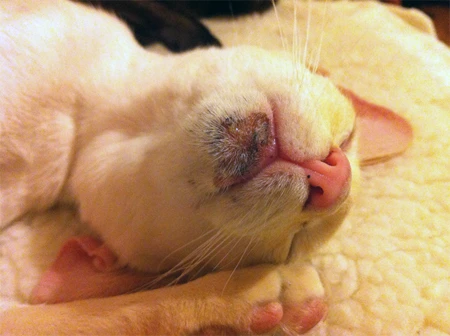
Left untreated, those blocked follicles can become inflamed. The chin looks pink or red underneath the black specks. You might notice mild swelling. Your cat may start rubbing their chin on things more than usual — not the normal bunting behaviour, but a more insistent, scratchy rubbing that tells you they’re uncomfortable.
At this point, you need to act. Home treatment should work, but you’re on a clock.
Stage 3: Pustules and Infection
This is where it gets unpleasant. The blocked follicles have become infected with bacteria (usually Staphylococcus or Pasteurella — bacteria that normally live harmlessly on your cat’s skin but seize their opportunity when a blocked pore hands them an invitation). Now you’re looking at:
- Swollen, angry-looking chin
- Pustules (essentially cat spots — yellowish or white heads)
- Crusting and scabbing
- Hair loss on the chin
- Your cat actively avoiding being touched on the face
At this stage, you need a vet. Home treatment alone won’t cut it once secondary infection has set in.
Stage 4: Furunculosis (The Severe End)
Rare, but it happens. The clinical term is pyoderma — deep skin infection. Draining abscesses. Significant pain. The chin can swell dramatically — I’ve seen photos that look like the cat has grown a second chin overnight.
Vet. Immediately. This may need oral antibiotics, pain relief, and potentially sedation for treatment. The cost for a severe case can run anywhere from £150 to £400+ depending on whether cultures and repeated visits are needed.
(If you’re wondering what general vet costs look like for cat ownership, I’ve covered that in my article on how much a kitten actually costs — spoiler: it’s always more than you think.)
What Actually Causes It (And the One Fix That Solves 80% of Cases)
This is where every other article gives you a list of eight possible causes and moves on. I’m going to tell you what I’ve actually seen cause it — and what I’d check first.
But before I get into the causes, let me tell you something that still stings. I had a queen who battled recurring chin acne for the best part of a year. I tried medicated wipes. I tried antibiotics. I tried changing her food. I spent well over £300 on vet visits. And the entire time, the cause was sitting in my kitchen — a set of plastic food bowls I’d been using for years because “they’d always been fine.”
Watching her chin flare up again and again, seeing her flinch when I tried to clean it, knowing she was uncomfortable and I couldn’t work out why — that was one of the worst feelings I’ve had as a breeder. When I finally twigged and switched to stainless steel, she cleared up in three weeks and never had another episode.
I tell you this because I don’t want you to waste the same time, money, and — most importantly — your cat’s comfort on a problem with a stupidly simple solution.
The Number One Culprit: Plastic Food Bowls
I’m going to say this once, clearly, because it’s the single most common cause I’ve encountered.
Bin your plastic food bowls.
Plastic scratches. Scratches harbour bacteria. Your cat pushes their chin into that bacterial breeding ground twice a day (minimum) while eating. The bacteria transfer to the chin. The chin’s sebaceous glands are already producing oil. Bacteria plus oil plus warm skin equals blocked, infected follicles.
I switched my entire cattery to stainless steel bowls over a decade ago. The change was dramatic. Cats that had been dealing with recurring chin acne for months cleared up within weeks and it never came back.
Stainless steel, ceramic, or glass. Those are your options. Ceramic works beautifully but chips more easily — and a chipped ceramic bowl has the same scratched-surface problem as plastic. Glass is fine but fragile. Stainless steel is virtually indestructible, easy to sterilise, and cheap. A decent set costs under £15.
And don’t forget water bowls and fountains — if you’ve got a plastic water fountain, swap it out too. Ceramic and stainless steel water fountains are widely available now and eliminate one more source of chin-to-plastic contact.
Poor Chin Hygiene (Yes, Really)
Some cats are meticulous groomers. Others are — how shall I put this — a bit slapdash.
The chin is the one area a cat genuinely struggles to groom properly. They can’t reach it directly with their tongue. They rely on licking their paw and wiping it across the chin, which is the feline equivalent of washing your face with a flannel you’ve already used to clean the rest of your body.
Cats with flat faces (Persians, Exotics) are particularly prone because the facial structure makes chin grooming even harder. Long-haired cats can trap food debris in the fur around their mouth, adding to the problem.
If your cat is a messy eater — prone to “gravy chops” after every wet food meal, and you know who you are — a quick wipe of the chin can prevent a world of grief down the line.
Stress
Stress suppresses the immune system. A suppressed immune system lets opportunistic bacteria get a foothold. This is why you might see a flare-up after a house move, the introduction of a new pet, building work, fireworks season, or that delightful period when the neighbours got a dog that barks at 3am.
(Fun fact: I’ve noticed more chin acne cases in my cattery during show season, when cats are being transported, handled by strangers, and generally having their routine disrupted. Coincidence? I don’t think so.)
Hormonal Factors
Entire (unneutered) males are more susceptible, partly because testosterone increases sebum production. This is closely linked to a related condition called “stud tail” — greasy, blackhead-covered skin at the base of the tail, caused by the same overactive sebaceous glands.
If you’re breeding, you’ll likely encounter stud tail in your boys at some point. The treatment principles are identical to chin acne.
Queens can also be more prone during certain hormonal periods. Entire females will often scent-mark more intensively by rubbing their chin and lips against objects — especially when they’re expecting kittens — which can increase sebum build-up and trigger a flare-up.
Neutering doesn’t eliminate the risk entirely, but it does reduce it significantly.
Allergies and Contact Dermatitis
Some cats develop chin acne as a reaction to something their face is touching. Beyond plastic bowls, this could include:
- Rubber mats under food bowls
- Certain fabric collars (particularly nylon)
- Scented cleaning products used on food bowls or feeding areas
- New laundry detergent on bedding the cat sleeps on
If the acne appeared suddenly and you’ve recently changed something in your cat’s environment, work backwards through what’s different. The answer is usually staring you in the face — sometimes literally.
Immune Suppression
Cats with FIV, FeLV, or other conditions that compromise the immune system are more prone to skin infections including feline acne. If your cat is developing severe or recurring acne despite addressing all the obvious triggers, ask your vet about underlying health screening.
How to Sort It Out at Home (Before It Gets Worse)
Right then. Your cat has black specks on their chin, you’ve identified it as mild feline acne (Stage 1 or early Stage 2), and you want to sort it out at home before it gets worse.
I promised you practical steps earlier — here’s exactly what works.
▶ Cat Chin Acne: 5 Natural Remedies | Veterinary Secrets
Step 1: Switch the Food Bowls
If you haven’t already, do this today. Stainless steel, ceramic, or glass. Wash them daily — not a quick rinse, an actual wash with hot water and washing-up liquid or a pet-safe disinfectant. I wash my cattery bowls in the dishwasher on a hot cycle. Bacteria don’t survive that.
Step 2: Clean the Chin
Use warm water and a clean cloth or cotton pad to gently soften and remove any black debris. Don’t scrub. Don’t pick at it. Don’t use human acne products (salicylic acid and benzoyl peroxide at human concentrations can burn cat skin — more on this in a moment).
For mild cases, warm water alone is often enough when combined with a bowl change.
A word on technique: Your cat’s chin may be sensitive and sore, even if the acne looks mild. Try to make cleaning an enjoyable — or at least tolerable — grooming activity. Start with a small area, be gentle, reassure them throughout, and always finish with a treat. A cat who associates chin cleaning with a Dreamie afterwards will tolerate it far better next time than one who was pinned down and scrubbed.
Step 3: Antibacterial Cleansing (If Warm Water Isn’t Enough)
If warm water alone isn’t shifting it after a week or so, step up to a gentle antibacterial cleanser. Your best options:
Chlorhexidine wipes or solution (0.5-2%): This is what most vets recommend as a first-line topical treatment. You can buy chlorhexidine wipes formulated for pets from most pet shops or online. Gently wipe the chin once or twice daily. It kills surface bacteria without being harsh on the skin.
Dilute hibiscrub: Hibiscrub (chlorhexidine gluconate 4%) is available from pharmacies. Dilute it — roughly a teaspoon in a cup of warm water — and use that to clean the chin. It’s the same active ingredient used in surgical hand scrubs, so it’s excellent at killing bacteria.
Coconut oil: Some breeders swear by a thin layer of virgin coconut oil on the chin. It has mild antibacterial and antifungal properties. I’ve used it as a follow-up after chlorhexidine cleaning and it does seem to help soften comedones. It’s not going to treat an infection, but for Stage 1 maintenance, it’s worth a try.
Step 4: Be Patient and Consistent
Feline acne doesn’t clear up overnight. You’re looking at 2-4 weeks of consistent daily cleaning to see significant improvement for mild cases. If you’re not seeing progress after 3 weeks of daily treatment, or if it’s getting worse, it’s vet time.
What NOT to Do
- Don’t squeeze the blackheads. I know the temptation is real (especially if you’ve watched those pimple-popping videos). Squeezing drives bacteria deeper into the skin and almost guarantees you’ll turn mild acne into a full-blown infection.
- Don’t use human spot treatments. Benzoyl peroxide is used in veterinary dermatology, but at much lower concentrations (2.5%) than human products (typically 5-10%). Using your own Clearasil on your cat’s chin will cause a chemical burn.
- Don’t use tea tree oil. It’s toxic to cats. Full stop. I mention this because it appears in far too many “natural cat remedy” articles written by people who’ve clearly never owned a cat.
When It’s Time to Call the Vet (And Why There’s No Shame in It)
No shame in this. Better to go early and be told it’s mild than wait until your cat’s chin looks like a battlefield. I’ll cover what they’ll actually do — and what it’ll cost — so you’re not walking in blind.
Go to the vet if:
- The chin is swollen, red, or warm to the touch
- You can see pustules or weeping sores
- Your cat is in obvious discomfort — flinching when touched, off their food, hiding
- Home treatment hasn’t worked after 3 weeks
- The acne keeps coming back despite addressing bowls, hygiene, and environment
- Your cat has other symptoms (weight loss, lethargy, changes in appetite) that might suggest an underlying condition
Your vet will likely start with a physical exam and may take a skin scrape or swab to rule out other conditions that look similar — fungal infections (ringworm), mites (Demodex), or eosinophilic granuloma complex. These all need different treatments, so it’s worth getting the right diagnosis.
Typical vet treatments include:
- Oral antibiotics (for confirmed bacterial infection) — usually a 2-3 week course
- Topical antibiotics or medicated shampoos
- Anti-inflammatory medication if there’s significant swelling
- In severe cases, a short course of corticosteroids to bring down inflammation — but note: steroids cannot be given to pregnant or nursing females, as they can pass from mother to kittens and cause harm. If your queen develops acne during pregnancy or nursing, your vet will need to use alternative treatments.
- Culture and sensitivity testing if the infection isn’t responding to first-line antibiotics
Cost varies, but budget £60-£100 for an initial consultation and basic treatment, rising to £200-£400 for severe cases requiring cultures, repeat visits, or specialist referral.
Stopping It Coming Back (Because It Will Try)
Prevention is genuinely better than cure here, because feline acne has a nasty habit of recurring. Once you’ve had one flare-up, you’ll likely have more unless you address the underlying triggers.
The prevention checklist:
- Stainless steel or ceramic bowls only. Non-negotiable. Replace them if they become damaged.
- Wash food bowls daily. Hot water, soap, proper wash. Treat them like you’d treat your own plates.
- Wipe the chin after meals if your cat is a messy eater or has had previous flare-ups. A quick swipe with a damp cloth takes five seconds.
- Reduce stress where possible. Feliway diffusers, consistent routines, safe hiding spaces, vertical territory. The usual feline happiness toolkit.
- Regular chin checks. Once you know what early feline acne looks like, a quick chin inspection during your normal grooming routine catches it before it becomes a problem.
- Clean bedding regularly. Wherever your cat sleeps, wash it weekly. Bacteria accumulate.
- Avoid scented cleaning products near food bowls and feeding areas.
If your cat is prone to recurring acne despite all of the above, a weekly preventative chin wipe with dilute chlorhexidine can keep things under control. Think of it as maintenance rather than treatment.
A note on supplements: There’s some evidence that veterinary-formula Essential Fatty Acid supplements — Evening Primrose Oil or Fish Oil capsules designed for cats — can help support skin health and reduce the frequency of flare-ups in acne-prone cats. They work by helping to regulate sebum production. They’re not a cure on their own, but as part of an overall prevention routine, they’re worth discussing with your vet — particularly for cats with chronic recurring acne that isn’t fully controlled by environmental changes alone.
⚡ Key Takeaways
- Plastic food bowls are the number one cause — switch to stainless steel, ceramic, or glass and you’ll solve most cases.
- It progresses through four stages — from harmless black specks to potentially serious infection. Catch it early.
- Mild cases (Stage 1-2) respond to home treatment — warm water cleaning, chlorhexidine wipes, and a bowl change.
- Swelling, pustules, or pain means vet time — don’t try to manage infected acne at home.
- Never squeeze the blackheads — and never use human acne products or tea tree oil on cats.
- Prevention is ongoing — daily bowl washing, regular chin checks, and stress management keep it from coming back.
What I’ve Learned Managing Feline Acne Across a Cattery
If you’re a breeder reading this, you already know that feline acne in a multi-cat household is a different challenge to managing it in a single pet.
A few things I’ve learned over the years:
Individual bowls matter. Communal food bowls in a cattery are a recipe for cross-contamination. Every cat gets their own bowl, washed after every meal. It’s more work. It’s also the single biggest thing you can do to prevent acne spreading through your cats.
Watch your stud boys. Entire males are your most likely candidates for both chin acne and stud tail. A regular grooming routine that includes chin and tail-base inspection catches problems early. I check my boys’ chins every time I groom them — it takes seconds and it’s saved me multiple vet visits.
Stress management during queening. Queens can develop temporary chin acne during pregnancy or nursing — hormonal changes plus the stress of raising kittens. It usually resolves once the kittens are weaned, but keep an eye on it.
Document it. If a particular cat line keeps throwing acne-prone offspring, that’s worth noting in your breeding records. It won’t stop you breeding from them (feline acne isn’t a serious hereditary health condition), but it’s useful information for new owners.
Your Cat’s Chin Sorted — What Next?
If this guide has helped you identify and treat your cat’s chin acne, brilliant. But feline acne is just one of the many surprises cat ownership throws at you. I’ve been writing about the realities of living with cats (and breeding them) for over twenty years now, and there’s always more to learn.
Have a browse through the full Siamese cat health guide for more practical guides written from a breeder’s perspective — no jargon, no waffle, just what actually works.
Frequently Asked Questions
Is feline acne contagious to other cats?
No. It’s not caused by a transmissible pathogen. The bacteria involved (Staph, Pasteurella) are normal skin residents — the problem is the blocked follicle, not the bacteria itself. Multiple cats in the same household can develop acne simultaneously, but that’s usually because they’re sharing the same dirty plastic bowl, not because they’ve “caught” it from each other.
Can feline acne spread to humans?
No. You cannot catch cat acne. Different species, different skin biology. The bacteria involved can potentially cause infection if they enter a break in human skin (a scratch, for example), but that’s not the same as catching acne.
Is feline acne painful?
At Stage 1 (blackheads only), probably not. Most cats are completely unbothered. At Stage 2 and beyond, yes — inflamed skin is uncomfortable, and infected skin is genuinely painful. A cat with severe chin acne may stop eating because it hurts to push their face into a food bowl.
Can I pop my cat’s blackheads?
No. Absolutely not. I know it’s tempting. Squeezing pushes bacteria deeper and guarantees a worse infection. Leave the extraction to the professionals.
How long does feline acne take to clear up?
Mild cases: 2-4 weeks with consistent home treatment. Moderate cases with vet treatment: 3-6 weeks. Severe cases: 6-12 weeks, sometimes longer. And it may recur — ongoing prevention is key.
Should I change my cat’s diet?
There’s limited evidence that diet directly causes feline acne. However, some cats do have food sensitivities that manifest as skin conditions. If your cat’s acne is persistent despite addressing all the environmental factors, discuss an elimination diet trial with your vet. It’s worth ruling out.
My cat only gets acne in summer — why?
Heat increases sebum production. More oil means more blocked follicles. Summer flare-ups are common. Increase your cleaning frequency during warmer months and ensure your cat has cool, clean resting spots.
Is feline acne linked to feline immunodeficiency virus (FIV)?
FIV can increase susceptibility to skin infections, including acne. But feline acne on its own does not indicate FIV. If your cat is developing severe, recurring skin problems, FIV testing is sensible as part of a broader health screen — but don’t jump to conclusions from a few chin spots.