
I knew something was wrong with my seal-point queen the morning she stopped meeting me at the kitchen door.
She’d done it every single morning for three years. Half five, kettle goes on, and there she’d be — threading between my ankles, yowling about breakfast like she hadn’t been fed in a fortnight. It was our thing.
Then one Tuesday — nothing. No yowling. No ankle-threading. I found her wedged behind the washing machine, staring at the wall. She wouldn’t come out. Wouldn’t eat. Wouldn’t even look at me.
Turns out my wife had rearranged the living room the day before. Moved the sofa. Swapped two armchairs. That was it. That was the entire catastrophe.
If you’ve never owned a Siamese, that story sounds ridiculous. If you have, you’re nodding. Because Siamese cats don’t just experience stress — they perform it. Loudly. Dramatically. And sometimes by weeing on your pillow.
This article is everything I’ve learned about stress in cats over 20-odd years of breeding, showing, and living with anywhere between 4 and 12 of them at any given time. What causes it, what it looks like, what actually helps — and when you need to stop Googling and call the vet.
Quick Answer: Stress in cats shows up as hiding, over-grooming, appetite changes, aggression, or inappropriate urination. Common triggers include house moves, new pets, changes to routine, and multi-cat tension. Siamese and Oriental breeds are particularly prone due to their intense bonding and sensitivity to environmental change. Most stress can be managed with routine, enrichment, safe spaces, and patience — but if your cat stops eating for more than 24 hours or starts urinating outside the litter tray, see your vet.
👇 Skip to the 8 things every cat owner needs to know about stress in cats
What Does Stress Actually Look Like in a Cat?
Here’s the problem: cats don’t tell you they’re stressed. They don’t sit you down and explain that the new air freshener is ruining their life. They just… change. And because the changes are often subtle, you can miss them for weeks.
After two decades of watching cats closely — mine, my breeding queens, the cats I’ve judged at shows — these are the signs I’ve learned to look for:
Hiding. This is the big one. A cat that suddenly starts spending all day under the bed, behind furniture, or in a cupboard is telling you something. Cats hide when they feel unsafe. If your cat was sociable last week and is invisible this week, something has changed.
Over-grooming and hair loss. Stressed cats lick themselves raw. You’ll see bald patches and hair loss, usually on the belly or inner thighs — stress hair loss in cats is more common than most owners realise. It’s a self-soothing behaviour — the feline equivalent of biting your nails. I’ve had queens do this after a difficult birth, and it can take months to grow back.
Appetite changes. Either direction. Some cats stop eating entirely (and that’s a vet visit if it lasts more than 24 hours). Others start comfort-eating like they’ve just been through a breakup. Both are stress responses.
Aggression. A cat that’s suddenly hissing, swatting, or biting when they never did before is often a scared cat, not a nasty one. Stress makes cats defensive. If your previously gentle cat draws blood when you pick them up, don’t punish them — investigate what’s frightened them.
The frozen stare. This one’s subtle but distinctive. A stressed cat will sit completely still, ears flat, pupils dilated, staring at nothing. They look like they’re switched off. They’re not — they’re on high alert and trying to be invisible. I’ve seen this at cat shows when a cat is overwhelmed by the noise and unfamiliar smells.
Excessive vocalisation. Siamese owners, you know this one. A stressed Siamese doesn’t go quiet — they go louder. That 3 a.m. yowling that’s been driving you mad? It might not be attention-seeking. It might be anxiety.
Litter tray avoidance. This is the one that brings most people to Google. A stressed cat that starts urinating or defecating outside the litter tray is not being spiteful. They’re telling you, in the only language they have, that something is wrong. More on this in a moment.
The Big Triggers: What Actually Stresses Cats Out
Cats are creatures of routine. They like their food in the same bowl, their sleeping spot undisturbed, and their humans behaving predictably. Disrupt any of that and you’re playing with fire.
Here are the triggers I’ve seen cause the most stress over 20+ years of breeding:
House moves. This is the nuclear option. Everything your cat knows — every scent mark, every safe corner, every patrol route — is gone overnight. I’ve moved house twice with cats, and both times it took weeks for the more sensitive ones to settle. The trick is giving them one room first (with food, water, litter tray, and their own bedding) and letting them expand their territory on their terms.
New people or pets. A new baby, a new partner moving in, a new cat or dog — all of these disrupt the social hierarchy. Cats don’t do change well, and they really don’t do uninvited guests well. If you’re introducing a new cat to an existing one, do it slowly. Days, not hours.
Building work or home renovations. Banging, drilling, strangers in the house, furniture being moved, dust everywhere. I once had a plasterer in for three days and two of my queens refused to come downstairs for a week after he left. The noise had traumatised them.
Changes to routine. New work hours. Feeding at a different time. Even a new brand of cat litter can trigger stress in sensitive cats. I changed from wood pellets to clumping litter once and one of my boys refused to use the tray for three days. Three days. Over litter.
Multi-cat tension. This is the silent killer in multi-cat households and catteries. Cats that don’t get along create a background hum of stress that affects every cat in the house — even the ones who seem fine. Blocked access to resources (food bowls, litter trays, sleeping spots) is a major trigger. The rule of thumb is one litter tray per cat, plus one spare. And food bowls need to be spread out, not lined up like a canteen.
Vet visits. The carrier comes out, and your cat is under the bed before you’ve even opened the latch. Sound familiar? Vet visits are stressful because they combine every trigger at once: confinement, travel, unfamiliar smells, being handled by strangers, and (often) pain. Leave the carrier out permanently with a blanket inside — make it a sleeping spot, not a prison transport.
Loss. Cats grieve. I’ve seen it too many times to doubt it. When a bonded companion dies — feline, human, even a dog — the surviving cat can become withdrawn, stop eating, and show every classic sign of stress. The old article on this site mentioned it, and it’s worth saying again: grief in cats is real, it’s not anthropomorphism, and it needs patience, not a replacement pet.
New homes (stressed kittens). If you’ve just brought a kitten home and it’s hiding under the bed, congratulations — you have a perfectly normal stressed kitten. Everything they knew has vanished overnight: their mother, their siblings, their scent markers, their safe spots. Give them one small room with food, water, litter tray, and a hiding spot. Let them come to you. Most kittens settle within 3–5 days if you don’t rush them.
Siamese Cats and Stress: Why Your Cat Takes It Harder Than Most
I need to be honest here, because this is a Siamese and Oriental site and I’d be doing you a disservice if I pretended all breeds handle stress equally.
They don’t.
Siamese cats are, by nature, one of the most emotionally intense breeds you can own. They bond fiercely to their people. They follow you from room to room. They talk to you constantly. They have opinions about everything and they’re not shy about sharing them.
That intensity cuts both ways. When a Siamese is happy, they’re ecstatically happy — purring, headbutting, climbing into your lap uninvited. When they’re stressed, they’re catastrophically stressed. The volume goes up. The behaviour changes are dramatic. And the inappropriate urination, when it happens, tends to be spectacularly targeted. (My stud cat once urinated on my husband’s pillow — and only his pillow — because he’d been away for a weekend. Message received.)
Orientals, Balinese, and Tonkinese are the same. Any breed in the Siamese family carries that emotional intensity. It’s what makes them wonderful companions and occasionally exhausting ones.
The practical upshot: if you own a Siamese or Oriental, you need to be more attuned to stress triggers than the average cat owner. The things that a laid-back British Shorthair would shrug off — a new air freshener, a visitor who stays too long, a slightly delayed dinner — can genuinely upset a Siamese. Not because they’re fragile. Because they care more.
When Stress Turns Into a Toilet Problem
This is the section most people actually came here for. I know because the search data tells me so.
Stress is the number one behavioural cause of cats urinating or defecating outside the litter tray. Not spite. Not laziness. Not “being naughty.” Stress. A cat whose world feels unsafe will often revert to marking behaviour — spraying urine on vertical surfaces, or urinating on soft horizontal surfaces (beds, sofas, clothes) — as a way of reclaiming territory and self-soothing with their own scent.
If your cat has suddenly started peeing somewhere they shouldn’t, the first thing to do is rule out a medical cause. Urinary tract infections, cystitis, kidney problems, and diabetes can all cause inappropriate urination. See your vet before you assume it’s behavioural.
Once the vet has given the all-clear, you’re looking at a stress response. And the fix isn’t punishment (which makes the stress worse) — it’s detective work. What changed? When did it start? Is there a pattern to where they’re going?
I’ve written a separate article on the difference between cat spray and cat pee — the two look different, smell different, and have different triggers. If your cat is doing it on walls and door frames, that’s spraying. If it’s on flat surfaces like beds and carpets, that’s urination. The distinction matters because the solutions are different.
The short version: address the stress trigger, add more litter trays, use an enzyme cleaner on affected areas (not bleach — bleach smells like ammonia to a cat, which is basically an invitation to pee there again), and give it time. Most stress-related toilet problems resolve within 2–4 weeks once the trigger is removed.
Stress Cystitis in Cats: The Hidden Condition Vets See Every Week
This is the one that catches owners off guard, because it looks exactly like a urinary tract infection — but it isn’t one.
Stress cystitis in cats (also called feline idiopathic cystitis, or FIC) is an inflammation of the bladder triggered by stress rather than bacteria. Your cat strains to urinate, passes tiny amounts, sometimes with blood in it, and may cry out in pain. It’s distressing to watch and it’s genuinely painful for the cat.
Here’s why it matters: your vet runs a urine test, finds no infection, and tells you the bladder is inflamed “for no obvious reason.” That reason is almost always stress. FIC is the single most common lower urinary tract diagnosis in cats under 10 years old, and stress is the primary trigger.
I’ve seen this in my cattery more than once — usually after a show season when the travel and disruption builds up, or after introducing a new cat to the household. The treatment for stress cystitis in cats is a combination of pain relief from your vet (usually a short course of anti-inflammatories), increasing water intake (wet food, water fountains, multiple water bowls), and — critically — finding and removing the stress trigger. Without addressing the stress, FIC tends to come back.
If your cat is straining to urinate, passing blood, or making frequent trips to the litter tray with little result, see your vet the same day. In male cats especially, urinary problems can become a life-threatening blockage very quickly.
▶ Recognising the signs of stress in cats and practical steps to help them feel safe again. (Ross: search YouTube for “signs of stress in cats” or “cat stress body language” — replace VIDEO_ID above.)
What You Can Actually Do About It
Right. You’ve identified the signs, you’ve worked out the trigger. Now what?
Here’s what’s worked for me over 20+ years, in rough order of importance:
Restore the routine. If you’ve changed something, change it back. If you can’t (new baby, house move, new pet), create a new routine as quickly as possible and stick to it rigidly. Feeding times, play times, quiet times — cats find routine deeply reassuring. My cats get fed at the same time every day, and I swear they can tell the time better than I can.
Create safe spaces. Every cat needs at least one place in the house that is entirely theirs — somewhere high up, enclosed, quiet, and warm. A covered cat bed on top of a wardrobe. A cardboard box with a blanket in a spare room. An igloo bed tucked behind a sofa. In a multi-cat household, each cat needs their own. No sharing.
Enrichment. A bored cat is a stressed cat. This is especially true for indoor cats and Siamese, who need mental stimulation like they need food. Puzzle feeders, interactive play sessions, window perches, bird feeders outside windows — all of these reduce background stress. Even something as simple as scrunching up a ball of foil and throwing it down the stairs can break a stress cycle.
Feliway and similar products. I’ll be honest: I’ve used Feliway diffusers in my cattery for years. Do they work? Sometimes. They’re not magic. They won’t fix a major stressor on their own. But I’ve found them useful as background support — they seem to take the edge off, especially during introductions or after house moves. The plug-in diffuser is better than the spray, in my experience. Pet Remedy is another option. Both are pheromone-based and neither will harm your cat.
Zylkene. This is a supplement (milk protein derivative) that some vets recommend for anxiety. I’ve used it before stressful events — shows, vet visits, firework season — and it does seem to help some cats. It’s not a sedative and it’s not a drug. Worth discussing with your vet if your cat’s stress is ongoing.
Play therapy. Fifteen minutes of interactive play — a wand toy, a laser pointer, a feather on a string — does more for a stressed cat than you’d believe. It burns off anxiety, redirects nervous energy, and rebuilds the bond between you and your cat. Do it at the same time every day if you can.
Pheromone diffusers near litter trays. If stress has caused a litter tray problem, putting a Feliway diffuser near (not on top of) the tray area can help. Also make sure the tray is clean, in a quiet spot, and not near food or water bowls. Cats won’t toilet where they eat — it’s hardwired.
When It’s More Than Stress
Sometimes what looks like stress is actually something deeper.
Depression in cats is real, and it overlaps heavily with stress. The difference, broadly, is duration and intensity. Stress is usually triggered by a specific event and resolves when the trigger is removed. Depression tends to be more persistent — a cat that’s been withdrawn, off food, and disengaged for weeks or months, with no obvious environmental cause.
If your cat has been showing stress signs for more than a few weeks and you’ve addressed every trigger you can think of, talk to your vet. There may be an underlying health issue (thyroid problems and chronic pain are common culprits), or your vet may recommend a referral to a qualified feline behaviourist.
I stress the word “qualified” — anyone can call themselves a pet behaviourist. Look for someone with an ABTC (Animal Behaviour and Training Council) registration or a veterinary referral. A good behaviourist will visit your home, observe your cat’s environment, and work with you on a structured plan. It’s not cheap (£150–300 for an initial consultation), but for a severely stressed cat it can be transformative.
And if your cat stops eating entirely for more than 24 hours, don’t wait. That’s a vet visit, not a stress-management exercise. Cats can develop hepatic lipidosis (fatty liver disease) surprisingly quickly when they stop eating, and it can be fatal. Especially in overweight cats.
Want the complete, step-by-step guide?
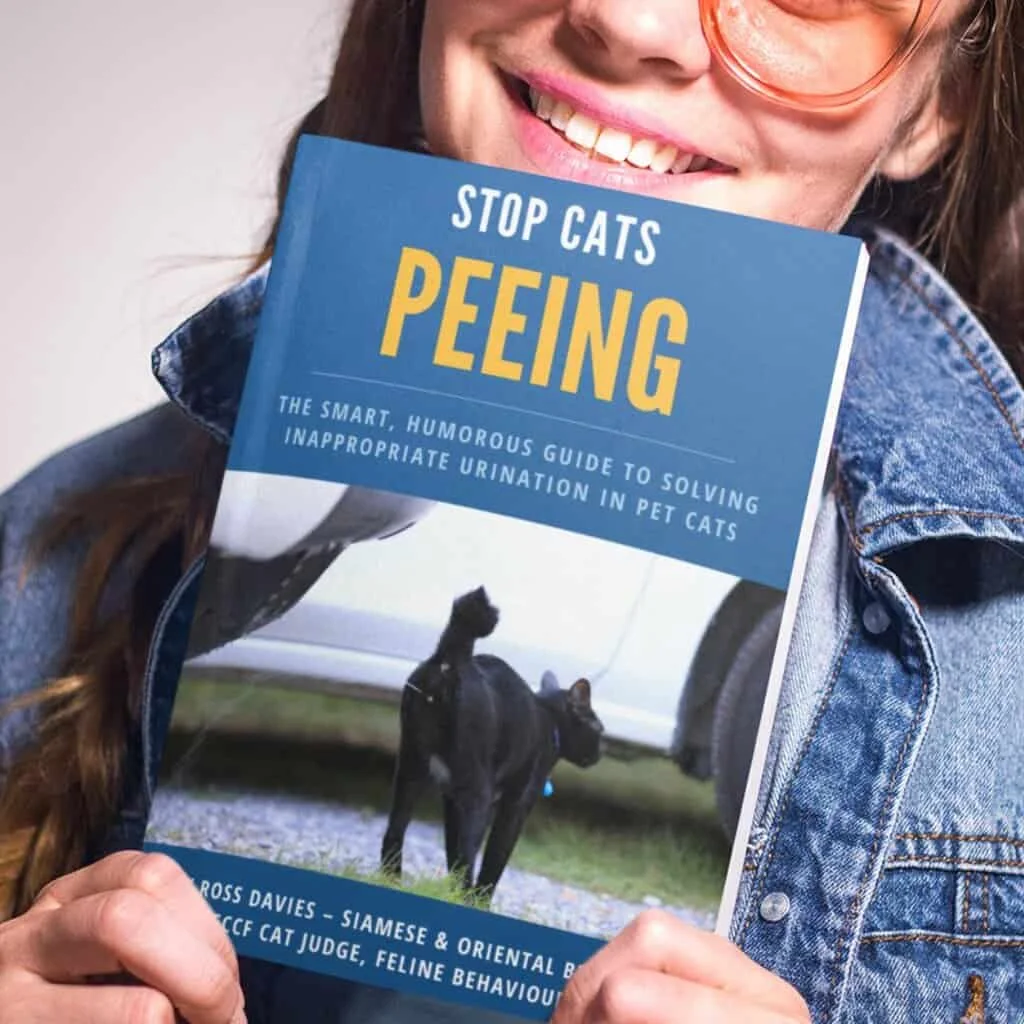
I wrote an eBook that covers everything — from identifying exactly what’s causing the problem in your specific situation, to the practical changes that actually work, to the cleaning methods that genuinely eliminate the smell (not just mask it).
It’s called Stop Cats Peeing, it’s an instant download, and it costs less than a bag of cat litter.
Key Takeaways
- Cats hide stress until it becomes a problem. By the time you notice hiding, over-grooming, or litter tray avoidance, the stress has likely been building for days or weeks.
- Routine is everything. Cats thrive on predictability — same feeding times, same sleeping spots, same humans behaving the same way. Disruption is the most common trigger.
- Siamese and Orientals feel it harder. Their intense bonding and emotional sensitivity means they react more dramatically to change than most breeds.
- Inappropriate urination is a stress signal, not spite. Rule out medical causes first (always), then investigate what changed in the cat’s environment.
- Every cat needs a safe space. High up, enclosed, quiet, and theirs alone — especially in multi-cat households.
- Feliway helps, but it’s not magic. Use it as background support alongside addressing the actual trigger. The plug-in diffuser is better than the spray.
- Play is medicine. Fifteen minutes of interactive play daily reduces anxiety, redirects energy, and strengthens your bond with your cat.
- If it lasts more than a few weeks, see the vet. Persistent stress may indicate an underlying health issue or clinical depression — both need professional assessment.
If your cat is peeing outside the tray and you want a proper, structured guide to fixing it — not generic internet advice but a step-by-step approach that actually works — my eBook covers everything you need. It’s £12.99 and it’s an instant download.
Frequently Asked Questions
Can cats die from stress?
Stress itself won’t directly kill a cat, but the consequences can be serious. Prolonged stress suppresses the immune system, making cats vulnerable to infections. Stress can trigger feline idiopathic cystitis (a painful bladder condition) and exacerbate existing health problems. If a stressed cat stops eating for more than 24–48 hours, they risk hepatic lipidosis (fatty liver disease), which can be fatal — especially in overweight cats. Always take stress seriously and see your vet if your cat stops eating.
How long does it take for a stressed cat to recover?
It depends on the trigger and the individual cat. A minor disruption (furniture rearrangement, a visitor) might resolve in a few days. A major upheaval like a house move or loss of a companion can take 2–6 weeks, sometimes longer. Siamese and Oriental breeds often take longer because they feel things more intensely. The key is removing or addressing the trigger and then being patient — recovery isn’t linear, and there will be good days and setbacks.
Does Feliway actually work for stressed cats?
In my experience, Feliway works as a support tool, not a solution. It won’t fix a major stressor on its own, but it can take the edge off alongside other interventions. I’ve used the plug-in diffuser in my cattery for years and find it helpful during introductions and after disruptions. Some cats respond strongly, others barely notice it. It’s worth trying — it won’t do any harm — but don’t expect miracles. Pet Remedy is an alternative that some owners prefer.
Why is my cat suddenly peeing on the bed?
Urinating on soft, horizontal surfaces like beds is a classic stress response in cats. Your bed smells strongly of you — the person your cat trusts most — so they’re mixing their scent with yours as a self-soothing behaviour. It’s not revenge or spite. Step one is always a vet visit to rule out urinary tract infections or cystitis. If it’s behavioural, look for what changed recently: new pet, new person, change of routine, building work. Address the trigger, use an enzyme cleaner on the bedding, and consider a Feliway diffuser in the bedroom.
Are indoor cats more prone to stress than outdoor cats?
Indoor cats can be more prone to certain types of stress — particularly boredom, lack of stimulation, and frustration from watching birds through windows they can’t get through. But outdoor cats face their own stressors: territorial disputes, traffic, predators, and weather. The key for indoor cats is enrichment — vertical space, puzzle feeders, interactive play, and window perches. A well-enriched indoor cat is no more stressed than an outdoor one. A bored indoor cat with nothing to do absolutely is.
Can a new cat cause stress in my existing cat?
Absolutely — and it’s one of the most common triggers I see. Cats are territorial, and bringing a new cat into their space without a proper introduction is a guaranteed stress bomb. The correct approach is a gradual introduction over 1–2 weeks: scent swapping first (swap bedding), then visual access (baby gate or cracked door), then supervised shared time. Never just put two cats in a room together and hope for the best. Even if they don’t fight, the background stress of an unwelcome intruder can persist for months.
Should I get my stressed cat medication?
Medication should be a last resort, not a first response. Try environmental management first: remove triggers, add safe spaces, increase enrichment, establish routine. If those don’t help after several weeks, talk to your vet about options. Zylkene (a milk protein supplement) is a non-prescription option that helps some cats. For severe cases, vets can prescribe anti-anxiety medication, but this should always be alongside behavioural management — not instead of it. A qualified feline behaviourist (ABTC-registered) can help design a plan.
How do I know if my cat is stressed or ill?
The honest answer is: you often can’t tell without a vet visit, because the symptoms overlap heavily. Hiding, appetite loss, litter tray avoidance, and lethargy are symptoms of both stress and a wide range of medical conditions (kidney disease, hyperthyroidism, diabetes, urinary infections, pain). The safest approach is always to see your vet first to rule out a physical cause. If the vet gives the all-clear, then you’re looking at a behavioural issue. Never assume it’s “just stress” without a professional check — cats are masters at hiding pain.