
You walk into the spare room.
Something smells wrong. Really wrong. That sharp, eye-watering, “oh no, not again” kind of wrong.
You look down. There’s a puddle on the floor near the litter tray.
Then you look up. There’s a streak running down the wall by the door.
Two messes. Same cat. But here’s the thing most owners don’t realise — those are two completely different problems, caused by two completely different things, and they need two completely different solutions.
Get them mixed up and you’ll spend months treating the wrong one. I’ve seen owners replace every carpet in their house, buy fourteen different litters, and seriously consider rehoming their cat — all because nobody told them whether their cat was spraying or peeing.
I’ve been breeding Siamese for over twenty years. I keep entire (unneutered) stud boys. I know what cat spray smells like at 6am on a Monday when you haven’t had your coffee yet.
Let me explain the difference — and more importantly, what each one is telling you.
Quick Answer: Cat spray and cat pee look, smell, and mean completely different things. Spraying is a deliberate territorial marking behaviour — your cat backs up to a vertical surface and deposits a small amount of pungent urine. Peeing outside the litter tray is an elimination issue, usually caused by a medical problem or litter tray setup your cat finds unacceptable. The single most important first step? Get your cat to the vet. What looks like a behavioural problem is a medical one more often than you’d think.
The Two-Second Test: Spray or Pee?
Before you do anything else — before you Google solutions, buy enzymatic cleaners, or phone your mum for advice — you need to work out which one you’re dealing with.
Here’s the quickest way to tell.
If it’s on a vertical surface — a wall, a door frame, the side of the sofa, a curtain, your favourite coat hanging on the back of a chair — it’s almost certainly spray. Cats spray by backing up to the surface, raising their tail (you might notice it quivering), and releasing a small squirt of urine. It’s deliberate. It’s targeted. And the smell is something else entirely.
If it’s on a horizontal surface — a puddle on the floor, a wet patch on your bed, a soaked bath mat — it’s almost certainly pee. Your cat squatted, released a full bladder’s worth, and chose that spot for a reason. That reason might be medical. It might be practical. But it’s not territorial marking.
There are grey areas (a cat might squat-pee against a vertical surface, or spray might drip down and pool on the floor), but that two-second check — vertical or horizontal — gets it right about 90% of the time.
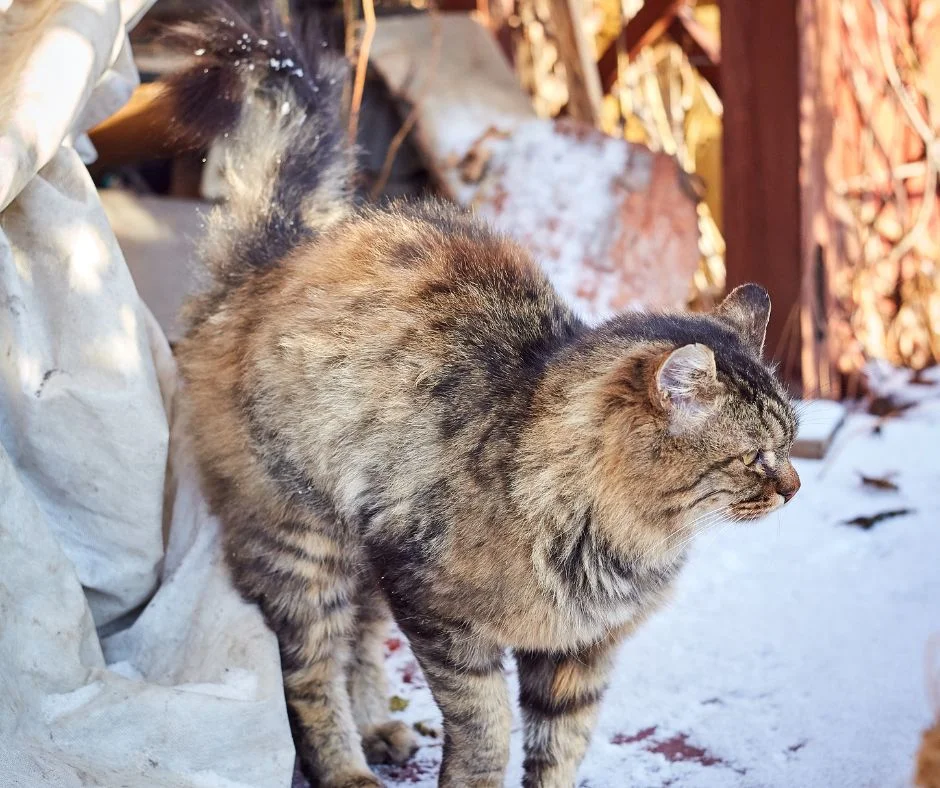
There’s another clue worth knowing. The amount of liquid is usually different. Spray tends to be a small volume — a thin streak, a light misting on the surface. Pee is a full bladder emptying, so you’ll typically find a proper puddle or a large wet patch. If you’re looking at something and thinking “that’s not much” — it’s probably spray. If you’re looking at it and thinking “how did one cat produce that much liquid” — it’s pee.
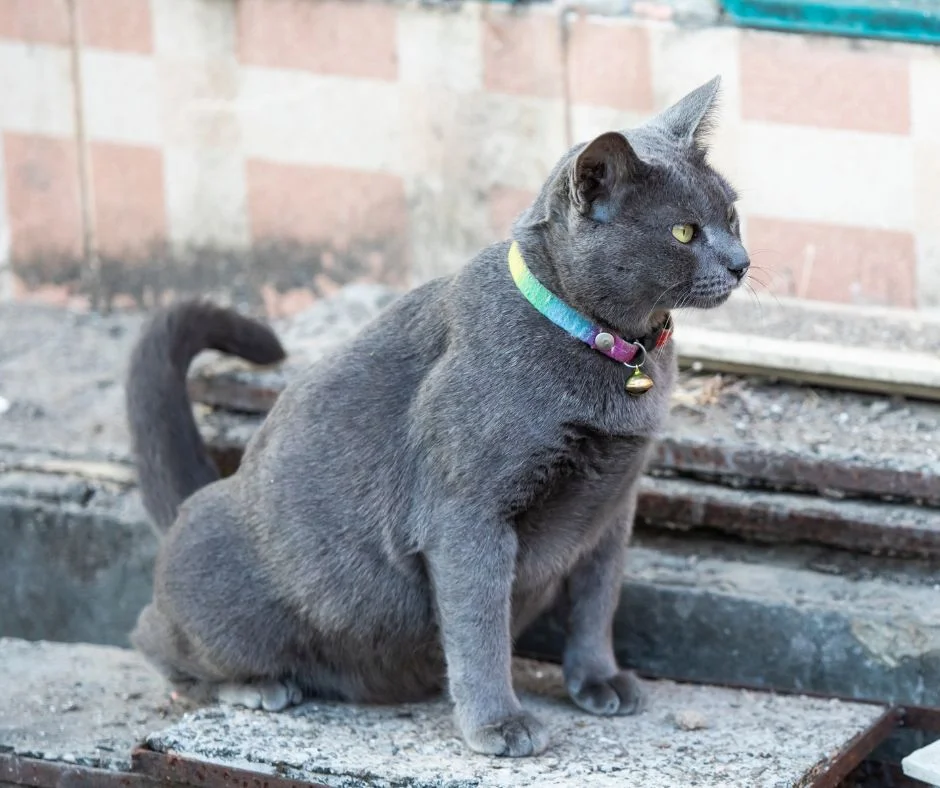
What Does Cat Spray Actually Smell Like?
Both smell bad. But they don’t smell the same bad.
Regular cat pee has that familiar ammonia tang. It’s unpleasant, but it’s recognisable. You’ve smelt it when the litter tray needs changing. It’s manageable.
Cat spray is something else.
It’s thicker, oilier, and carries additional pheromones and proteins from the anal glands that give it a dark, musky intensity that regular urine doesn’t have. If regular cat pee smells like a dirty litter tray, cat spray smells like someone set fire to a dirty litter tray inside a tyre factory.
I’m not exaggerating. When one of my stud boys sprays — and they do, because they’re entire males and it’s literally what they’re designed to do — I can smell it from two rooms away. It clings to surfaces. It seeps into fabrics. Standard cleaning products barely touch it.
(My wife has opinions about this. Strong ones.)
The smell difference is actually useful, though. If you walk into a room and the smell hits you like a wall before you even find the source — that’s probably spray. If you find a wet patch and have to get close to smell it — that’s probably pee.
This matters for cleaning too. Regular cat pee responds reasonably well to enzymatic cleaners — the ones that break down uric acid crystals rather than just masking the smell. Spray is harder. Those extra pheromones and proteins bond to surfaces differently, and you’ll often need multiple treatments with a proper enzymatic product, sometimes combined with a blacklight to find every trace. Ordinary household cleaners — bleach, disinfectant, the lemon-scented stuff under the sink — won’t cut it for either, but they’re especially useless against spray. They mask the smell for you, but your cat can still detect it, which means they’ll often spray the same spot again.
Why Cats Spray: It’s Not What You Think
Most people assume spraying means their cat is being naughty, spiteful, or deliberately trying to ruin their furniture.
None of that is true.
Spraying is communication. It’s your cat leaving a message — a chemical Post-it note — for other cats. In the wild, it’s how they mark territory, advertise their presence, and signal reproductive availability. It’s completely normal feline behaviour.
The problem is when they do it inside your house.
Here are the most common triggers:
Unneutered males. This is the big one. An entire tom will spray to mark his territory and advertise himself to females. If your male cat isn’t neutered and he’s spraying — that’s your answer. Neutering reduces spraying by roughly 90% in males, and the sooner you do it, the less likely the behaviour becomes habitual. I keep stud boys entire for breeding, and managing their spraying is part of the job. For a pet cat? Get them done.
New cats in the neighbourhood. Your cat sees (or smells) an unfamiliar cat through the window, the cat flap, or under the back door. They feel their territory is under threat. So they spray to reinforce the boundary. This is remarkably common and often missed — owners don’t realise their cat has been watching next door’s new tom through the patio doors for three weeks.
Multi-cat households. The more cats you have, the more complex the social dynamics become. A cat who feels insecure in the group — maybe they’re being bullied at the food bowls, or losing access to their favourite sleeping spot — may spray to establish their presence. It’s the feline equivalent of sticking a flag in the ground.
Stress and change. New baby. House move. Building work. A new piece of furniture in the wrong place. Cats are creatures of habit, and anything that disrupts their sense of security can trigger spraying. I once had a queen start spraying after I moved her scratching post six feet to the left. Six feet.
Females spray too. This catches people off guard. Unspayed females will spray when they’re in season to advertise to males. But even spayed females can spray when stressed or feeling territorially insecure. It’s less common, but it happens — and owners often misidentify it as inappropriate urination because they don’t expect females to spray.
Can Neutered Cats Still Spray?
Yes. And this is one of the most common questions I get from owners who assumed the problem would disappear after the operation.
Neutering removes the hormonal drive to spray, and it works brilliantly in most cases — around 90% of males stop or significantly reduce spraying after being neutered. For females, spaying has a similar success rate.
But that still leaves roughly 10% who carry on.
There are a few reasons this happens. Timing matters. If your cat has been spraying for months or years before being neutered, the behaviour can become habitual — essentially learned rather than hormonal. The longer they’ve been doing it, the more likely it is to persist after the operation. This is one of the reasons vets recommend neutering early.
Stress doesn’t need hormones. A neutered cat who feels territorially insecure — because of other cats in the house, neighbourhood cats outside, or environmental changes — can still spray as a stress response. The hormones might be gone, but the instinct to mark when they feel threatened remains.
Medical issues can mimic spraying. Occasionally, what looks like continued spraying after neutering is actually a urinary tract problem causing discomfort and unusual urination behaviour. Always worth a vet check if spraying continues or restarts after neutering — particularly if the pattern changes or you notice other signs like straining, blood in urine, or frequent trips to the tray.
So if you’ve had your cat neutered and they’re still spraying — don’t panic, and don’t assume nothing can be done. It just means the cause is behavioural or environmental rather than hormonal, and you need to look at the triggers rather than the testosterone.
I’ve had owners tell me their neutered cat “started spraying again” after years of no problems. Almost every time, something in the environment changed — a new cat moved in next door, a family member left for university, or building work started nearby. Cats have long memories and the instinct to spray never fully disappears. It just sits dormant until something wakes it up.
Why Cats Pee Outside the Litter Tray: This Is Different
If your cat is squatting and peeing outside the tray — on the bed, the carpet, the bathroom floor, your clean laundry — the cause is almost always one of two things: a medical problem, or a litter tray problem.
And here’s the thing that matters: you must rule out medical first.
I cannot stress this enough.
▶ Cat Peeing Outside of the Litter Box? A Vet Explains Why
Medical Causes (More Common Than You’d Think)
Urinary tract infections (UTIs). Painful urination makes cats associate the litter tray with pain. So they try somewhere else, hoping it won’t hurt this time. They’re not being difficult — they’re in pain and trying to solve it the only way they know how.
Feline idiopathic cystitis (FIC). Inflammation of the bladder, often stress-related, that causes frequent, painful urination. This is incredibly common in cats under ten and is often the hidden culprit when owners say their cat “suddenly started peeing everywhere.”
Kidney disease. Produces more urine than normal. Your cat may not be able to get to the tray in time, or the tray fills up faster than usual and they refuse to use a dirty one (can you blame them?).
Diabetes. Same issue — increased urine output. A cat who suddenly starts having accidents after years of perfect litter tray behaviour should be checked for this.
Arthritis. Older cats with joint pain might find it difficult or painful to climb into a high-sided litter tray. They’re not being lazy — they physically can’t manage it anymore.
I’ve seen owners spend months trying behavioural solutions when the answer was a £60 vet visit and a course of antibiotics. Don’t be that owner.
Litter Tray Problems (The Other Half)
If the vet gives your cat the all-clear medically, the problem is almost certainly the tray itself. And by “the tray,” I mean any of about fifteen things that could be wrong with it.
Cats are spectacularly fussy about where they do their business. The wrong litter type, a tray that’s too small, a tray that’s in the wrong place, a tray that isn’t clean enough, a tray that’s too close to their food — any of these can be enough for your cat to decide the duvet is a better option.
The general rule is one tray per cat plus one spare. So two cats need three trays. And they should be in different locations, not lined up like a bank of toilets in a service station.
Covered litter trays are another common flashpoint. Owners love them because they hide the mess and contain the smell. Cats often hate them because they trap the smell inside — and for a creature with a sense of smell fourteen times stronger than yours, being inside a covered tray that hasn’t been scooped since yesterday morning is the equivalent of you using a portaloo at the end of a music festival. Some cats tolerate covered trays perfectly well. Others refuse point-blank. If your cat has stopped using a covered tray, try removing the lid before you change anything else.
But the specifics — the exact setup that will work for your particular cat — depend on factors that vary from cat to cat and house to house.
The First Thing You Must Do (Regardless of Which It Is)

Whether you think it’s spraying or peeing, the very first step is the same.
Take your cat to the vet.
For inappropriate peeing, you’re ruling out UTIs, cystitis, kidney disease, diabetes, and arthritis. For spraying, you’re checking whether neutering is appropriate and ruling out any pain-related issues that might be triggering the behaviour.
Don’t skip this step. Don’t convince yourself you already know what the problem is. A vet check gives you a clean starting point — and it might solve the entire problem on its own.
When you go, take a urine sample if you can — your vet will thank you and it saves a second visit. The easiest way is to replace your cat’s normal litter with a non-absorbent type (your vet can supply this, or you can use aquarium gravel) and collect the sample with a clean syringe or pipette. Get it to the vet within a few hours. They’ll check for infection, crystals, glucose, and kidney markers — all of which can explain the behaviour in one simple test.
Fixing It: What Actually Needs to Happen
Once you’ve got a vet clearance, the approach depends entirely on whether you’re dealing with spraying or peeing.
For spraying: You’re looking at the triggers. Is the cat neutered? Are there cats outside causing stress? Is there tension in a multi-cat household? Has something changed in the environment? The solution is almost always about removing or managing the trigger — not punishing the cat. Punishment makes spraying worse. Every single time.
▶ How to STOP Your Cat Spraying Everywhere: 9 tips for success!
Practical steps that actually help with spraying include blocking visual access to outdoor cats (closing blinds on problem windows, covering glass on the bottom half of doors), adding vertical territory inside the home (cat trees, high shelves, window perches) so your cat feels more secure, and thoroughly cleaning every sprayed surface with an enzymatic cleaner to remove the scent markers completely. If your cat can still smell previous spray marks, they’ll top them up. It’s like refreshing a bookmark.
In multi-cat households, you might need to increase resources — more feeding stations in different rooms, more litter trays, more sleeping spots — so the cat who’s spraying doesn’t feel like they’re competing for essentials. Sometimes it’s as simple as putting a second water bowl on a different floor of the house.
One thing that catches people out: cats often spray near entry points — front doors, back doors, cat flaps, ground-floor windows. These are the boundaries of their territory, and when they feel those boundaries are under threat, that’s where the marking goes. If your cat is spraying by the back door, it’s worth checking whether neighbourhood cats have been visiting your garden. A motion-activated deterrent outside can sometimes resolve indoor spraying without you having to change anything inside the house.
For inappropriate peeing: You’re looking at the litter tray setup and the environment. The wrong tray, the wrong litter, the wrong location, not enough trays, trays that aren’t clean enough — these are all fixable, but the fix has to be specific to your cat and your home. Generic advice from a Google search rarely cuts it because every situation is different.
Start with the basics: are the trays big enough (one and a half times the length of your cat is the minimum), are they in quiet spots where your cat won’t be ambushed by other pets or startled by the washing machine, are you scooping at least once a day, and have you recently changed the litter brand? Cats notice these things. They notice everything.
If the basics are all fine and the vet’s given the all-clear, you’re likely looking at a more nuanced environmental issue — something in the home that’s making your cat feel insecure enough to avoid the tray. That’s where it gets specific to your particular situation.
I won’t pretend there’s a simple five-step fix I can give you in a blog post. If there were, the internet wouldn’t be full of desperate cat owners on forums at 2am trying to work out why their cat keeps peeing on the bed.
What I can tell you is that the problem is almost always solvable — once you understand what’s actually causing it.
Want the complete, step-by-step guide?

I wrote an eBook that covers everything — from identifying exactly what’s causing the problem in your specific situation, to the practical changes that actually work, to the cleaning methods that genuinely eliminate the smell (not just mask it).
It’s called Stop Cats Peeing, it’s an instant download, and it costs less than a bag of cat litter.
The Myths That Make Everything Worse
While we’re here, let me save you from the advice that will actively set you back.
“Rub their nose in it.” No. This does nothing except terrify your cat and damage your relationship with them. They don’t connect the punishment with the behaviour. All they learn is that you’re unpredictable and scary — which increases stress, which increases spraying and inappropriate urination. It’s the opposite of helpful.
“They’re doing it out of spite.” Cats don’t think like this. They’re not plotting revenge because you went on holiday or bought the wrong food. They’re responding to stress, pain, or environmental problems. Attributing human motivations to cat behaviour is the number one reason people fail to fix the problem.
“Just add another litter tray.” Sometimes this helps. Sometimes it makes no difference at all because the issue isn’t the number of trays — it’s the type, the location, the litter, or the cleanliness. One more tray in the wrong spot with the wrong litter is just one more tray your cat ignores.
“Use citrus sprays to deter them.” Cats dislike citrus, yes. But spraying orange oil on the spot where your cat pees doesn’t fix the reason they’re peeing there. It just moves the problem to a different spot. You’ll end up with a house that smells of cat pee and oranges, which is somehow worse than just cat pee.
“Just plug in a Feliway and it’ll sort itself out.” Synthetic pheromone diffusers can help reduce stress in some cats, and I’ve seen them make a noticeable difference in multi-cat households. But they’re a support tool, not a solution on their own. Plugging one in without addressing the actual cause of the spraying or peeing is like putting a plaster on a broken leg. It might take the edge off, but the leg’s still broken.
“They’ll grow out of it.” No, they won’t. Inappropriate urination and spraying don’t resolve themselves. If anything, they get worse the longer they go unaddressed — the behaviour becomes more ingrained, the scent marks build up in the home, and the underlying cause (whether medical, environmental, or territorial) continues unchecked. The sooner you act, the easier it is to fix.
Key Takeaways
- Spray hits vertical surfaces. Pee hits horizontal surfaces. That’s your starting point for working out which you’re dealing with.
- Spray smells worse. It carries extra pheromones and proteins that make it significantly more pungent than regular urine.
- Spraying is territorial communication. It’s triggered by insecurity — other cats, environmental changes, multi-cat tension, or being unneutered.
- Neutered cats can still spray. About 10% continue after the operation, usually because the behaviour became habitual or the trigger is stress-based rather than hormonal.
- Inappropriate peeing is usually medical or environmental. UTIs, cystitis, kidney disease, or litter tray problems are the most common causes.
- Always see the vet first. Whether it’s spraying or peeing, a vet check is the non-negotiable first step. It might solve everything, and it rules out the things you can’t diagnose from Google.
- Punishment makes it worse. Every time. Without exception.
- It’s almost always fixable. Once you correctly identify whether it’s spray or pee, understand the underlying cause, and apply the right approach — most cats stop.
If your cat is peeing outside the tray and you want a proper, structured guide to fixing it — not generic internet advice but a step-by-step approach that actually works — my eBook covers everything you need. It’s £12.99 and it’s an instant download.
Frequently Asked Questions
How can I tell if my cat is spraying or peeing?
The quickest test is the surface. If the urine is on a vertical surface — a wall, door frame, curtain, or the side of furniture — it’s almost certainly spray. If it’s a puddle on a horizontal surface — the floor, your bed, a bath mat — it’s pee. Volume is another clue: spray is a small squirt, pee is a full bladder emptying. The smell is different too — spray is significantly more pungent because it contains extra pheromones and proteins from the anal glands.
Can neutered cats still spray?
Yes. Neutering stops spraying in roughly 90% of males, but about 10% continue. This usually happens when the behaviour became habitual before neutering, or when the trigger is stress-based rather than hormonal — such as neighbourhood cats, multi-cat tension, or environmental changes. If your neutered cat starts spraying, a vet check is still the first step to rule out medical causes.
Why has my cat suddenly started peeing outside the litter tray?
A sudden change in litter tray habits almost always points to either a medical issue or an environmental one. UTIs, feline idiopathic cystitis, kidney disease, diabetes, and arthritis are the most common medical causes. If the vet gives the all-clear, look at the litter tray setup — cleanliness, location, size, litter type, and whether anything in the home has recently changed. Cats don’t do this out of spite — they’re telling you something is wrong.
Does cat spray smell different from cat pee?
Significantly. Regular cat pee has the familiar ammonia smell you’d recognise from a litter tray that needs changing. Cat spray is far more intense — it contains additional pheromones and oily secretions from the anal glands that give it a dark, musky quality. If you can smell it from across the room before you’ve even found the source, it’s almost certainly spray.
Will a Feliway diffuser stop my cat spraying?
It can help reduce stress-related spraying in some cats, but it’s a support tool — not a solution on its own. A Feliway diffuser won’t fix the underlying trigger, whether that’s an outdoor cat causing territorial anxiety, tension in a multi-cat household, or a medical issue. Use it alongside other interventions, not instead of them.
How do I clean cat spray properly?
You need an enzymatic cleaner — one that breaks down uric acid crystals and the extra proteins in spray, rather than just masking the smell. Standard household cleaners, bleach, and disinfectant won’t cut it. Your cat can still detect the scent even when you can’t, and if they can smell previous spray marks, they’ll often spray the same spot again. A UV blacklight helps you find every trace, and you may need multiple treatments for spray on porous surfaces like wood or fabric.
Do female cats spray?
Yes. Unspayed females will spray when they’re in season to advertise to males. Even spayed females can spray when stressed or feeling territorially insecure. It’s less common than in males, but it does happen — and owners often misidentify it as inappropriate urination because they don’t expect females to spray.
Should I punish my cat for spraying or peeing in the house?
No. Never. Punishment — rubbing their nose in it, shouting, squirting water — does nothing except terrify your cat and increase their stress. Cats don’t connect the punishment with the behaviour. All they learn is that you’re unpredictable and frightening, which makes the problem worse, not better. The solution is always about identifying and addressing the cause, not punishing the symptom.