Let me guess.
You walked into the spare room this morning, took one sniff, and your whole face changed. That specific, eye-watering, gut-punch sort of smell that only cat pee makes. The one that somehow gets worse on a hot day. The one that your mum could smell from the driveway.
You’ve probably already tried something. Maybe a squirt of Flash, maybe some Febreze, maybe (god help you) a bit of bleach. And here’s the bad news: none of those things work. Some of them actively make it worse.
This guide is the one I wish someone had handed me ten years ago when my first stud cat absolutely destroyed a £900 wool rug on his second night in the house. I’m going to walk you through what actually works, what to buy, what to never buy, and how to make sure your cat doesn’t come back and do it in the exact same spot tomorrow.
Grab a cup of tea. This is going to take a few minutes, but if you follow it properly you’ll save your carpet, your sofa, your sanity and probably your relationship with whoever else lives in your house.
Heads up: this article contains Amazon affiliate links. If you buy something through one of them I earn a small commission at no extra cost to you — it helps keep the site running. Full disclosure here.
Quick Answer: Cleaning cat pee properly comes down to four steps: find every hidden patch with a UV torch (it’s rarely just one), blot the liquid out without rubbing, soak the area with a proper enzyme cleaner and leave it for the full dwell time, then check your work 24 hours later. Sounds simple enough. The catch is that most “pet odour” cleaners on the supermarket shelf don’t contain enough enzymes to touch the uric acid crystals causing the smell — and a handful of internet favourites like bleach, vinegar and steam cleaners will actively bond the stink into your carpet permanently. So which products actually work, and which mistakes turn a £50 problem into a new-carpet problem?
👇 Jump to the 8 rules that actually kill cat pee smell for good
Why Cat Pee Is Such a Nightmare to Clean
Cat urine is not like dog urine. It’s not even like human urine. It’s in a league of its own, and there’s a specific chemical reason for that.
When a cat pees, the urine starts out as a mix of urea, urobilin, creatinine, electrolytes, sodium, other detritus, and uric acid. As it dries, the urea and the other water-soluble bits evaporate or wash out fairly easily. But the uric acid? The uric acid forms crystals. And those crystals bond tightly to whatever the pee soaked into — carpet fibres, wood grain, sofa cushion foam, mattress ticking, concrete.
Uric acid crystals don’t dissolve in water. They don’t dissolve in most household detergents. They don’t dissolve in bleach. They will sit there, perfectly preserved, for months or even years. And every time the weather turns humid — or you spill a drink nearby, or the dog has a wee accident in the same spot — those crystals reactivate, release their gases again, and the smell comes roaring back.
This is why you can “clean” a cat pee stain six times, think you’ve won, then smell it again the moment the heating comes on in October. You haven’t cleaned it. You’ve just masked it.
The only thing that genuinely gets rid of cat pee is a cleaner that uses enzymes (and often bacteria too) to physically break down the uric acid crystals into smaller compounds that can then be rinsed or evaporated away. No enzymes, no fix. That’s the whole story.
Step 1: Find the Exact Spot (Yes, All of It)
Sounds obvious. It isn’t.
If the pee is fresh and still wet, you know where it is. Great. Skip to Step 2.
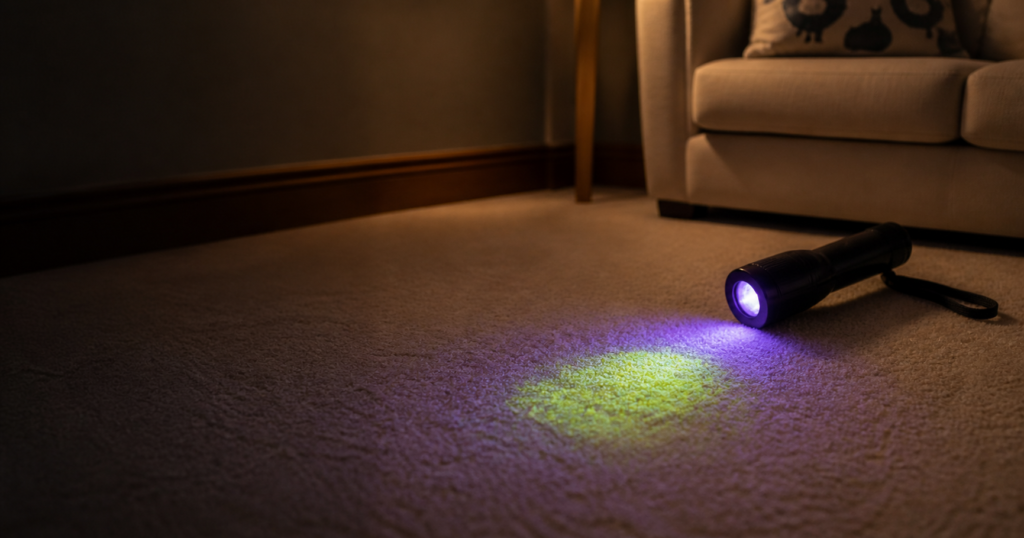
If you’re chasing a smell without a visible stain — which is 90% of the time — you need a UV blacklight torch. Cat urine fluoresces a sort of eerie greeny-yellow under UV light, even weeks or months after the fact. You turn off all the room lights, crank the blacklight on, and suddenly every secret crime scene in the room lights up like a Blackpool illumination.
This matters because cats almost never pee in just one spot. If you find one patch, there are usually two or three more nearby that you’ve been smelling without knowing where. Clean only the obvious one and the smell never actually leaves.
A decent UV torch costs about a tenner on Amazon. It is — and I say this as someone who has owned an embarrassing quantity of cat-cleaning gadgets — genuinely the most useful tool in the entire cat-owning arsenal. Buy one. You’ll use it more than you expect.
Step 2: Blot, Don’t Rub (This Bit Is Non-Negotiable)
If the pee is still wet, grab a stack of kitchen roll or an old towel you don’t mind throwing away. Press down hard on the wet patch. Don’t scrub, don’t rub, don’t wipe. Press straight down, lift straight up, and do it repeatedly with fresh dry paper until you can press a clean paper towel on the spot and it comes up almost dry.
Rubbing spreads the pee sideways, pushes it deeper into the carpet fibres, and creates a stain five times bigger than the original deposit. Blotting lifts the liquid up and out. It’s the difference between a tennis-ball-sized problem and a dinner-plate-sized problem.
(If it’s on a hard floor — laminate, tile, wood — skip the blotting and just wipe the surface pool up with paper towel, then move straight to Step 3. Hard floors are the easy mode of cat pee disasters, so count your blessings.)
Step 3: Soak It With an Enzyme Cleaner (Not Just Spritz)
Here’s where most people go wrong. They give the stain a polite little spritz — two or three pumps — thinking they’re being economical. Then the smell comes back three days later and they blame the product.
You cannot spritz cat pee out of a carpet. The uric acid has sunk through the pile, through the backing, into the underlay and maybe even into the floorboards underneath. If your enzyme cleaner doesn’t reach every single place the urine reached, the bits you miss will still stink.
You need to soak the area. Properly soak it. Enough cleaner that the wet patch matches roughly the area you saw glowing under the UV torch in Step 1, plus another inch or two of margin on every side. I’m talking ounces, not squirts.
Then — and this is the part almost everyone skips — leave it alone. Read the label. Most enzyme cleaners need a minimum dwell time of 10 to 15 minutes, some want 20, a few stubborn ones want an hour. That’s how long the enzymes need to actually do their job. Wipe it up after 30 seconds and you’ve achieved literally nothing.
After the dwell time, blot up any excess, then let the area air dry naturally. Don’t use a hair dryer, don’t throw a fan at it on full blast, don’t use heat of any kind. The enzymes keep working as the spot dries slowly. Rushing the drying stops them mid-job.
Step 4: Check Your Work (Twice)
Once everything’s bone dry — usually 24 hours later, sometimes 48 for a soaked carpet — come back with your UV torch and check the spot again in the dark. If it’s still glowing, the cleaner didn’t reach all of it. Repeat Step 3. This is normal on the first round for heavy saturations. Some bad spots take three rounds.
Do the sniff test too, but do it first thing in the morning when the room has been shut up all night. Warm, still air is the worst case, and that’s when faint residual pee reveals itself.
A quick note before the product picks.
The products below are ones I’ve either used myself, researched heavily, or both. The links go to Amazon and they’re affiliate links — meaning if you buy through them I earn a small commission (usually a few pence per pound you spend). It doesn’t cost you a penny more. It helps me keep writing these guides instead of gatekeeping them behind a paywall.
I don’t recommend rubbish just because it pays. If I wouldn’t let it near my own cats, it’s not on the list. Read the full affiliate disclosure if you want the proper legal version.
The Best Cat Pee Cleaners — A Proper Comparison
I’ve used a frankly embarrassing number of these over the years. Some are brilliant. Some are expensive nothing-burgers. Here are the ones I actually keep in the cupboard, plus the UV torch you need to make any of them work properly.
| Product | Best for | Why it works | Watch out for | Buy on Amazon |
|---|---|---|---|---|
| Simple Solution Extreme Stain & Odour Remover | Everyday carpet accidents, general-purpose | Pro-bacteria enzyme formula, works on old and new stains, forgiving on dwell time | Has a slight sweet fragrance — not chemical, but noticeable for the first hour | Check Price → |
| Urine Off Cat & Kitten Formula | Set-in stains, old pee you just discovered, mattresses | Designed specifically for cat urine, removes uric acid crystals even on stains months old | More expensive per ml than Simple Solution — save it for the hard cases | Check Price → |
| Rocco & Roxie Professional Strength | Big soaked patches, deep-pile carpet, multi-cat accidents | Powerful certified enzyme formula, chlorine-free, safe on most surfaces | Imported from the US so postage sometimes adds a few quid | Check Price → |
| Vansky UV Blacklight Torch (51 LED) | Finding invisible stains before you clean | 395nm UV LED, lights up urine, vomit, scratches — basically essential kit | Don’t shine it in your own eyes (it’s a torch, behave yourself) | Check Price → |
| Bio-One Biological Urine Remover | Hard floors, grout, concrete, garages | Live bacteria continue to feed on residue for up to 72 hours after application | Not ideal for upholstery — it’s a liquid biological that wants an absorbent surface | Check Price → |
If you can only afford one enzyme cleaner, buy the Simple Solution. If you’ve got an old stain that nothing’s touching, upgrade to Urine Off. If you’ve got a cat who’s going through a phase and you’re cleaning weekly, get the Rocco & Roxie big bottle because it works out cheaper per ml. And whatever you do, buy the UV torch. I genuinely cannot stress this enough.
How to Clean Cat Pee on Specific Surfaces
Carpet and Rugs
Follow the four steps above exactly. If the stain is old and the carpet is synthetic, you can get away with a fairly generous soak. If it’s wool, be slightly more conservative — wool hates being over-wet because it can shrink and the backing can rot — but don’t be so tentative that the cleaner doesn’t reach the underlay.
For really stubborn old patches on carpet that keep coming back, you sometimes have to lift the edge of the carpet and treat the underlay directly, or in the worst cases replace the underlay and seal the floorboards underneath with a coat of shellac-based primer. I know that sounds like overkill. On genuinely disastrous old stains in old houses, it’s sometimes the only way.
Mattress
Brutal. Genuinely one of the worst. Mattresses are thick and absorbent and you cannot soak them properly without causing mould in the foam underneath.
Your best shot: blot every bit of liquid out, soak the top layer of fabric with an enzyme cleaner (Urine Off is specifically designed for this), leave it for the full dwell time, blot again, then stand the mattress on its side in front of an open window for 48 hours to dry. Under no circumstances use a hair dryer or put the mattress back flat before it’s completely dry — you’ll trap moisture and grow mould in the middle of it.
If it’s an old mattress you were already thinking of replacing, this might be the moment. Cat pee in memory foam is very nearly unfixable.
Sofa, Chair and Upholstery
If the cushion cover unzips and comes off, take it off and hand-wash it in cold water with a cap of enzyme cleaner in the rinse. Then treat the cushion foam underneath separately with the same method as the mattress.
If the upholstery is fixed and non-removable, treat it like a carpet — soak, dwell, blot, dry — but be extra careful about over-wetting, because sofa foam can hold water for weeks and go mouldy in exactly the same way as a mattress.
Wood and Laminate Floors
Easy if it’s fresh. Wipe it up, spray enzyme cleaner on, wait the dwell time, wipe again. Done.
Hard if it’s old and soaked into the grain. Wood is porous and unsealed floorboards can drink urine straight down into themselves. At that point you’re looking at sanding, sealing, or replacing the affected boards. Laminate is kinder — the top layer is sealed, so as long as the pee didn’t get into the joints it cleans off easily.
Concrete and Garage Floors
Concrete is the worst surface by a mile because it’s porous, alkaline, and urine reacts with it chemically. Use a biological cleaner like Bio-One, apply generously, leave it overnight, then scrub with a stiff brush and rinse. You might need two or three rounds. After that, seal the concrete with a concrete sealer — otherwise the next accident will soak straight in exactly the same way.
What to Never, Ever Use
Before we wrap up, let me save you a few specific mistakes. These are the ones I see people make over and over.
- Bleach. Bleach contains ammonia compounds and cat urine contains ammonia. To a cat’s nose, bleach smells like another cat has already peed there — so they come back and top it up to claim the spot. You are literally inviting the next accident.
- Ammonia-based cleaners. Same reason as bleach. Check the label on your all-purpose kitchen sprays — a surprising number contain ammonia.
- Vinegar. The internet loves vinegar for cat pee. The internet is wrong. Vinegar masks the smell briefly and does nothing about the uric acid crystals. It also smells absolutely rank for the first few hours, so all you’ve achieved is replacing one bad smell with a different bad smell.
- Baking soda on its own. Baking soda alone can’t break down uric acid. It can help absorb moisture if sprinkled on a fresh wet stain before enzyme treatment, but it’s not a cleaner.
- Steam cleaner. Please don’t. Heat permanently bonds the uric acid to the fibres and makes the stain chemically unremovable. Cold cleaning always.
- Febreze. It’s a fragrance spray. Fine for a poo-fart on the sofa, useless for cat urine. Fragrance on top of urine just smells like fragranced urine.
- Carpet shampoo with fragrance. Even the “pet” ones often don’t have proper enzymes. Read the label — if it doesn’t explicitly say it targets uric acid or urine enzymes, it won’t work on the stuff that matters.
Are You Sure It’s Pee and Not Spray?
Quick sanity check before we finish: is your cat actually peeing, or are they spraying? Because the cleaning is the same, but the reason behind it — and therefore the long-term fix — is completely different.
Spray is usually on vertical surfaces (walls, doors, the side of the sofa, curtains), smaller in volume, and accompanied by a distinctive tail-quiver behaviour. Peeing happens on horizontal surfaces, is a proper puddle’s worth of liquid, and the cat often squats like they’re using the tray. If you’re not sure which you’re dealing with, the full diagnosis is over on my cat spray vs cat pee guide — it matters, because the behavioural fixes are totally different.
Stopping the Repeat Offence
Cleaning the mess is half the job. The other half is figuring out why it happened — and fixing that — so it doesn’t happen again next week on a different bit of carpet.
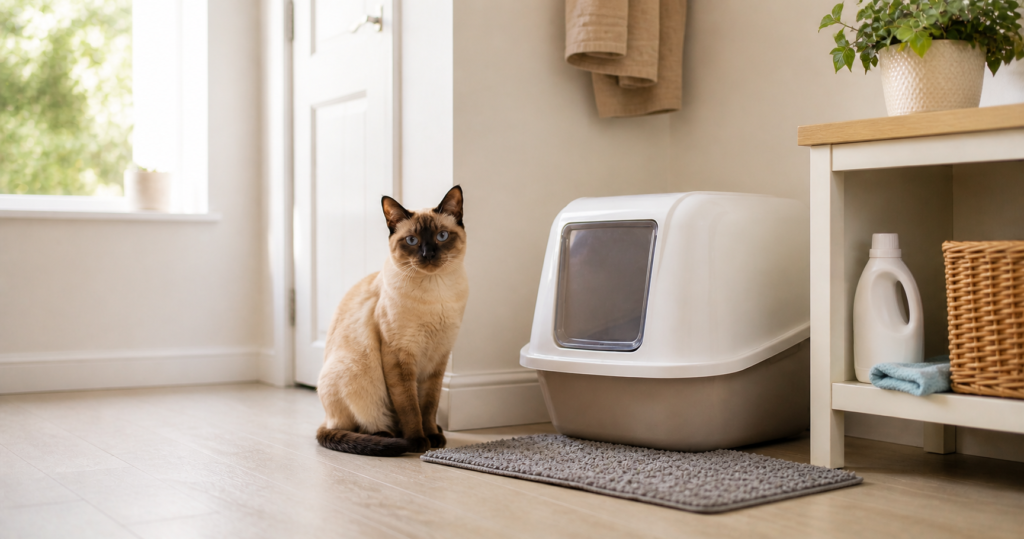
Cats pee outside the tray for three main reasons: medical (urinary tract infection, crystals, kidney issues, diabetes), litter tray problems (wrong litter, dirty tray, not enough trays, wrong location), or stress (new cat, new baby, new house, a scary cat outside the window, moved furniture, or depression in cats that’s genuinely under-recognised). The first thing — always — is a vet check. Don’t try to behaviourally fix a problem that might actually be a bladder infection.
Once the vet has ruled out the medical side, you work through the tray setup (the rule is one tray per cat plus one spare, all cleaned daily, all in quiet low-traffic locations), and you address the stress triggers one at a time. It’s almost never “naughty” behaviour. It’s almost always a signal.
Want the complete, step-by-step guide?

I wrote an eBook that covers everything — from identifying exactly what’s causing the problem in your specific situation, to the practical changes that actually work, to the cleaning methods that genuinely eliminate the smell (not just mask it).
It’s called Stop Cats Peeing, it’s an instant download, and it costs less than a bag of cat litter.
Key Takeaways
- The smell is uric acid crystals. Only enzyme cleaners break them down. Nothing else works long-term.
- Blot, don’t rub. Rubbing pushes pee deeper and makes the stain five times bigger.
- Soak the area properly with enzyme cleaner, leave it for the full dwell time on the label, then let it air dry slowly. No heat.
- Buy a UV blacklight torch. It is the single most useful tool in the whole process — you cannot clean stains you can’t find.
- Never use bleach, ammonia, vinegar, Febreze or a steam cleaner on cat pee. All of them either fail or actively make the problem worse.
- Carpets, mattresses and sofas all need the “soak and dwell” treatment. Hard floors are much easier.
- After cleaning, figure out why. Vet first, litter setup second, stress triggers third.
- Simple Solution is the daily driver, Urine Off is the set-in stain specialist, and Rocco & Roxie is the big-bottle multi-cat option.
If your cat is peeing outside the tray and you want a proper, structured guide to fixing it — not generic internet advice but a step-by-step approach that actually works — my eBook covers everything you need. It’s £12.99 and it’s an instant download.
Frequently Asked Questions
Does vinegar really neutralise cat pee?
No. Vinegar is acidic and cat urine is acidic too, so the chemistry doesn’t neutralise anything. It masks the smell for a few hours then fades, while the uric acid crystals underneath carry on exactly as before. Use an enzyme cleaner. Save the vinegar for your chips.
Can I clean cat pee with baking soda and washing-up liquid?
You can use baking soda to absorb moisture from a fresh wet stain before you apply an enzyme cleaner, but baking soda on its own doesn’t destroy uric acid crystals. Washing-up liquid is a surfactant — it’ll clean visible residue but it doesn’t touch the deep crystalline stuff causing the smell. It’s a decent pre-treatment, not a solution.
How long does cat urine smell last if I don’t clean it properly?
Untreated, the smell can persist for years. The uric acid crystals don’t break down on their own — they sit in the carpet or mattress and release ammonia gas every time humidity rises. I’ve walked into rooms where a cat had an accident a decade earlier and the smell was still there on a damp day. Enzyme treatment is the only reliable fix.
Will my cat pee in the same spot again if I don’t clean it right?
Yes, almost guaranteed. Cats return to spots that smell like their own urine because the scent marks the location as “theirs” — or as a toilet. If you don’t break down the uric acid crystals fully, your cat will keep smelling them even when you can’t, and will keep going back to top up. This is why half-cleaning a cat pee stain actually makes the behaviour worse.
Are enzyme cleaners safe for cats?
The reputable pet-specific enzyme cleaners (Simple Solution, Urine Off, Rocco & Roxie) are formulated to be safe around cats once dry. Keep your cat out of the room while the area is wet, let it air dry fully, and there’s no issue. Do check the label on whichever bottle you buy — if anything says “toxic to animals” or “keep pets away until fully dry” take that seriously.
Is steam cleaning OK for cat urine stains?
No, and it’s one of the worst things you can do. Heat chemically bonds the uric acid crystals to the carpet fibres in a way that makes them effectively impossible to remove afterwards. Always use cold-water treatment for cat urine. If you’ve already steam cleaned a stain and the smell is worse, I’m sorry — you’ve probably now got a permanent problem and the only fix is replacing that section of carpet and underlay.
What’s the best cat pee cleaner for old, set-in stains?
Urine Off Cat & Kitten Formula. It’s specifically designed for cat urine and it’s the one I reach for when a stain is weeks or months old. You’ll usually need to apply it two or three times on an old stain, letting it dwell for the full time each round. Expensive per bottle, but worth it when nothing else is working.