If you have never seen an apricot point Siamese in the flesh, I will let you into a secret — most people who think they have, actually saw a cream. Apricot is that rare.
It is one of the hardest Siamese colours to find, one of the hardest to breed, and (if I am honest) one of the hardest to judge, because getting the tone exactly right is a genuine balancing act. When it is right, though, there is nothing quite like it: a warm, glowing peach-apricot on the points over a soft creamy body, often with a faint metallic bloom that seems to catch the light.
Here is everything I have learned about the apricot point — what it actually looks like, how it differs from cream, the genetics behind that warm glow, and what to expect if you are lucky enough to own one.
What Does an Apricot Point Siamese Look Like?
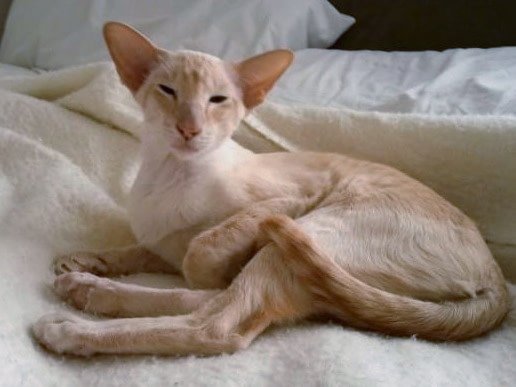
The body is a glowing off-white to soft cream, warmer than you would expect, almost as if it is lit from within. The points — the mask, ears, legs and tail — are a warm, hot apricot. Think the colour of a ripe apricot rather than ginger or red.
The giveaway is the bloom. As an apricot matures, the points often develop a subtle pewter or metallic sheen over the warm base. It is hard to photograph and even harder to describe, but once you have seen it you never mistake it again.
Nose leather and paw pads are a pinkish “old rose” rather than dark. And the eyes — as with every Siamese — are a clear, vivid blue. No exceptions. If the eyes are not blue, it is not a Siamese.
Apricot Point vs Cream Point — What Is the Difference?
This is the question I get asked more than any other, usually by someone convinced their cream is “a bit warm.” And fair enough — the two are genuinely easy to confuse, especially in younger cats.
A cream point is a clean, cool, pale cream. An apricot is a cream that has been warmed up and given that hot, glowing, slightly metallic quality. Side by side it is obvious. On their own, even experienced breeders sometimes have to look twice.
The simplest way I explain it: cream is the colour of clotted cream, apricot is the colour of the jam you put on top.
The Genetics Behind the Apricot Point
Here is where it gets fiddly (stay with me). Apricot is not a base colour in its own right — it is a cream that has been modified.
The modifier responsible is the caramel gene, also called the dilute modifier. When it acts on the cool dilutes — blue, lilac and fawn — you get the cool caramels. When that same modifier acts on a cream, you get apricot: the one warm member of the caramel family.
Because apricot is built on the cream (red-series) base, and the red series is sex-linked, apricots can be either male or female — unlike the tortie points, which are a female-only affair. To breed apricots reliably you need both the cream and the caramel modifier in your lines, which is exactly why they are so thin on the ground.
If you want the bigger picture on how all the colours fit together, our complete Siamese breed and colour guide lays out the full family tree. The caramel point page covers the cool side of the same modifier.
Just How Rare Is an Apricot Point Siamese?
Very. Apricot sits alongside fawn and caramel as one of the rarest recognised Siamese colours in the UK.
You can go to show after show and not see one. In more than twenty years of judging I can count the genuinely outstanding apricots I have handled on not very many fingers. Good photographs of them are rarer still — which, as you will see further down this page, is something we are trying to fix.
Apricot Point Siamese Personality and Temperament
Colour has no bearing on temperament. An apricot point is, first and last, a Siamese — and that means you are getting one of the most vocal, intelligent and people-obsessed cats on the planet.
They will talk to you all day, follow you from room to room, supervise everything you do, and take it as a personal insult if you leave the house. They are demanding in the best possible way.
If you want a quiet, independent, ornamental cat, the apricot point is not for you. If you want a cat that is genuinely part of the family and never shuts up about it, you will be very happy indeed.
When Do Apricot Point Kittens Get Their Colour?
Like all Siamese, apricot kittens are born almost white — the points develop gradually over the first weeks and months, and the full warm bloom can take a good while longer.
This is exactly why apricot is so often mis-registered as cream in young kittens. The warmth and the metallic sheen simply have not arrived yet. As a rule, do not commit to calling a kitten apricot until the colour has properly developed — I have seen plenty of “creams” warm up into apricots and a few hopeful “apricots” settle as cream.
Apricot Point Siamese Health
There are no health problems specific to the apricot colour. An apricot is exactly as healthy — or as vulnerable — as any other Siamese.
That means the things to ask any Siamese breeder about apply here too: heart screening for HCM, eye testing for PRA, and awareness of the breed-wide issues such as amyloidosis and dental disease. A responsible breeder will be happy to talk you through what they test for and why. If they are cagey about it, walk away.
The GCCF Breed Standard for Apricot Point Siamese
The apricot point is a recognised Siamese colour with the GCCF. The standard calls for warm apricot points with that characteristic glowing, slightly metallic quality, over a glowing off-white body, with nose leather and paw pads in pinkish tones — and, of course, the clear blue eyes that define the breed.
The most common fault I see is tone. Too cold and you are looking at a caramel; too red and it strays towards cream-with-attitude rather than a true apricot. Getting that warm, glowing balance bang on is the whole challenge of the colour — and the reason a really good apricot turns heads in the show hall.
Frequently Asked Questions About Apricot Point Siamese
Is the apricot point a recognised Siamese colour?
Yes. It is recognised by the GCCF as a Siamese colour, though it remains one of the rarest you will come across.
What is the difference between apricot and cream point?
Cream is a cool, pale cream. Apricot is a cream warmed and modified by the caramel gene, giving hot, glowing points with a faint metallic sheen. Side by side the difference is clear.
Can apricot point Siamese be male and female?
Yes. Because apricot is built on the cream (red-series) base, both sexes occur — unlike the tortie points, which are female only.
Why are apricot point Siamese so rare?
You need both the cream colour and the caramel modifier present in your breeding lines to produce them, which relatively few breeders have. That combination keeps numbers very low.
How much does an apricot point Siamese kitten cost?
Expect to pay a similar price to any well-bred, health-tested Siamese kitten from a reputable breeder. Rarity does not always mean a higher price — availability is the bigger hurdle. You may well wait a while to find one.
Do apricot points change colour as they age?
The warm bloom and metallic sheen develop and deepen as the cat matures, and like all Siamese they tend to darken gradually with age.
Is an apricot point a good first Siamese?
Temperament-wise, absolutely — it is every bit a Siamese. Just be prepared for a long search, because finding one available is the real challenge.
A Gallery of Apricot Point Siamese
Apricot point is among the rarest Siamese colours, so photographs are scarce. Here is what we have so far — and we would love your help to grow it.
📸 Got an Apricot Point Siamese? Help us build this gallery
Apricot point is one of the rarest Siamese colours and good photos are hard to find. If you have an apricot point, enter our photo competition — your cat could be featured here.
Notable Show Winners