
Chocolate point Siamese cats are one of the four traditional Siamese colours recognised by the GCCF — and one of the most visually striking. Where the seal point is dark and dramatic, the chocolate point Siamese is warm and inviting, with rich milk-chocolate brown points contrasting against a clean ivory body. If you’ve been searching for information about chocolate point Siamese cats, chocolate pointed Siamese kittens, or wondering how to tell a chocolate point from a seal point, this guide covers everything from breed standard descriptions and genetics to personality, kitten colour development, and what to expect if you’re thinking of bringing one home.
I’ve judged hundreds of Siamese cats across every colour variety in more than twenty years as a GCCF Full Judge, and chocolate points hold a special place in the breed. They’re the warm counterpart to the cool-toned blue, the lighter sibling of the seal, and when you see a really good one — clean ivory body, even milk-chocolate points, vivid blue eyes — it’s a genuinely beautiful cat.
What Does a Chocolate Point Siamese Look Like?
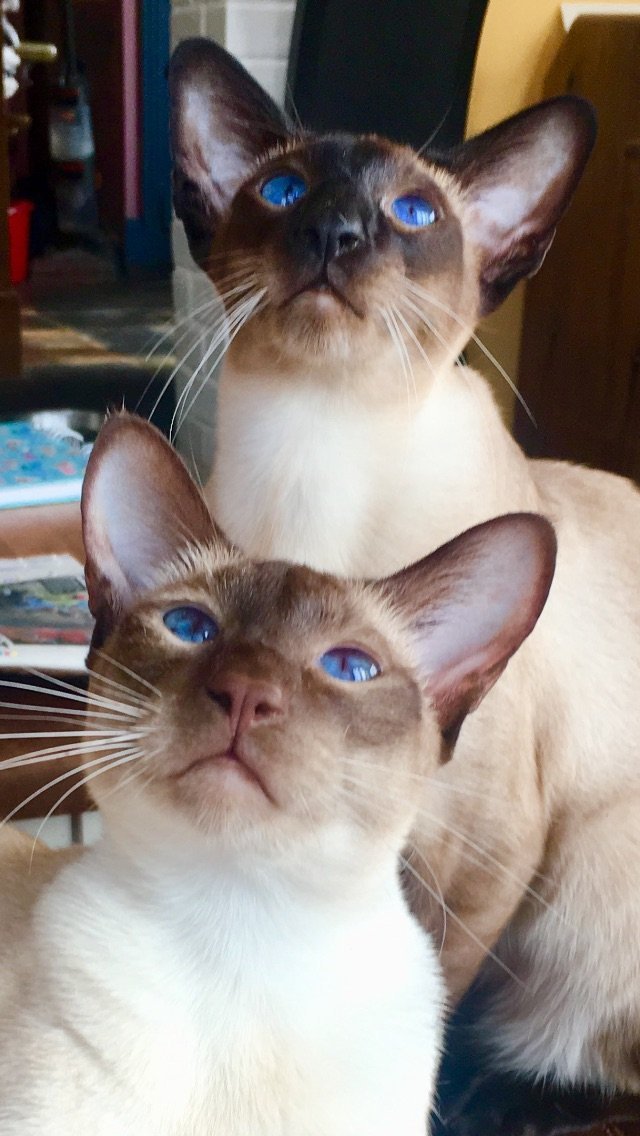
The chocolate point Siamese cat has warm milk-chocolate coloured points — the ears, face mask, paws, and tail — on a body that should be ivory all over. The overall impression is softer and warmer than the more commonly seen seal point. The points should be an even, warm-toned chocolate brown — not too dark (that’s seal) and not too reddish (that could indicate cinnamon influence).

The GCCF breed standard (breed number SIA b, registration number 24b) calls for the points to be milk chocolate in colour — warm in tone — with the body colour a clear ivory with no shading. In practice, some body shading does develop with age, but a good chocolate point retains a much cleaner, whiter body throughout its life compared to a seal point. This is one of the distinguishing features that makes chocolate points so photogenic and so popular at shows.
Nose leather is pinkish chocolate — a warm, dusky pink-brown that’s quite different from the dark brown nose of a seal point. Paw pads range from pinkish chocolate to cinnamon pink. Eyes should be vivid, clear blue — the same requirement as all Siamese colour varieties.
Chocolate Point vs Seal Point Siamese — What’s the Difference?
This is the single most common question I’m asked about chocolate point Siamese, and it’s easy to understand why. Both are brown-pointed cats, and if you’ve never seen them side by side, the difference can seem subtle. But once you have seen them together, you’ll never confuse the two again.
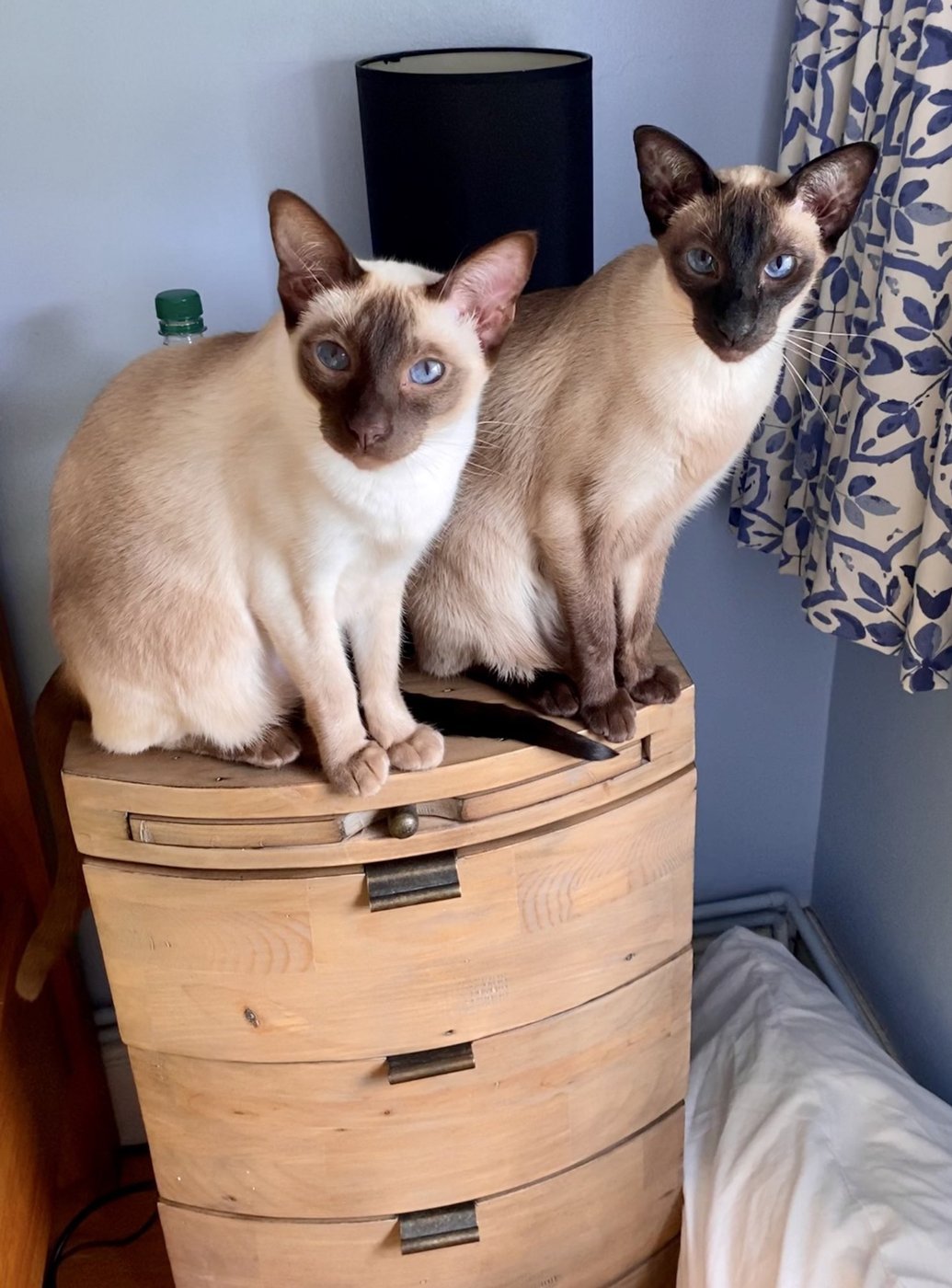
The key differences between chocolate point and seal point Siamese are in tone and intensity. Seal points have deep, dark seal-brown points that are almost black in good light. Chocolate points have lighter, warmer milk-chocolate points. The body colour differs too: seal points develop a warm cream to fawn body that darkens significantly with age, while chocolate points maintain a cleaner ivory body. Nose leather is the quickest way to tell them apart — dark seal brown on a seal point versus pinkish chocolate on a chocolate point.
Genetically, the difference is straightforward. Seal is the dominant form at the B locus (the gene that controls brown pigment intensity), while chocolate is the recessive form. A cat must carry two copies of the chocolate gene (bb) to be a chocolate point — if it carries even one copy of the seal gene (Bb or BB), it will be a seal point (though it may carry chocolate recessively). This is why two seal point parents can produce chocolate point kittens if both carry the recessive chocolate gene.
One important clarification: you may see the term “chocolate seal point Siamese” used online. This is not a real colour variety. A Siamese cat is either a seal point or a chocolate point — never both. The confusion usually arises from people seeing a dark chocolate point and assuming it must be a seal/chocolate mix, but genetically that’s not how it works. Seal and chocolate are different expressions of the same gene, and a cat can only display one.
The Genetics Behind Chocolate Point Siamese
Like all Siamese cats, chocolate points carry the cs gene — the temperature-sensitive form of the gene that controls melanin production. This gene causes the enzyme tyrosinase to only function at lower temperatures, which is why pigment only appears on the cooler extremities (the points) while the warmer body stays pale.
What makes a chocolate point specifically chocolate, rather than seal, is the B locus. The B gene controls the structure of eumelanin (brown/black pigment) granules. The dominant form (B) produces the intense dark brown seen in seal points. The recessive form (b) produces a lighter, warmer brown — chocolate. A chocolate point Siamese must be homozygous recessive at this locus (bb) to express the chocolate colour.
Chocolate is also the parent colour for lilac point Siamese. When a chocolate point also carries the dilution gene (dd), the chocolate is diluted to the pale, frosty pinkish-grey that we call lilac. So lilac point Siamese are, in genetic terms, dilute chocolate points — just as blue points are dilute seal points.
Are Chocolate Point Siamese Cats Rare?
Chocolate point Siamese are not rare, but they are less common than seal point Siamese. Because the chocolate gene is recessive, both parents must carry it (either as chocolate points themselves, or as seal points carrying chocolate recessively) to produce chocolate point kittens. In practice, responsible breeders who work with chocolate point lines produce them regularly, and you shouldn’t have difficulty finding a chocolate point kitten from a GCCF registered breeder — though you may need to wait for the right litter.
Chocolate points are considerably more common than the rarer Siamese colours such as cinnamon, fawn, caramel, and apricot point. They’re one of the four traditional colours and have been bred consistently since the early twentieth century.
A Gallery of Chocolate Point Siamese
A selection of chocolate point Siamese — pet companions and pedigree show cats. Click any photo to open the scrollable gallery.
📸 Got a Chocolate Point Siamese? Add your cat to this gallery
This gallery grows over time — pet or pedigree, every chocolate point is welcome. Enter our photo competition and your cat could feature here.
Notable Show Winners
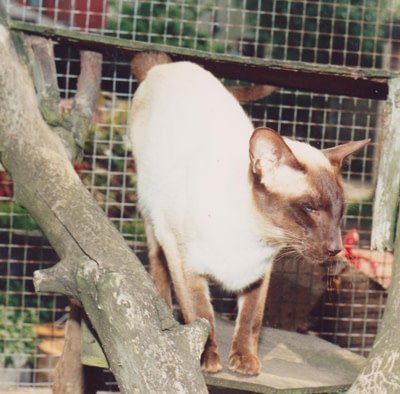
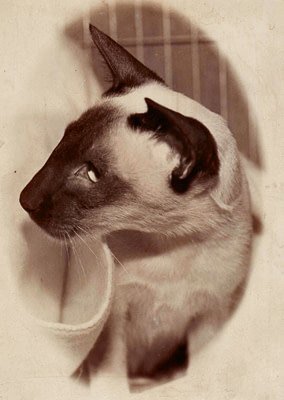
Chocolate point Siamese that have made their mark in the show ring over the years.




Chocolate Point Siamese Personality and Temperament
There’s a persistent belief that different colour varieties of Siamese have different personalities. I’ll be honest — after twenty-plus years of judging every colour on the show bench, I don’t see consistent temperament differences between colours. What I do see are differences between breeding lines, individual cats, and how they’ve been raised.
That said, all Siamese cats — including chocolate points — share the breed’s characteristic personality: they’re vocal, sociable, intelligent, and demand attention. Siamese are not cats that sit quietly in a corner. They want to be involved in everything you do, they’ll tell you about it loudly, and they form extremely strong bonds with their people. Chocolate point Siamese are typical Siamese in every behavioural sense.
If you’re used to a more independent breed, the intensity of a Siamese’s attachment can be surprising. They don’t do well left alone for long periods, and many Siamese owners find that having two cats (not necessarily both Siamese) helps keep them company and prevents destructive boredom.
When Do Chocolate Point Siamese Kittens Develop Their Colour?
All Siamese kittens are born almost completely white — the uniform warmth of the womb suppresses pigment production everywhere. Chocolate point kittens are no exception, though the timeline for colour development is slightly different from darker varieties.
Seal point kittens typically show visible colour on the ears and nose within the first few days. Chocolate point kittens take a little longer — you’ll usually see the first faint shadows of colour appearing on the ears and nose at around one to two weeks, with the colour becoming clearly visible by four to six weeks. The face mask fills in progressively over the first few months, and the full depth of the milk-chocolate colour continues developing through the first year.
In very young kittens, distinguishing a chocolate point from a seal point requires an experienced eye. The key difference at the earliest stage is tone — chocolate has a warmer, lighter quality even when faint, while seal appears cooler and denser. By twelve weeks (when kittens are ready to leave the breeder), the colour should be clearly established and identifiable, though it will continue to deepen.
Body colour development is slower in chocolate points than seal points. Where a mature seal point may develop significant body shading (sometimes becoming quite dark overall), chocolate points tend to maintain a cleaner ivory body well into middle age. Some body shading is normal in older chocolate points, but it’s typically less pronounced than in seals.
Chocolate Point Siamese Health
Chocolate point Siamese share the same health profile as all Siamese cats — the colour variety doesn’t create any additional health risks. Siamese as a breed are generally healthy and long-lived, with an average lifespan of 15-20 years, though some live well into their twenties.
The breed-specific health considerations that apply to all Siamese include progressive retinal atrophy (PRA), which reputable breeders test for, and a predisposition to certain heart conditions. Siamese can also be prone to dental issues. A good breeder will discuss their health testing programme with you and provide evidence of clear results for the parents.
Chocolate Tabby Point and Chocolate Tortie Point Siamese
Beyond the solid chocolate point, the chocolate colour also appears in patterned varieties. Chocolate tabby point Siamese carry the agouti gene in addition to the chocolate gene, producing striped tabby markings on warm chocolate points — a ringed tail, striped legs, the characteristic “M” on the forehead, and pencil lines on the face. The contrast between the milk-chocolate tabby stripes and the lighter ground colour of the points creates a striking, complex pattern.
Chocolate tortie point Siamese (almost exclusively female, as tortoiseshell requires two X chromosomes) display a mixture of chocolate and red or cream on the points. Every chocolate tortie is unique — the distribution of chocolate and red patches is random and unpredictable, making each one a genuine one-off.
The GCCF Breed Standard for Chocolate Point Siamese
The GCCF standard for chocolate point Siamese (breed number SIA b, 24b) describes the ideal as follows. Points should be milk chocolate in colour — the same shade on ears, mask, paws, and tail. The body should be ivory with no shading. Nose leather is chocolate or pinkish chocolate. Paw pads are chocolate or pinkish chocolate to cinnamon pink. Eyes should be clear, bright, vivid blue.
In judging, the things that distinguish a truly excellent chocolate point are evenness of point colour (no variation between ears and tail, for example), clarity of the ivory body, and that warm milk-chocolate tone that’s neither too dark (approaching seal) nor too pale (approaching lilac). The overall impression should be warm, clean, and well-contrasted.
Frequently Asked Questions About Chocolate Point Siamese
What are the differences between chocolate point and seal point Siamese?
Seal points have much darker, almost black-brown points on a cream-to-fawn body, while chocolate points have lighter, warmer milk-chocolate points on an ivory body. Nose leather is dark seal brown on a seal point and pinkish chocolate on a chocolate point. Genetically, seal is dominant and chocolate is recessive at the B locus.
How much do chocolate point Siamese kittens cost?
A GCCF-registered chocolate point Siamese kitten from a responsible, health-testing breeder in the UK typically costs between £1,000 and £1,200. Prices vary depending on the breeder’s location, the kitten’s quality relative to the breed standard, and whether the kitten is sold on the active or non-active register. Show-quality chocolate point Siamese cats with exceptional pedigrees and breed potential may cost more. Prices reflect the cost of responsible breeding — health screening (PRA-Rdac, PKDef), veterinary care, socialisation, and GCCF registration. Be wary of significantly cheaper kittens — they may not be from health-tested, pedigree parents.
What do chocolate point Siamese cats look like as adults?
Adult chocolate point Siamese have warm milk-chocolate points on a predominantly ivory body. With age, some body shading develops, but chocolate points generally retain a cleaner, lighter body colour than seal points throughout their lives. They have the typical Siamese body type — long, elegant, and muscular — with vivid blue almond-shaped eyes.
When do chocolate point Siamese kittens develop their colour?
Chocolate point kittens are born white and begin showing faint colour on the ears and nose at one to two weeks. The colour becomes clearly visible by four to six weeks and continues deepening through the first year. Full adult colour is typically reached by twelve to eighteen months.
What is the personality of a chocolate point Siamese cat?
Chocolate point Siamese share the classic Siamese temperament: vocal, sociable, intelligent, and deeply attached to their owners. They’re active, playful cats that need company and mental stimulation. There’s no evidence that colour variety affects personality in Siamese cats.
Browse More Siamese Colour Profiles
Traditional colours: Seal Point Siamese · Blue Point Siamese · Lilac Point Siamese
Patterned varieties: Tabby Point Siamese · Tortie Point Siamese
Complete reference: Siamese Colour Chart — every recognised Siamese colour compared side by side.
Or return to the full Siamese cat breed profile for a comprehensive overview of the breed.
Finding a Chocolate Point Siamese Breeder
Looking for a chocolate point Siamese kitten? Our guide to finding a good cat breeder covers the questions to ask, the health tests to expect, and the red flags that should make you walk away. Not every Siamese breeder works with chocolate lines, so check the GCCF breeder list or ask at local shows for recommendations.
Bringing home a kitten? I wrote an eBook for new kitten owners that covers everything you actually need to know — how to prepare your home, what to feed, litter training that actually works, stopping the biting and scratching, reading your kitten’s body language, and what’s normal versus what’s not. It comes with printable checklists, a vaccination record and a first-week diary. It’s called Kitten Care for New Cat Owners, it’s an instant download, and it will save you a lot of late-night Googling at 4am. Get the eBook — £12.99