The Siamese colour chart covers every recognised colour variety of the Siamese cat breed — from the four traditional colours that have been shown since the early twentieth century to the newer shades recognised by the GCCF over the past few decades. Whether you’re trying to identify a Siamese cat’s colour, understand the genetics behind Siamese colouring, or compare different Siamese colour points side by side, this guide is the definitive UK reference.
A quick note on terminology: throughout this guide I use the British spelling “colour” and the GCCF terminology, because this is a UK-based resource written by a GCCF judge. If you’ve arrived here searching for “Siamese cat colors chart” or “Siamese color chart” — welcome, you’re in exactly the right place. Everything here applies equally regardless of which side of the Atlantic you’re on; only the spelling differs.
After more than twenty years as a GCCF Full Judge for Siamese and having assessed hundreds of cats across every colour variety, I can tell you that Siamese colour is one of the most fascinating — and most misunderstood — aspects of the breed. The range is far wider than most people realise, the genetics are elegant in their simplicity, and the way colour develops and changes throughout a Siamese cat’s life is unlike any other breed.
How Many Colours Do Siamese Cats Come In?
The GCCF recognises Siamese cats in a total of 30 colour and pattern combinations. These break down into solid points (a single colour on the points), tabby points (striped markings on the points), and tortie points (tortoiseshell patterning on the points). The underlying colours are: seal, blue, chocolate, lilac, red, cream, cinnamon, fawn, caramel, and apricot. Each of these can appear as a solid point, and most can appear as tabby or tortie point varieties as well.
In practice, the colours divide neatly into three groups: the four traditional colours that most people recognise, the newer colours that expanded the palette from the 1960s onwards, and the patterned varieties (tabby and tortie) that add further visual complexity.
The Four Traditional Siamese Colours
These are the original Siamese colours — the ones that established the breed’s identity and remain the most commonly seen in the show ring and in breeders’ catteries.
Seal Point Siamese
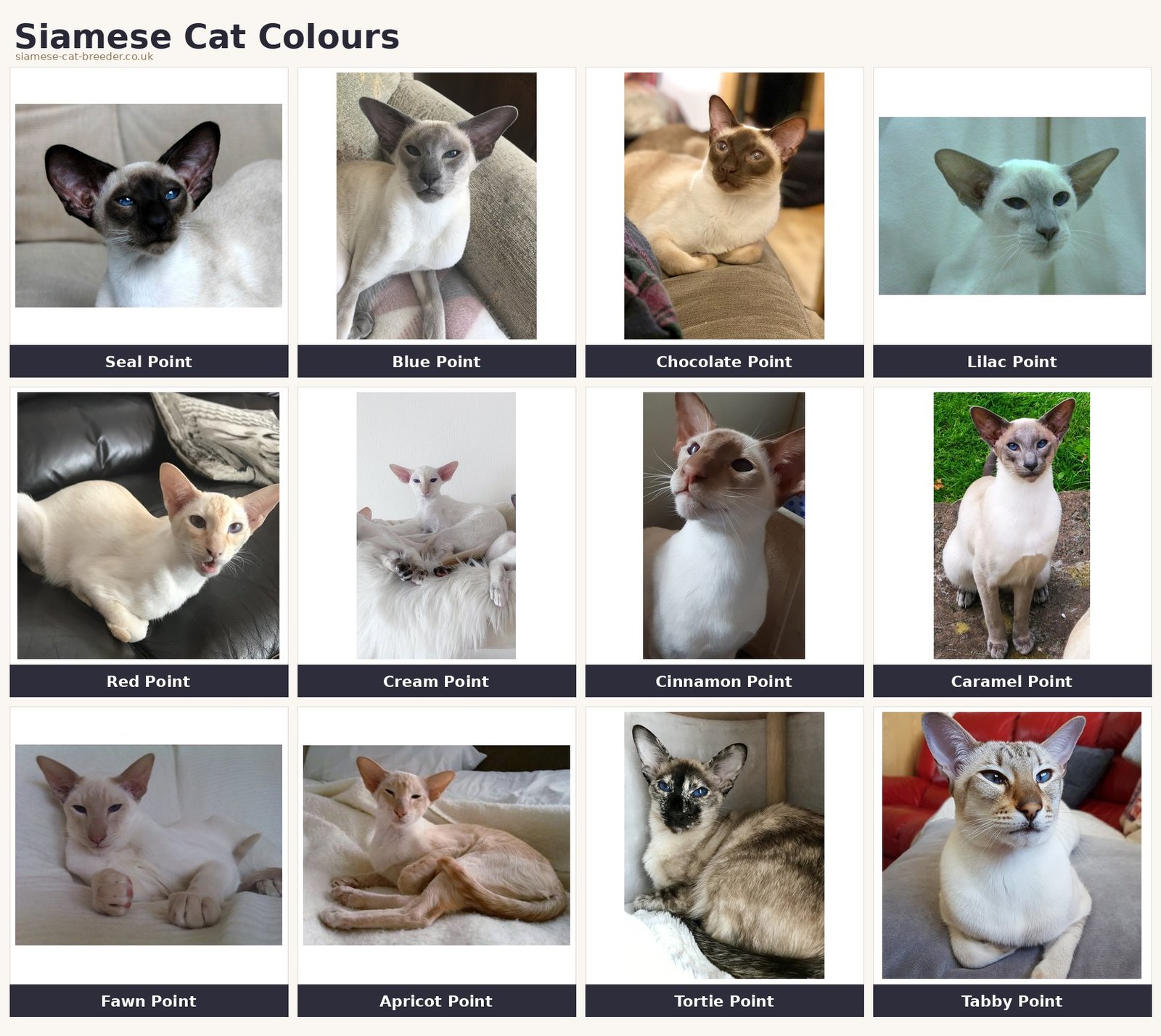
The original and most iconic Siamese colour. Seal point Siamese have deep, dark seal-brown points — almost black in good light — contrasting with a warm cream to fawn body. The contrast between dark points and pale body is the most dramatic of any Siamese colour, which is why seal points remain the image most people have when they think “Siamese cat.” The body colour darkens with age, and mature seal points often develop significant body shading. Nose leather and paw pads are dark seal brown. Read the full seal point Siamese guide.
Blue Point Siamese
The dilute form of seal point. Blue point Siamese have slate-grey to steel-blue points on a glacial white to pale bluish-white body. The overall effect is cooler and more elegant than the warm tones of a seal point. Blue is one of the earliest recognised Siamese colours after seal, and a really good blue point — with clear, even colour and icy-white body — is a thing of genuine beauty. Nose leather is dark blue-grey. Paw pads are blue-grey. Read the full blue point Siamese guide.
Chocolate Point Siamese
Warm milk-chocolate brown points on an ivory body. Chocolate point Siamese are lighter and warmer than seal points — the difference is immediately obvious when you see them side by side. Where seal is dark and dramatic, chocolate is warm and inviting. Chocolate points tend to retain cleaner, whiter bodies throughout their lives compared to seal points, which is one reason they photograph so well. Nose leather is pinkish chocolate. Paw pads are pinkish chocolate to cinnamon pink. Read the full chocolate point Siamese guide.
Lilac Point Siamese
The palest and most ethereal of the traditional four. Lilac point Siamese have frosty pinkish-grey points — sometimes described as having a lavender or dove-grey tone — on a magnolia-white body. Lilac is the double dilute: both the chocolate and blue dilution genes combine to produce this delicate, almost ghostly colour. The contrast between points and body is the subtlest of all Siamese colours. Nose leather and paw pads are pinkish lilac. Read the full lilac point Siamese guide.
The Newer Siamese Colours
These colours were introduced through carefully planned breeding programmes from the 1960s onwards. Each has full GCCF recognition for championship competition, and each brings something genuinely distinctive to the Siamese palette.
Red Point Siamese
Rich reddish-orange points — sometimes called “flame point” in American terminology — on a warm white to apricot body. Red point Siamese are sex-linked (the red gene is carried on the X chromosome), which has implications for breeding programmes. One quirk of the red gene is that it often allows faint tabby markings to show through even in genetically solid cats, making the distinction between a solid red point and a red tabby point occasionally tricky. The body is warm white with an apricot tinge. Nose leather and paw pads are pink.
Cream Point Siamese
The dilute form of red point. Cream point Siamese have pale, cool cream points on an almost-white body. This is one of the subtlest Siamese colours — the contrast between points and body is very low, and in some cream points the colour is barely visible in certain lighting. Like red points, cream points may show faint tabby ghost markings. The body is warm creamy white. Nose leather and paw pads are pink.
Cinnamon Point Siamese
Warm cinnamon-brown points — lighter, more reddish, and distinctly warmer than chocolate. Cinnamon point Siamese are relatively uncommon and have a warmth that’s quite different from the cooler chocolate. The body is ivory. Cinnamon is genetically related to chocolate but produced by a different allele at the same locus. Nose leather is pinkish cinnamon. Paw pads are cinnamon to pinkish brown.
Fawn Point Siamese
The dilute of cinnamon — warm mushroom or rosy-fawn points on a pale magnolia body. Fawn point Siamese are among the rarest of the recognised colours and have an extremely subtle, warm appearance that’s distinct from both lilac and cream. The body is pale magnolia. Nose leather is pink, outlined in fawn. Paw pads are pinkish fawn.
Caramel Point Siamese
A distinctive brownish-grey with a warm metallic sheen, created by the dilute modifier gene (Dm) acting on blue, lilac, or fawn. Caramel point Siamese have a unique, slightly bronzed quality to their points that’s unlike any other Siamese colour — it’s genuinely hard to describe in words and one of those colours you need to see in person to appreciate. The body is warm off-white. Nose leather is pinkish, outlined in caramel. Paw pads are caramel to pinkish.
Apricot Point Siamese
The dilute modifier acting on cream, producing warm apricot points with a metallic sheen on an almost-white body. Apricot point Siamese are very rare and visually subtle — the metallic quality distinguishes them from plain cream points. The body is warm white. Nose leather and paw pads are pink.
Tabby Point and Tortie Point Varieties
Beyond the solid colours, Siamese also come in tabby point (striped markings on the points) and tortie point (tortoiseshell patterning on the points) varieties. Tabby points carry the agouti gene, which allows the tabby pattern to show through the point colour — creating striped legs, a ringed tail, the characteristic “M” on the forehead, and pencil lines on the face. Read the full tabby point Siamese guide.
Tortie point Siamese display the tortoiseshell pattern — a mixture of the base colour with red or cream — restricted to the points. Because tortoiseshell requires two X chromosomes carrying different colour genes, tortie points are almost exclusively female. Read the full tortie point Siamese guide.
Tabby and tortie patterns can combine with every base colour, creating an enormous variety: seal tortie tabby point, blue tortie tabby point, and so on. The full GCCF register of Siamese varieties runs to over 30 recognised combinations.
How Do Siamese Cats Get Their Colour?
The genetics behind Siamese colouring are genuinely fascinating — and understanding them explains everything about how the colour chart works. All Siamese cats carry the cs gene (also written cscs), a temperature-sensitive form of the gene that controls melanin production. This gene causes the enzyme tyrosinase — which is essential for producing pigment — to only function at lower temperatures.
This means that pigment is only produced on the cooler extremities of the cat’s body: the ears, face mask, paws, and tail — the “points.” The warmer core body stays pale because the enzyme is inactive at normal body temperature. It’s a beautifully simple mechanism that creates one of the most recognisable colour patterns in the cat world.
The specific colour that appears on the points depends on which colour genes the cat carries in addition to the cs gene. A cat carrying the gene for black pigment will be a seal point. A cat carrying the dilution gene as well as black will be a blue point. Chocolate, lilac, cinnamon, fawn, caramel, and apricot all result from different combinations of colour, dilution, and modifier genes — but all are expressed only on the points because of the temperature restriction.
When Do Siamese Kittens Develop Their Colour?
Siamese kittens are born almost completely white. This is because in the womb, the kitten’s entire body is at a uniformly warm temperature — so the cs gene suppresses pigment production everywhere. Colour development follows a predictable timeline, though darker colours develop faster and more visibly than paler ones.
In the first week or two, faint shadows begin appearing on the ears and nose — these are the first signs of point colour. By four to six weeks, the colour is usually clearly visible on the ears, nose, paws, and tail. The face mask develops progressively, typically filling in fully over the first few months. By twelve weeks (when kittens are ready to leave the breeder), the point colour should be clearly established, though it will continue to deepen and develop through the first year.
Darker colours like seal are usually identifiable within days of birth. Paler colours — especially lilac, cream, fawn, and apricot — can take weeks to become clearly visible, and accurate colour identification in very young kittens sometimes requires an experienced eye.
Do Siamese Cats Change Colour?
Yes — and this is one of the most distinctive aspects of the breed. Because Siamese colour is temperature-dependent, anything that affects the cat’s body temperature can alter its colouring. There are three main factors that cause colour change in Siamese cats.
Age: Siamese cats generally darken with age. As a Siamese grows older, the body colour tends to deepen, and in some varieties — particularly seal points — elderly cats can become quite dark overall, with the contrast between points and body significantly reduced.
Temperature: Siamese living in cooler environments tend to develop darker body shading than those in warmer climates. Similarly, a shaved patch of fur (for surgery, for example) may grow back darker if the skin temperature in that area is lower during regrowth.
Health: Fever or illness can sometimes cause temporary lightening of point colour, because the elevated body temperature reduces pigment production even on the extremities. Conversely, poor circulation can cause localised darkening.
Siamese Colour Comparison Chart
Here is a quick-reference comparison of every recognised Siamese point colour, covering point colour, body colour, nose leather, paw pads, and the genetic relationship between each colour:
Seal Point: Deep seal brown points. Cream to fawn body. Dark seal brown nose leather and paw pads. Base colour — the darkest and most dramatic.
Blue Point: Slate-grey to steel-blue points. Glacial white body. Dark blue-grey nose leather and paw pads. Dilute of seal.
Chocolate Point: Warm milk-chocolate points. Ivory body. Pinkish chocolate nose leather and paw pads. Recessive to seal at the B locus.
Lilac Point: Frosty pinkish-grey points. Magnolia body. Pinkish lilac nose leather and paw pads. Double dilute (chocolate + blue dilution).
Red Point: Rich reddish-orange points. Warm white to apricot body. Pink nose leather and paw pads. Sex-linked (carried on X chromosome).
Cream Point: Pale cool cream points. Warm creamy white body. Pink nose leather and paw pads. Dilute of red.
Cinnamon Point: Warm cinnamon-brown points. Ivory body. Pinkish cinnamon nose leather and paw pads. Recessive to chocolate at the B locus.
Fawn Point: Warm mushroom or rosy-fawn points. Pale magnolia body. Pinkish fawn nose leather and paw pads. Dilute of cinnamon.
Caramel Point: Brownish-grey points with metallic sheen. Warm off-white body. Pinkish caramel nose leather and paw pads. Dilute modifier (Dm) acting on blue, lilac, or fawn.
Apricot Point: Warm apricot points with metallic sheen. Warm white body. Pink nose leather and paw pads. Dilute modifier (Dm) acting on cream.
What Colour Are Siamese Cat Paw Pads?
Paw pad colour is one of the most reliable ways to identify a Siamese cat’s colour variety, particularly when the point colour itself is subtle. The general rule is that darker point colours produce darker paw pads, while lighter and red-based colours produce pink paw pads. Seal points have dark seal brown paw pads. Blue points have blue-grey paw pads. Chocolate points have pinkish chocolate paw pads. Lilac points have pinkish lilac paw pads. Red, cream, cinnamon (with a pinkish-brown tinge), fawn, caramel, and apricot points all have pink to pinkish-brown paw pads.
GCCF vs CFA: Recognised Siamese Colours
One area of considerable confusion is the difference between which colours the GCCF (UK) and CFA (American) registries recognise as Siamese. The GCCF recognises all the colours listed above — seal, blue, chocolate, lilac, red, cream, cinnamon, fawn, caramel, apricot, plus all tabby and tortie variants — as Siamese. The CFA, by contrast, only recognises the four traditional colours (seal, blue, chocolate, lilac) as Siamese. All other colours are classified by the CFA as a separate breed: the Colorpoint Shorthair.
This means that a red point Siamese registered with the GCCF in the UK is genetically identical to a Flame Point Colorpoint Shorthair registered with the CFA in the US — but they carry different breed names. Similarly, what the GCCF calls a tabby point Siamese, the CFA calls a lynx point Colorpoint Shorthair. The cats themselves are the same; only the registry classification differs.
Frequently Asked Questions About Siamese Cat Colours
How many colours do Siamese cats come in?
Under the GCCF, Siamese cats come in ten base colours (seal, blue, chocolate, lilac, red, cream, cinnamon, fawn, caramel, and apricot), each of which can appear as solid point, tabby point, or tortie point varieties. This creates over 30 recognised colour and pattern combinations in total.
Is Siamese a breed or a colour?
Siamese is a breed. The colour pattern associated with Siamese — dark points on a pale body — is called the “pointed” or “colourpoint” pattern. While the pointed pattern can appear in other breeds (such as the Ragdoll or Birman), only pedigree Siamese cats with the correct body type, head shape, and documented ancestry are true Siamese. A random-bred cat with pointed colouring is not a Siamese any more than a cat with long fur is a Persian.
What determines a Siamese cat’s colour?
Genetics. The specific combination of colour genes a Siamese cat inherits from its parents determines its point colour. The cs gene restricts pigment to the cooler extremities (creating the pointed pattern), while other genes determine whether the pigment is seal, blue, chocolate, lilac, red, cream, or one of the rarer colours. The tabby pattern requires the additional presence of the agouti gene.
What is the rarest Siamese cat colour?
Apricot point, fawn point, and caramel point Siamese are the rarest recognised colours. Cinnamon point is also uncommon. These colours require specific genetic combinations that relatively few breeding programmes produce. The four traditional colours — seal, blue, chocolate, and lilac — are by far the most commonly bred.
Do Siamese cats’ eyes change colour?
All Siamese cats have blue eyes — this is a breed requirement. Siamese kittens are born with blue eyes that may appear slightly paler or deeper as they mature, but the colour remains blue throughout life. The intensity of the blue can vary between individuals, and the GCCF breed standard calls for clear, vivid blue eyes across all Siamese colour varieties.
Browse Individual Colour Profiles
For a detailed guide to any specific Siamese colour — including breed standard descriptions, genetics, personality insights, and what to look for in a kitten — explore the individual colour profiles below:
Traditional colours: Seal Point Siamese · Blue Point Siamese · Chocolate Point Siamese · Lilac Point Siamese
Newer colours: Red Point Siamese · Cream Point Siamese · Cinnamon Point Siamese · Fawn Point Siamese · Caramel Point Siamese · Apricot Point Siamese
Patterned varieties: Tabby Point Siamese · Tortie Point Siamese
Or return to the full Siamese cat breed profile for a comprehensive overview of the breed.
Finding a Siamese Breeder
Looking for a Siamese kitten in a specific colour? Our guide to finding a good cat breeder covers everything you need to know — from the questions to ask and the health tests to expect, to the red flags that should make you walk away. Not every breeder works with every colour, so you may need to seek out a specialist if you’re set on one of the rarer varieties.
Bringing home a kitten? I wrote an eBook for new kitten owners that covers everything you actually need to know — how to prepare your home, what to feed, litter training that actually works, stopping the biting and scratching, reading your kitten’s body language, and what’s normal versus what’s not. It comes with printable checklists, a vaccination record and a first-week diary. It’s called Kitten Care for New Cat Owners, it’s an instant download, and it will save you a lot of late-night Googling at 4am. Get the eBook — £12.99
Bringing home a kitten? Don’t wing it.

I wrote an eBook for new kitten owners that covers everything you actually need to know — how to prepare your home, what to feed, litter training that actually works, stopping the biting and scratching, reading your kitten’s body language, and what’s normal versus what’s not. It comes with printable checklists, a vaccination record and a first-week diary.
It’s called Kitten Care for New Cat Owners, it’s an instant download, and it will save you a lot of late-night Googling at 4am.